As we journey through Holy Week, I’m meditating less on Jesus on the cross—I see that every day—and am instead meditating on Jesus razing hell.
Israel’s displacement and killing of Palestinians continues; the U.S. continues to escalate the war with Iran; and immigrants are still being hunted down by cowards in masks. Every day we see Christ crucified. What does the hope offered by Jesus, that these forces of evil can be stopped, look like? What are the lessons for us on the road from the crucifixion to the resurrection?
I once believed that beauty could save the world, that art was itself a kind of action. I’ve grown disillusioned with this framework, which is not to say I’ve grown cynical. I simply recognized an illusion and have had to reframe some of my beliefs as such. Hope is for the dis-illusioned, not the naive.
I gained notoriety within the niche of Christian leftist activists as a printmaker, mostly due to my woodcut featuring Mary with a raised fist surrounded by a provocative phrasing of the Magnificat. I made it for me, not for an audience. I wanted an image of the Mary I myself had been drawn to. It was a shock when, about a year later, it went viral, and I suddenly had a part-time gig making religious art. It felt important. It felt like it was doing something for the world.
I often wonder if what I am actually doing is commodifying dissent. A cute shirt that says “Pride was a riot” can run you thirty bucks or more, but the Stonewall uprising wasn’t enacted via symbolic consumer products. The damned demanded liberation through concrete action with their bodies on the line. Was I just making posters for people to put on their walls to feel grateful that they’re not like those other bad Christians?
I remember the first Advent season after October 7, in the middle of Israel’s genocidal massacre in the Gaza Strip, social media feeds filled with the image of the Nativity scene at Evangelical Lutheran Christmas Church in Bethlehem: The baby Jesus doll wrapped in a keffiyeh, lying delicately in a pile of rubble. Yes, this is true, I thought. For those who had eyes to see, we witnessed a livestream genocide: hospitals bombed, thousands of children murdered, homes bulldozed. I see that Palestinian Nativity scene, and I feel, yes, this is how awful it is to witness the whole death of God in each of these children. I see this image, and it validates the intensity of outrage in my bones. That was Advent 2023. Then there was 2024; the occupation of the West Bank and the genocide of Palestinians in Gaza continued. And then, during Advent 2025, Israel was still starving, bombing, and shooting at the people of Gaza. Images circulated. I don’t want to see the mangled flesh of children again. And I don’t want to see an artistic depiction that shows that each of these deaths is the death of a whole universe. I know. What I want is for it to stop. But it is still happening, nonetheless.
My Christianity was saved by learning to see Christ in the oppressed and downtrodden, but at this point, I am sick and tired of seeing Christ as primarily being oppressed and downtrodden. He is our liberator. Jesus’ words in Matthew 25, “I was in prison and you visited me,” are echoed by socialist activist and trade unionist Eugene Debs when he said in 1918 that “while there is a soul in prison, I am not free.” This is, indeed, a spiritual truth. Jesus is every caged soul in Immigration and Customs Enforcement’s concentration camps. But the thing to do when we recognize this fact is not to carve little drawings of Jesus in ICE custody. The thing to do is to set the captives free.
Jesus did not begin his ministry by announcing, “I am here to proclaim a spiritual truth about how you should recognize the dignity of the incarcerated by seeing me as one of them.” That’s not a statement that would get a mob to try to throw you off a cliff. To paraphrase Jesus’s words in Luke 4: “I am here to set all prisoners free, to forgive all debts, to tell you that God is on your side.”
Yes, I worship “Christ the Incarcerated.” But I also worship “Christ the Excarcerator,” the one who frees the prisoners. That God is simply one of us or, even more precisely, that God is simply the oppressed among us, is not adequately good news. The good news is that God is on our side and will destroy what is oppressing us. He has “made captivity itself a captive” (Ephesians 4:8). Will we follow this savior in destroying sinful carceral logic and structures or acquiesce to the forces of evil that build partition walls and concentration camps?
Yes, I worship “Christ the Incarcerated.” But I also worship “Christ the Excarcerator,” the one who frees the prisoners.
READ MORE: ICE Must Be Abolished. Can Truth and Reconciliation Follow?
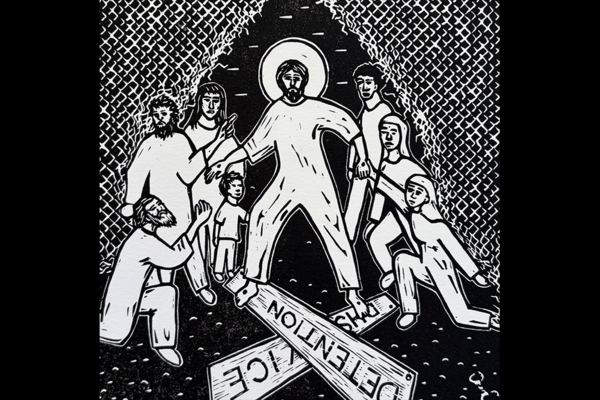
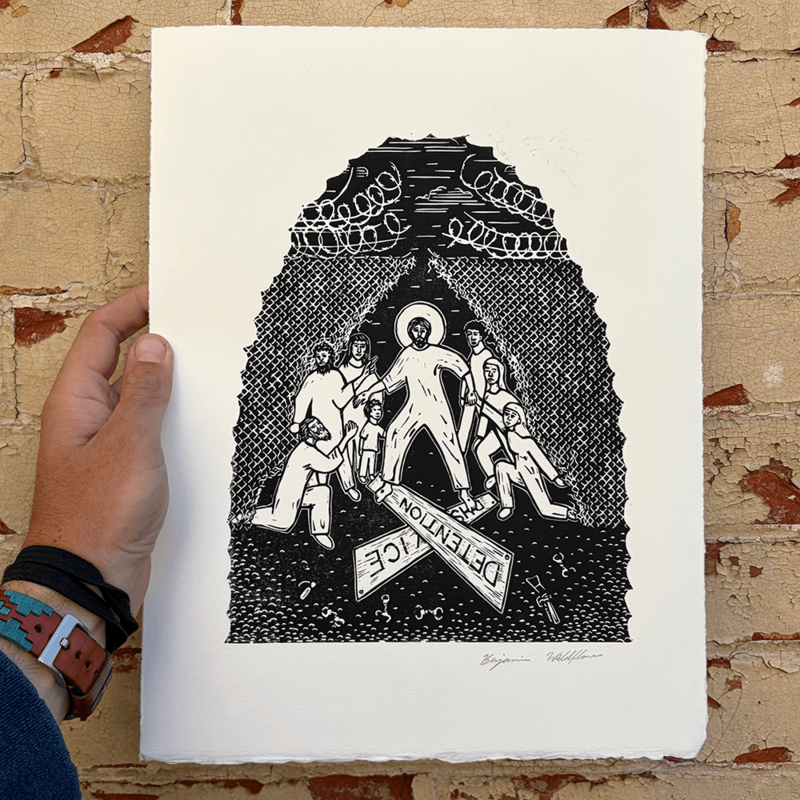
The image accompanying this essay is my latest linocut print. I was recently approached by the abolitionist and theologian Hannah Bowman to carve a take on the Anastasis icon, which depicts the “Harrowing of Hell,” an under-appreciated segment of the drama of Christ’s death and resurrection. Jesus descends to Hades not as judge, but as liberator. In the traditional icon, he’s usually shown pulling Adam and Eve from ancient caskets, and a crew of saints and prophets follow him as the gates of hell fall under his feet in the shape of a cross. Beneath Christ’s feet, there’s often a dark abyss where a character representing death is bound, while all the other tools of incarceration and torture are cast into nothingness. In my rendering of this icon, I depict the instruments of death as I have witnessed them: the tools of state violence, incarceration, and policing. Christ is breaking through the gate and the barbed wire of an ICE detention facility to lead the captives to freedom.
260331-BenWildflowerSQ.png
This is not a law-and-order God. This is a God who leads a jailbreak. This is a coyote God, smuggling you across the border, breaking the rules and regulations to deliver you to the promised land. This is a God who knows, in his body, what it is to suffer under the hellish forces of the nations that gloat as they massacre the innocent, and this God is going to burn it all down. He has passed through the hellish ordeals of being caged, tortured, hidden away, and disposed of, and has emerged victorious. He has shown us what is to be fully human and fully alive: to liberate and welcome, not to incarcerate and deport. Our God is a once-enslaved self-emancipator who will not rest until all his people are free. The new world that Jesus imagined is at odds with any society built on caging our fellow bearers of God’s sacred light.
In the prayer that Jesus taught his disciples to pray, we say “thy kingdom come on earth as it is in heaven” because when we look around, we see that we are living in Satan’s kingdom of hell here on earth. Are you satisfied with the status quo of hell on earth, or are you accepting Christ’s invitation to break every chain? Will you choose to believe this prayer’s promise that Satan’s kingdom can be abolished? Which side are you on?
As we fight back against enfleshed powers of evil, whether it be ICE, capitalism, militarism, or the many other demonic manifestations of hatred, I am given not so much comfort as I am given courage from the savior whose raid of the underworld shows me that these powers can kill us, but they can’t stop us.
This Easter season, let us remember that God is on the side of those who are being legally caged, massacred, starved, and tortured. Our lawless, loving savior has broken down the gates of hell from the inside so that there might be liberation for all. May our lives be a prayer built on this hope.

Ben Wildflower is an artist, union shop steward, parent, partner, bicycle enthusiast, and neighbor in Kensington, Phil.
Did this article have an impact on you? Tell us how! Whether you’re moved to take action, have a question, or want to share a comment (good or bad), we value your feedback!