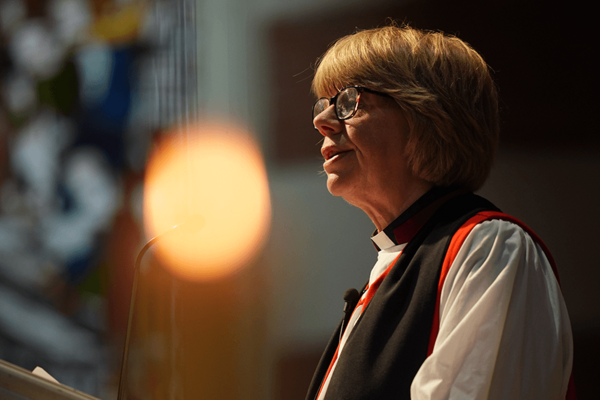
Sarah Mullally, the Archbishop of Canterbury, apologized for the Church of England’s coercive adoption practices and treatment of pregnant mothers during the post-World War II period through 1976.
“We are profoundly sorry for the pain, trauma and stigma experienced—and still carried—by many people because of historical adoption practices in homes linked to the Church of England,” said Mullally in a video released online on June 18.
In its own report, the church acknowledged that leadership knew pastoral guidance to keep mothers and babies together was disregarded in some cases and muddled with other language in church records, including “dehumanising and dismissive attitudes, falling short of what would be expected towards anyone in the church’s care, not least people who were rendered especially vulnerable by their circumstances.”
Children were commodified while mothers were seen as in need of correction, the report says. A church overseeing body knew about poor living conditions and underresourced staff at that time.
“The apology is going to have a big effect on people. It will bring healing, and it will bring release—release of things people have felt for years,” said Tina, an adopted person who gave her video testimony to the church. “It also means forgiveness can flow as well, which is really key in bringing healing to people.”
Others say the apology is “poor,” reported the BBC. Diana Defries, a spokesperson for Movement for an Adoption Apology, told Sojourners they requested an in-person apology but received a video. She said the apology contained “distancing language” and neglected to include sins of omission, where the church failed to provide adequate medical care which led to “significant harm” and failed to treat infant deaths with dignity by burying many in unmarked graves.
Scale of church involvement
According to its own report, the Church of England was involved in potentially over 200 homes, though not all of them were operated at the same time or had the same level of central oversight. The church research estimates 185,000 unmarried mothers across England and Wales relinquished children during this time. Many women who stayed at the homes also performed menial labor during their pregnancies.
Penny, in video testimony released by the church, said she was 15 and pregnant by a boyfriend when she entered a home. After several days of labor, Penny delivered a baby girl at a hospital.
“I remember one of the night nurses said, ‘I don’t know how you could give up your baby.’ And I never felt at any point was I given a choice. You’re 15 and you’ve done something that people are terribly shocked by, and society says is wrong, and the church says you’ve sinned, and the best thing you can do is give that baby a chance of another life that’s not with you,” she said. “If you love your baby, that’s what you will do.”
Penny described how she struggled to bond emotionally with her second child, whom she had after marrying, and learned to mistrust authority and the church. However, at one point in adulthood, she read the New Testament to learn about Jesus’ teachings.
“What he said was not very much to do with what went on in the homes and the Christians that I’d met. I didn’t see any evidence of mercy or understanding or acceptance,” she said.
Patterns across the Anglosphere
In the U.K., the Church of England, the Catholic Church, and the Salvation Army ran most mother-and-baby homes with support from the state, social workers, and medical professionals. Patterns of similar adoption practices echoed in other Anglophone countries, including the U.S., where some estimate that up to 1.5 million mothers were forcibly separated from their children in the “Baby Scoop Era.”
In 2023, the Episcopal Church became the first U.S. institution to investigate its role in supporting maternity homes and forced adoptions. Although it has not apologized for a systemic role, the Presiding Bishop Sean Rowe apologized to Francine Gurtler, an advocate for parents like herself who were coerced into relinquishing their children, late last year.
Gurtler, along with Mark Diebel, an adoptee and priest, wrote a letter to Rowe following the apology from Mullally, asking the Episcopal Church to reckon with its own responsibility in the Baby Scoop Era and offer healing and justice for those affected. They asked the Episcopal Church to follow the Church of England’s example of accepting responsibility for its role despite not having full oversight of all maternity homes.
“As Archbishop Mullally noted, accountability does not require direct involvement in the day-to-day operation of every institution. Dioceses and parishes look to the church's leadership for moral guidance, theological direction, and institutional authority,” the pair wrote, sharing the letter with Sojourners. “In light of the Church of England's apology, we respectfully urge Presiding Bishop Rowe to reconsider the need for a formal apology and to work with the mothers, children, and extended families on next steps toward justice and healing.”
Prior to this, two Canadian religious institutions formally apologized for forced adoption practices: the United Church of Canada and the Roman Catholic Archdiocese of Vancouver. The Salvation Army’s U.K. branch and the head of the Catholic Church in England and Wales also apologized.
Movement for apology
Momentum for the church apology began in 2023 when the BBC investigated the treatment of women and babies at St. Monica’s, an unwed mothers home run by the Diocese of Carlisle of the Church of England. After a former resident took her own life in 2006, her husband searched for the grave of her infant who died at the home. His discovery prompted a media investigation that uncovered at least 200 unmarked graves uncovered at least 200 unmarked graves at other church-run homes, including four others run by the Church of England.
In late 2024, the Church of England began research into its archives and other church forums to understand its involvement in mother-and-baby homes and adoption practices in the U.K. more broadly. In 2025, the bishop of Carlisle, Rev. Rob Saner-Haigh, apologized for the mistreatment of mothers at St. Monica’s and dedicated a memorial for babies buried at the site.
Yet advocates say an institutional apology and large-scale efforts to repair damages were long overdue. Veronica Smith, a co-founder of the Movement for an Adoption Apology, passed away in 2024 without hearing an apology.
"Everyone caught up in this dark period of our history hoped for a sincere apology from the Church of England for the attitudes, policy and extensive harm done in church affiliated homes and places overseen by the Church,” said Defries. “There are some very good and sincere people within the organisation, but they did not participate in this process.”
During a parliamentary committee hearing in March, Defries described how she stayed at Nazareth House, run by Catholic nuns in Southampton, after she conceived with her boyfriend.
“We were always spoken down to… [like] we lacked mental capacity,” she told the committee. In the hospital, no one spoke to her or explained what was happening. “They put me in a delivery room and held me down,” she said. “I had stitches without anesthesia.” She received an injection to dry up her milk without understanding what it was for.
Defries gave testimony as part of the U.K. government’s process for issuing its own apology. It released its most recent report after hearing testimonies from mothers this spring. While the governments of Ireland, Scotland, and Wales also all previously issued apologies, a U.K. parliamentary inquiry into the matter began in 2017.
The Church of England’s apology came alongside an offer of existing resources for adoptees, parents, or extended family members seeking to find each other and reconnect and a hotline for counseling support. But advocates note that support specifically for birth parents is still sorely needed. They also want a national archive of this history and trauma-informed support and help accessing records, and they remain uncertain over whether the church will go further to move the needle to provide access to archives.
“There are legal measures in place to hide records,” said Defries. “What we’re pushing for is all the records to be held in one location, so they become accessible, searchable and redacted to a minimal level.”
“In light of the Church of England's apology, we respectfully urge Presiding Bishop Rowe to reconsider the need for a formal apology and to work with the mothers, children, and extended families on next steps toward justice and healing.”

Rebecca Randall, an independent reporter and editor, is a Black and Korean U.S. domestic adoptee. She writes on the environment, religion, and adoption. Her first mother is an adoptee from South Korea.
Did this article have an impact on you? Tell us how! Whether you’re moved to take action, have a question, or want to share a comment (good or bad), we value your feedback!