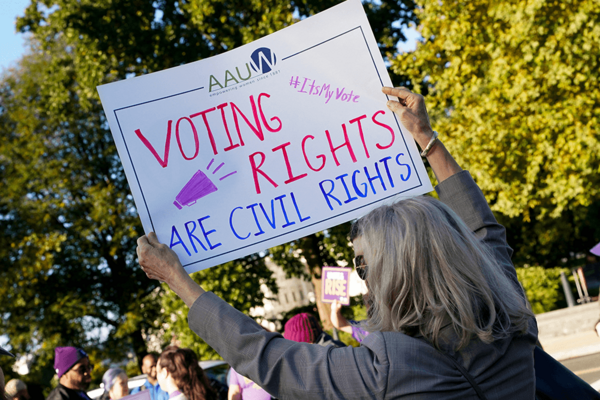
Faith leaders joined civic leaders in raising alarm over a recent Supreme Court ruling that experts say could significantly reshape how states apply one of the country’s core protections for minority voting rights. The Court’s decision in Louisiana v. Callais to block Louisiana from using a racially contested congressional map did not formally overturn Section 2 of the Voting Rights Act, but in her dissent, Justice Elena Kagan warned that the ruling has rendered it “all but a dead letter.”
Civil rights organizations and faith leaders immediately shared the sentiment that the conservative court was continuing to eviscerate the Voting Rights Act of 1965 one section at a time.
“The Supreme Court’s decision falsely claims fidelity to the law while stripping it of its power,” said the National Council of Churches in a written statement. “By invalidating a district created to reflect Louisiana's racial and political diversity, and comply with Section 2 of the Voting Rights Act, the Supreme Court decision silences voices that the Voting Rights Act was designed to uplift. Such an action does not restore our democracy; it wounds it. At a time when the nation should be working to strengthen representation and public trust, this decision moves us backward.”
In a 6-3 ruling, the court rejected Louisiana’s 2024 congressional map, which included two majority-Black districts out of the state’s six. One-third of Louisiana residents are Black. The Court held that the map—challenged by a group of voters identifying as “non-African American”—violated the Equal Protection Clause of the Fourteenth Amendment by making race the predominant factor in drawing district lines.
The disputed map had been adopted in response to earlier litigation alleging that Louisiana’s 2022 map diluted Black voters’ representation in violation of Section 2 of the Voting Rights Act of 1965. That map included only one majority-Black district. To comply with Section 2, Louisiana drew the 2024 map with two majority-Black districts, which the “non-African American” voters then challenged.
“The Constitution almost never permits a State to discriminate on the basis of race, “Justice Samuel Alito wrote in themajority opinion, “The time had come to resolve whether compliance with the Voting Rights Act can indeed provide a compelling reason for race-based districting.” The majority decided it cannot.
Leaders from pro-democracy groups and civil rights organizations expressed concerns that this interpretation opens the door to civic regression in numerous areas, as politicians’ gerrymandering efforts are essentially blessed by the Court so long as they use partisanship as their pretext.
“When maps dilute Black voting power, women and families lose ground on the issues that matter most — from strong public education to equal pay to civil rights protections,” said Gloria L. Blackwell, CEO of the American Association of University Women.
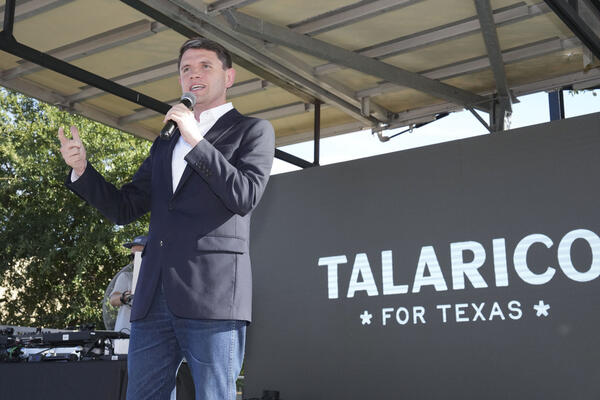
Their concerns are heightened by state legislatures waiting in the wings to redraw maps in response to the court’s decision. In Texas, whose contested 2025 Congressional map was upheld by the Supreme Court just days before the Louisiana decision, conservative lawmakers were explicit about their plans on social media.
“When the US Supreme Court rules in the Louisiana v. Callais case that Section 2 of the Voting Rights Act is unconstitutional, Texas will take up redistricting again (Congressional, Texas Senate and Texas House),” state Rep. David Spiller posted on X. “Get ready. It’s coming,”
The Voting Rights Act was one of the landmark victories of the Civil Rights Movement, and faith leaders have been quick to recall the role of churches and religious leaders in securing it. Interfaith Alliance said it was disgusted by the ruling and posted a minidocumentary on Black nuns advocating for the 1965 legislation. The caption connected the two moments in history: “This is a clear attempt to undermine the hard-won achievements of the civil rights movement, which so many people of faith, especially Black people of faith, dedicated their lives to.”
Democratic Senator Raphael Warnock, who is also the senior pastor of Ebenezer Church in Atlanta, wrote on social media that the decision was a “devastating and profound step backwards for American Democracy.”
Warnock said the ruling gutted the protections that his predecessor at Ebenezer and Civil Rights champion Rev. Martin Luther King Jr. “marched for [and] the protections made possible by civil rights protesters who spilled blood in pursuit of a more perfect union.”
Faith leaders representing other groups expressed both solidarity with Black voters and concern for their own communities.
“We know that Jewish safety and the safety of all marginalized people will come through a robust democracy,” Rabbi Jonah Dov Pesner, director of the Religious Action Center of Reform Judaism, said in a statement.
He called the Louisiana decision the latest in a “piece-by-piece” dismantling of the Voting Rights Act that began with Shelby County v. Holder in 2013, a ruling that lifted the requirement for states with discriminatory histories to gain federal clearance before changing their voting laws.
That decision struck down Sections 4(b) and 5 of the Voting Rights Act.
Pesner urged Congress to pass the John R. Lewis Voting Rights Advancement Act, which would reinstate the preclearance requirement with a modern formula for determining which states it applies to.
The legacy of Lewis and the others whose direct action and concrete demands shaped the original movement for voting rights showed up in the resolutions from leaders to continue the increasingly uphill fight, both in spirit and specificity.
“Like the 600 people in Selma Alabama on the Edmond Pettus Bridge who did not retreat despite the level of force present at the foot of the bridge, we will not retreat,” April England-Albright, national legal director of Black Voters Matter, said. “Instead, we will move forward, by relentlessly fighting for expanded federal voting rights legislation, state level voting rights, rank choice voting, proportional representation opportunities to give more marginalized representation, and constitutional changes. And we are going to win.”
Reuters reporting contributed to this story.
“Like the 600 people in Selma Alabama on the Edmond Pettus Bridge who did not retreat despite the level of force present at the foot of the bridge, we will not retreat,” April England-Albright, national legal director of Black Voters Matter, said.

Did this article have an impact on you? Tell us how! Whether you’re moved to take action, have a question, or want to share a comment (good or bad), we value your feedback!