I’ve heard the temptation of Jesus in the wilderness described as a warning against testing God. Maybe. But lately I’ve been thinking that the story is about testing your luck.
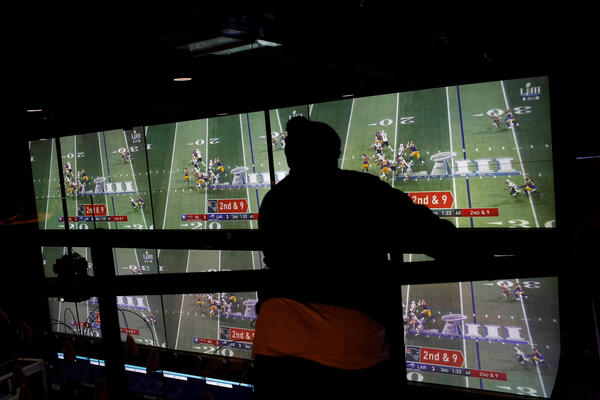
Here’s how the scene might look in 2026: The devil isn’t a shadowy figure on a mountaintop. He’s a sleek betting app. A notification lights up the screen: Turn this stone into bread. Massive payout. No one will know. Another notification appears: Jump from the temple. Stick the landing. Viral moment. Your followers will explode. Then there is the final notification, the final temptation: Bow to me just once. Lifetime guarantee. Unlimited upside. In the story, Jesus swipes away the temptation for the massive payout. But today, with the rise of predictive markets and sports gambling, it’s getting hard for us to do the same. It’s harder to resist this modern temptation because, for a lot of people, it now takes something big just to get by.
The economic commentator Kyla Scanlon has dubbed this the casino economy. Instead of valuing security, dignity, and predictability, our economy favors those who have a stomach for risk. “This economy is largely defined by froth,” Scanlon wrote in The New York Times, “Look and you will see gambling throughout the economy – in markets, policy and how we talk about the future.”
That high-leverage mentality is everywhere on my feed. Sports betting odds share space with breaking news headlines. Screenshots of cryptocurrency gains get passed around like testimonies. One friend jokes (kinda) about becoming an influencer, and another one is “building in public,” hoping to monetize their personal brand. The future begins to feel dependent on one well-timed move, one lucky bet, one algorithmic blessing. Bow to me just once.
Even institutions reflect that logic. In one recent case, a U.S. soldier used classified information to bet on a prediction market on the removal of Venezuelan President Nicolas Maduro, and profited from it. When asked about it, President Donald Trump shrugged it off by saying the world has “become somewhat of a casino.” The Department of Homeland Security has offered bonus incentives to people willing to take on the dangerous and stigmatizing work of separating families, which resembles the “profit boosts” in sports betting that potentially enhance your earnings. College, once framed as the safest path for finding a career and becoming financially stable, also feels like its own high-leverage bet now. Is taking out tens of thousands of dollars in loans just to have a chance in an uncertain job market really more rational than chasing a million followers? Both futures are unstable, and both require you to bet on yourself. One just comes with crushing interest.
Gambling has moved from vice to vibe. Commentators are saying that Gen Z workers are “playing the economy like a casino,” turning to the speculative market because traditional pathways feel unreliable. According to Axios, “The American dream is no longer defined by years of hard work paying off with a home and job security. It’s now about hope for a big break after taking bigger risks.” When the job market compresses, house prices rise out of reach, and institutions feel fragile, bold bets start to look responsible, even virtuous. Every economy forms a spirituality. The casino economy says that those who play it safe have little faith.
I recognize the pull because I feel it too. As a parent trying to build a life in a moment where everything feels uncertain, I’m not outside this economy. I often find myself wondering if making one right move (a fellowship, a viral essay, a career pivot) could help me hit the jackpot and find some stability. Maybe if I bow just once.
IMG_9991-2.jpeg

For many communities of color, this temptation isn’t new. In the communities I grew up around, as long-standing economic inequality limited access to stable jobs and networks, the routes that remained were high-risk: music, sports, entertainment, entrepreneurship. All these pathways are defined more by breakthrough moments than steady progression. When stability is blocked, people learn to find another way. Even if it means building a higher tolerance for risk and treating their lives as something to leverage rather than something to form.
READ MORE: Some ICE Agents Want Out. Christians Can Help Them
Today, that logic is spreading from the margins into the mainstream. The casino economy depends on that same urgency and is changing what kind of people we’re becoming.
Decades ago, Thomas Merton wrote in Conjectures of a Guilty Bystander that “the rush and pressure of modern life are a form, perhaps the most common form, of its innate violence.” He wasn’t writing about meme stocks or crypto speculation, but he was naming the kind of culture that would lead to making them inevitable. When everything accelerates and stratifies, the sense of self begins to thin out. There’s less time to test what you believe, less space to stay anywhere long enough to be changed. And over time, it becomes harder to tell which instincts are yours and which have been shaped by external pressures. What looks like a shift in the economy is also a shift in personal formation: People become more anxious and less grounded. They also become easier to move and shape against the steady formation that allowed Jesus to resist temptation in the desert.
But a hard question should be asked here: Does slow formation actually “work” anymore? Many of us assumed that slow, steady formation would lead somewhere stable. That promise feels emptier now. Think of your friend who did everything right, got the grades and degree, and is still looking for a job. Or maybe they found a job but can’t afford their own place. It often feels like success is tracked with timing, proximity, or luck.
Maybe the deeper problem is our definition of success. In a casino economy, success is reduced to a binary of a few winners and many losers. The slow work of becoming, then, will always feel like it isn’t working. But as the late Peruvian theologian Gustavo Gutierrez argues in A Theology of Liberation, faith is lived within history, especially in conditions marked by injustice. But to live by faith within that system doesn’t mean taking on its logic. It means being formed against it. A spirituality that can operate within a system where one person’s gain depends on another’s loss is one that has conceded too much, because faith is not a zero-sum game. A faithful life today can’t be about figuring out how to chance upon the right outcome in a volatile system. It’s about who we become, regardless of the outcome. This kind of faithful formation can’t rely on shortcuts.
In Contemplative Prayer, Thomas Merton makes this point as well: “In the spiritual life, there are no tricks and no short cuts. Those who imagine that they can discover gimmicks and put them to work for themselves usually ignore God’s will and grace.” The reason Jesus was able to resist the temptations in the desert is because of his spiritual formation, his hidden life. Jesus’ hidden life was formed through decades of growing up in obscurity, being a laborer, participating in family rhythms, and practicing a quiet faithfulness. That kind of formation doesn’t produce quick results or breakthrough moments. But it’s precisely what made the temptation in the desert less compelling.
Taking risks is not inherently bad. The Christian tradition is full of people taking courageous leaps—Abraham leaving home at the behest of God, Mary saying yes to being the mother of the Messiah, Peter stepping out of the boat to meet Jesus on the water. But these risky acts of faith emerged from a long process of formation. They are not bets placed in isolation. A wager tries to control outcomes. But the formation that Christ invites us to poses a central question: “Who am I becoming regardless of the outcome?” This is not a question asked in a casino economy. Christian formation may not guarantee stability, beat the algorithm, or fix the system, but it does do something even better: It helps us resist the temptation of allowing the system to decide who we become.
As heartbreaking as it is, our economic system is content to try to form us all into gamblers.
As heartbreaking as it is, our economic system is content to try to form us all into gamblers. Given the stakes, the harder and more defiant invitation is not to win the game, but to refuse to become what it demands.

Colin Martinez Longmore is an opinion writer for the 2026 Sojourners Journalism Cohort.
Did this article have an impact on you? Tell us how! Whether you’re moved to take action, have a question, or want to share a comment (good or bad), we value your feedback!