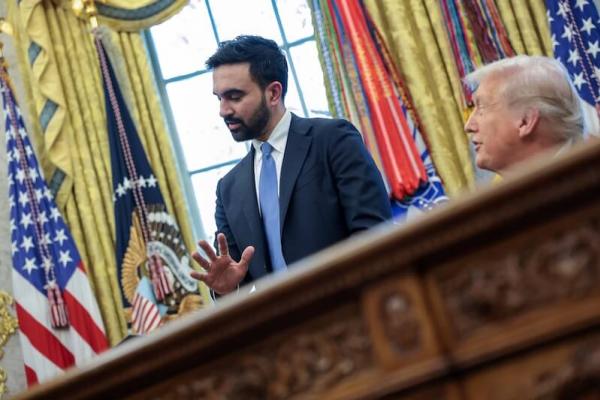
When President Donald Trump and New York Mayor-elect Zohran Mamdani first met back in November, I had to laugh. Partially because there is something deeply absurd about these two men—Mamdani, a self-proclaimed Democratic Socialist, and Trump, who once proclaimed he wished to be a dictator for “one day”—smiling and posing for photos in the Oval Office. But I mainly found myself laughing because, despite the drastic differences between these two politicians, both have been critical to my own faith and political journey.
Ten years ago, I wanted to vote for Trump. Today, I wish I lived in New York City so Mamdani could be my mayor. How and why did my politics and commitments as a Christian change so drastically? To answer that question, we have to travel back in time to August 2015.
Amid an intense presidential election, my family arrived in the U.S. as migrants in search of new opportunities. As a 16-year-old non-citizen, I believed in the “American Dream,” that it was the promised land—a land of opportunity. America captured my heart as an ideal of the good life—a new home where one could escape the broken systems of their country of origin.
We watched the 2016 presidential election, not fully understanding how it would change American politics in such a dramatic way. Truthfully, we believed that Trump’s election would bode well for migrants like us. My father prayed, “We hope for a leader who will be righteous.” As far as we were concerned, Trump was that leader.
I sneered at the photos of Trump with Mamdani in the Oval Office. But when Trump was elected president in November 2016, I cheered.
***
In 2018, I began my college education at Moody Bible Institute—a bastion of conservative evangelicalism. Initially, the idea of socialism repudiated me. But during my time at Moody, I unexpectedly became a socialist.
The message that was hammered into me through white evangelicalism was that capitalism was the economic system that God intended. It allowed people to become diligent; socialism made people lazy. Capitalism gave people opportunities to make a living, but socialism thieved upon people’s hard-earned wages. Capitalism came from Judeo-Christian values, but socialism allegedly opposed religion.
Naturally, because Trump is an unapologetic capitalist, I loved him. And in many ways, Moody Bible Institute seemed to be the perfect place for a capitalist Christian like me. The school itself began as a capitalist venture.
Historian Timothy Gloege calls Moody a key player in forging the bond between American evangelicalism and modern consumer capitalism. Founded in 1889 by revivalist Dwight L. Moody, the institute quickly became a bulwark of corporate evangelicalism through Moody’s partnership with Henry Crowell, the president of Quaker Oats. Over time, the small school expanded into a full-fledged business empire in the heart of Chicago, with its reach extending across Christian radio, book publishing, aviation training, and theological education.
While at Moody, I volunteered at fundraising events and worked highly publicized gatherings designed to court wealthy donors. I was all in. Captivated by a faith packaged like a product, I became a product myself: an international student, aflame with evangelical zeal, trained to spread the gospel.
I found myself trapped within the depths of this American religio-capitalist system, digging myself further into its abyss. I would eventually realize that I was gasping for air.
Capitalism: a structure of sin
That moment came most acutely in 2020, during my sophomore year, on the coattails of a worldwide pandemic and a police officer brutally murdering George Floyd. Some of Floyd’s last words were, “I can’t breathe!”
As riots and protests raged throughout the country, I sat in my dorm room, wrestling. What kind of world are we living in that an innocent man like George Floyd could be murdered in cold blood by the police? I began to doubt my previous endorsement of Trump, as his response to these protests was to frame them as “acts of domestic terror.” How could I have ever believed I could rightfully belong in this country?
I went in search of new answers.
During this time, a former professor at Moody subversively introduced me to Black theologians like Willie James Jennings, J. Kameron Carter, and James H. Cone. It was Cone, in particular, who left a lasting impression on me. His searing theological intervention into American Christianity shattered the illusions I had long held about the gospel, power, and capitalism.
Through reading Cone, I realized that the U.S. I so believed in, and the version of Christian capitalism that I so embraced, was radically inconsistent with the ethics of Jesus.
For Cone, the very economic and structural realities that oppress the poor—especially those racialized as Black—are fundamentally produced and sustained by racism. I understand this through the lens of racial capitalism: a system in which the poor are exploited and absorbed into a capitalist order whose very architecture is organized through racial logics. Accordingly, in For My People: Black Theology and the Black Church, Cone argues that Christians cannot adequately analyze “the structure of capitalism” as an expression of structural sin without the help of Karl Marx. As he puts it, “Marxism as a tool of social analysis can disclose the gap between appearance and reality, and thereby help Christians to see how things really are.” Put differently, Marxism equips Christians to perceive the world truthfully—to discern what must be resisted and to identify the appropriate tools and strategies for struggling against the capitalist system that perpetuates racial oppression.
READ MORE: Said I Wasn’t Gonna Tell Nobody About James H. Cone
When I think back to my engagement with Cone, I clearly see how it laid the groundwork for me to become a supporter of Mamdani. Mamdani, too, has been influenced by the Black church when it comes to his convictions around prioritizing the needs of the most vulnerable in our economic system. Quoting Rev. Martin Luther King Jr., Mamdani said, “Call it democracy or call it democratic socialism; there must be a better distribution of wealth for all of God’s children in this country.”
The George Floyd protests and my readings in Black theology put me at a critical crossroad: Would I remain beholden to the capitalist system I had long defended, or would I finally listen to the warnings of Black Christians about the racial violence embedded within capitalism itself?
And at that crossroad, I found myself again at the feet of Jesus, remembering his unmistakable warning: “You cannot serve both God and mammon” (Matthew 6:24).
Moody made me a socialist
After graduating from Moody in 2022, I eventually realized that I would have never become a socialist if I hadn’t been a student there.
After graduating from Moody in 2022, I eventually realized that I would have never become a socialist if I hadn’t been a student there.
It is doubtful the curriculum designers intended this, but regardless, they gave me the exegetical and theological tools to take Jesus’ words seriously; to actually read the gospels and imitate, as best I could, the example that Jesus set. Over time, I’ve become more grateful for my education, despite the baggage. Because ultimately, attending Moody is what made me a socialist.
I started to see that the commitment of liberation theology to the poor witnessed to the gospel of Jesus. Practically speaking, a gospel that is unapologetically partisan toward those deemed disposable among us is focused on improving their material conditions. Anything less would be a compromise of the kind of radical solidarity that the gospel is calling us toward.
It is unlike Christ to let people suffer and die from preventable diseases while their families drown in medical debt. It is unlike Christ to let children starve while the wealthy throw extravagant parties at the expense of the poor. It is unlike Christ to fund a genocidal war that has taken tens of thousands of lives, displacing entire communities and blocking the flow of life-saving humanitarian aid.
Mamdani’s policies—essentially a platform focused on expanding welfare programs—are a good and necessary first step toward repairing New York City’s broken political system and could even serve as a model for reform across the U.S. Such reforms are urgently needed in a time of incessant inflation, deepening debt, growing inaccessibility to basic necessities, and an affordability crisis that falls most heavily on communities of color. Welfare expansion and systemic reform are therefore not minor adjustments but essential beginnings—initial steps toward improving the quality of life for the discarded and exploited masses.
Even so, I admit that I remain skeptical that expanding the welfare state alone can address the crisis of racial capitalism. Necessary as welfare reform is, it cannot solely overcome the deeper structural forces at work. For example, Mamdani has walked back his criticisms of police racism that he made in 2020. I think this is an indication of Mamdani failing to reckon with the full reach of racial capitalism, which relies not only on individualized or isolated instances of racism but also on a capitalist carceral state that profits from incarceration. Reforming or defending institutions like the police, then, is insufficient. The police—along with the broader carceral order—must be structurally reevaluated in pursuit of radical alternatives that challenge racial capitalism at its core.
Even amid these disagreements, Mamdani’s win signals, for me, a burgeoning political consciousness rising from the oppressed masses—the working class, racialized communities, and those rendered “the least” among us. That rising consciousness inspired me to live out my political theology through embracing anti-capitalist politics—through socialism. I resonate with the Institute for Christian Socialism’s position, which insists that resisting capitalism is not a betrayal of Christian faith but an expression of the gospel’s deepest commitments.
To pursue socialist politics, then, is to follow Christ more faithfully. Becoming a socialist means joining the work of redeeming a world suffocating under the weight of global capitalist extraction and exploitation. In the words of Filipino-Mexican American theologian and journalist Colton Bernasol, the task before us is to participate in the movement “of those who struggled, consciously or not, to create a freer world for [us], even if it was for a freedom they would not witness.” Indeed, it is to bear witness to Jesus’ struggle for a freer world in our present moment, here and now.
Born again
So, when Mamdani began his long-shot campaign for mayor in June 2025, relying on buzzworthy slogans and working-class rallying cries that resonated far beyond the city, it also resonated with me—a Christian socialist and a green card holder living in central New Jersey.
For too long, capitalism has held mainstream American Christianity hostage, dismissing the social imperatives of the gospel as antichrist. When I think back to the days before I became a Christian socialist, I think of the white evangelical influencers I use to listen to—people like Allie Beth Stuckey, who called socialism “immoral,” or the late Christian nationalist Charlie Kirk who even claimed that the free market gives people the unbounded ability to pursue “the good of all mankind”—something I once vehemently believed.
But I am in a different place now. In many ways, becoming a Christian socialist has made me feel as though I’ve been born again.
Jesus’ gospel reveals a radically different economy from capitalism—one rooted not in profit or possession, but in condemning riches and pursuing justice for the exploited. Such is the radicality of Christian socialism that, 10 years ago, I could never have accepted. I was too mired in the illusions of the American dream to see any other possible life beyond it. For me, everything came down to the opportunities the evangelical free market had made possible.
Still today, evangelical institutions across the world continue to perpetuate capitalist structures that harm us all, especially the most vulnerable. I hope more Christians will awaken to the social implications of a gospel that demands risk for the sake of the oppressed. I hope Christian socialism can finally be understood not as a threat, but as what it truly is: an expression of faithfulness to the gospel’s call for justice.
When Mamdani defeated Andrew Cuomo in New York City’s mayoral Democratic primary earlier this year, I—like many others—felt a sense of hope that had long been absent. Maybe, just maybe, the tides were turning for leftist politics in the U.S. Maybe, just maybe, we could begin to reorient this country toward the struggle for a freer world, and steer it away from fascism.
On the evening of Nov. 4, 2025, I had just arrived home after a long day at work. I had eagerly been awaiting the results of the general election. A few hours later, the good news broke: Mamdani had been elected mayor, and I cheered.

Yanan (or Abdul) is a theologian from the Philippines. He writes about Christian radical politics, and his writing has appeared in BitterSweet Monthly, Interfaith America, the Institute for Christian Socialism, and other outlets.
Did this article have an impact on you? Tell us how! Whether you’re moved to take action, have a question, or want to share a comment (good or bad), we value your feedback!