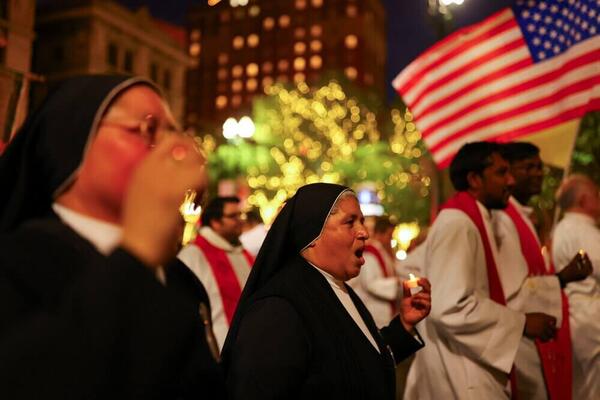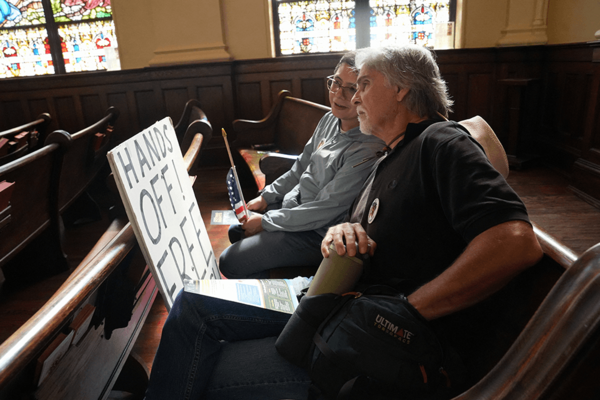
This past weekend thousands of people marched to the polls in nearly 3,000 events for the No Kings: Vote Early mobilization. This was a historic surge in getting people and communities mobilized for early voting in neighborhoods across the country. Whenever possible, voting early and ensuring an overwhelming voter turnout is arguably one of the most powerful tools and best defenses we have against the abuse of power and authoritarian consolidation.
But early voting, let alone voting on election day, still requires persuading and, in many cases, empowering people to actually vote. Given the challenging reality that an estimated 87 million eligible voters didn’t exercise their vote in the 2024 election, I’ve been thinking a great deal about what role our Christian faith can and should play in dramatically increasing voter turnout.
It can be tempting to shame or even condemn the 87 million eligible voters who didn’t vote in 2024, which is more people than who actually voted for President Donald Trump. I can understand reactions of exasperation and even anger. But we should reserve any shaming or condemnation. Not only do we not know anyone’s circumstance or motivations but, from a purely pragmatic point of view, trying to shame people into voting is counterproductive.
Instead, we must actively work to remove the barriers that make it difficult to vote, listen more deeply to both concerns and hopes, and help illuminate a greater reason to vote.
The reality is that people had all sorts of different reasons they didn’t vote, many wholly unrelated to their faith, Christian or otherwise. When registered voters were asked in a Census Bureau survey why they didn’t vote in 2024, 20% cited lack of interest, 18% said they were too busy, 15% didn’t like the candidates or issues on the ballot, 12% were dealing with illness or disability, 7% were out of town, and 4% forgot. It’s also important to remember the role voter suppression plays in throttling turnout.
Most of these reasons aren’t theological. But some are, and those are the ones that Christians and the church are most responsible for.
Strategist Ash-Lee Woodard Henderson sheds critical light on why 87 million eligible voters sat out the last election and how to best reach them. According to Henderson, these people “aren’t lost. They’re unorganized.” Henderson places these voters into three categories: the “locked out” who don’t vote because of preventative barriers; the “politically homeless” who don’t vote because they believe it won’t change anything; and the “ideologically out” who don’t vote because they have opted out of the two-party system entirely.
The “locked out” point to the urgent need to remove real structural barriers to voting that so often have a disproportionate impact on Black, brown, and low-income voters. Our vote is a critical way that we affirm God’s image in everyone. Through Faiths United to Save Democracy, Sojourners has been working with over 30 national faith-based organizations to protect everyone’s freedom to vote and increase access to voting, which we believe is an essential way we honor the imago dei, the image of God in every person. In contrast, any effort to deter or deny voters the freedom to vote becomes an assault on imago dei itself.
As for Henderson’s categories of the politically homeless and ideologically out, I think it’s critical to examine many of the theological barriers and blinders that often deter these groups from voting—particularly those who share our Christian faith.
The politically homeless
For the politically homeless, both an overly privatized faith and an apolitical faith serve as major stumbling blocks to voting.
When following Jesus is viewed as a private issue that carries little or no public import, voting becomes detached from our faith. For Christians, faith can become all about personal salvation and our own personal holiness, failing to recognize that while a personal, redemptive relationship with Jesus is the starting point of Christian faith, it is far from the endpoint. Following Jesus has profound social, political, and economic implications; it requires enlistment in God’s kingdom-building project of advancing communal righteousness, justice, and love.
Similarly, an apolitical faith that seeks to stay above the fray of politics. I have found the apolitical faith particularly common within my own Baptist tradition, where the separation of church and state is often treated as sacrosanct. However, the separation of church and state does not require the separation of our faith from the public realm. In fact, our public life is diminished when we fail to participate through the act of voting.
The ideologically out
The desire to maintain a pure faith plays a key role in many Christian voters who fall into the ideologically out. In this argument, politics is seen as inherently corrupting or divisive, filled with compromises made to support the lesser of two evil choices. This argument is particularly alluring in a time in which our politics have become so hyper-partisan, polarized and seemingly broken.
It’s true that kingdom of God is never on the ballot, which means we must make imperfect choices. The challenge is that when we decide not to vote, we can inadvertently endorse the status quo and relinquish our voice and agency to affect change.
The faith-based case for voting
If these are some barriers, then what does a faith-inspired polemic look like for why Christians should vote because of their faith, rather than in spite of it?
First, our vote helps us to advance the common good in society. We’re taught in Romans 13 about the proper role of government, which Paul explains is to restrain evil and promote the common good. Paul says that the commandments “are summed up in this one command: ‘love your neighbor as yourself.’ Love does no harm to a neighbor. Therefore love is the fulfillment of the law” (v. 9-10). I read that to say that the laws a government enacts should ultimately be focused on the principle of neighbor-love which, in the context of governance, means promoting the common good. So for a Christian, the function of voting is to judge which politicians or ballot initiatives will best promote the common good of our society and the wider world.
Second, our vote helps us fulfill Jesus’ mandate in Matthew 25 to care for and protect “the least of these.” For me, using the vote to create change at scale starts with the ability of elections to help—or harm—the people in the most vulnerable circumstances both in the U.S. and around the world. Matthew 25:31-46 makes clear that both people and nations are judged by how they treat society’s most vulnerable people—which includes the sick, the hungry, the immigrant, the imprisoned, and those living in the quicksand of poverty. Election outcomes have profound consequences for all of us, particularly for the most vulnerable among us.
Two proof points include the 2008 election that led to tens of millions of people gaining access to health insurance and the 2024 election, which enabled the passage of legislation that has already caused 5 million people to lose access to Supplemental Nutritional Assistance Program benefits and millions more lose access to healthcare.
Third, our vote is an essential way we resist and overcome oppression, tyranny, and the abuse of power. In 1 Samuel 8, we get a cautionary tale that reinforces the importance of voting with discernment and the danger of unaccountable power. The people of Israel demand that Samuel give them a king so that they can be like other nations. Even when Samuel warns them of what a king ruling over Israel will actually mean for its people—everything from sons being sent to die in wars to cronyism to economic exploitation—the people insist anyway, reasoning that a king would “fight [their] battles” (v. 20).
In the thousands of years since the Hebrew Scriptures were written, we’ve seen many examples of what happens when people driven by fear, envy, and insecurity lift a strongman figure. The Christian responsibility to vote against the misuse and abuse of power should serve as a bulwark and a counterbalance to the scapegoating and fearmongering that we see so often in our politics.
“Voting is a way for us to make our earthly home more closely resemble the eternal reign of God to which we all look forward.”—Adam Russell Taylor
All of these reasons reinforce the argument that, at its core, voting is an act of discipleship and even a Christian responsibility—one that we should actively discuss with our friends, family, and others within our sphere of influence who aren’t voting. In giving us the Lord’s Prayer (Matthew 6:9-13), Jesus instructs us to pray “your kingdom come, your will be done, on earth as it is in heaven.” Voting is a way for us to make our earthly home more closely resemble the eternal reign of God to which we all look forward.
Don’t mistake me—voting is no panacea for changing our communities or for living out of faith. And faithful citizens who want to engage civically have many other tools at their disposal, from attending town halls and serving as poll workers to canvassing and volunteering for causes we believe in. However, voting is arguably, as the late Rep. John Lewis described it, “the most powerful nonviolent tool” we have in a democratic system.
When it comes to conversations any of us can have with people in our lives who don’t vote, the Lord’s Prayer, Matthew 25, and Romans 13 are a few ways we can explain to fellow Christians why we choose to vote and why we see it as a Christian imperative. So can the examples of elections whose outcomes resulted in clear impacts on millions of people for good or for ill.
But ultimately, we need to be sensitive and humble. It’s easy to become filled with conviction at the righteousness of our argument and end up alienating the people we are trying to convince. As I’ve argued, when someone feels like they’re being blamed, it almost never leads to a change in mind or heart. Instead, focus on the opportunity that voting represents. It’s a chance to make our communities, the nation, and the world better, to meaningfully shift the world toward God’s preferred reality.
As Rev. Sen. Raphael Warnock is fond of saying, “a vote is a kind of prayer for the world we desire for ourselves and for our children.” Perhaps it is time to apply the full weight of our faith to the imperative to vote and to encourage, support, and persuade as many of our family, friends, neighbors, fellow members of our congregations, co-workers and more to also vote.
Rev. Adam Russell Taylor is president of Sojourners and author of A More Perfect Union: A New Vision for Building the Beloved Community. Follow him on Bluesky @revadamtaylor.
Did this article have an impact on you? Tell us how! Whether you’re moved to take action, have a question, or want to share a comment (good or bad), we value your feedback!