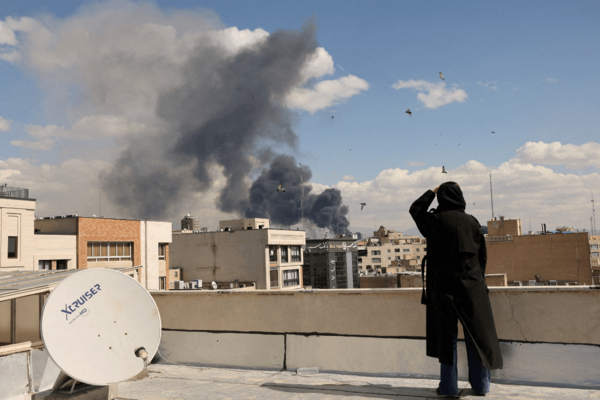
After I saw that President Donald Trump had ordered attacks on Iran, I thought about the passage in 1 Samuel in which the Israelite elders get fed up with being run by a series of judges and ask for a king. The prophet Samuel, after praying over the matter, urges them to rethink the request, reciting a laundry list of all the things a king will do to the people. First among them: “He will take your sons and make them serve with his chariots and horses, and they will run in front of his chariots. Some he will assign to be commanders of thousands and commanders of fifties, and others to plow his ground and reap his harvest, and still others to make weapons of war and equipment for his chariots” (8:11-12). In short: Kings start wars.
Samuel ends his speech with a grim prediction: “When that day comes, you will cry out for relief from the king you have chosen, but the Lord will not answer you in that day” (8:18).
READ MORE: A Field Guide to Christian Nonviolence
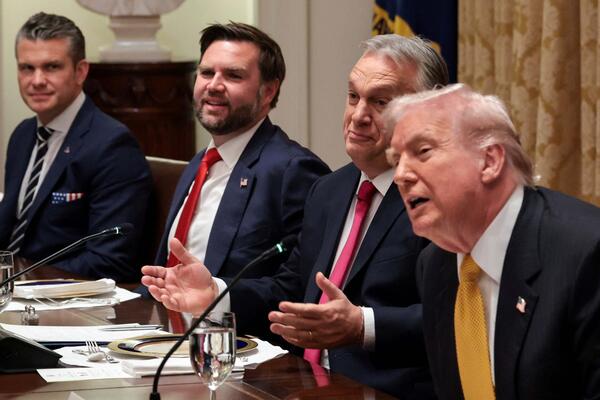
Now, the United States famously has no kings. But don’t tell Trump that. When asked by The New York Times whether there were any limitations on his powers, Trump responded: “Yeah, there is one thing. My own morality. My own mind. It’s the only thing that can stop me.” This is not Trumpian bluster: His administration has ignored the courts, the Constitution, and international law at every turn. When the Supreme Court told him his tariffs were illegal, Trump just ordered new ones. When the Constitution told him his deportations were illegal, Trump simply ignored it. And when the law mandates that war must be approved by Congress, Trump decided that the separation of powers is for woke libs and started a war anyway. If this isn’t the behavior of a self-styled king, what would a king look like?
So the United States has a king. And while kings start wars, they rarely die in them. As Samuel pointed out to Israel’s elders, the dying is usually done by sons and daughters. Trump himself pointed this out on Friday evening, in a video announcing his strikes on Iran. “The lives of courageous American heroes may be lost and we may have casualties,” he said. “That often happens in war.” He said nothing of the casualties that might be inflicted on people of other nations, including the people of Iran, whom he warned to “stay home” because “It’s very dangerous outside. Bombs will be dropping everywhere.”
He’s right. And while Trump may claim that his strikes are intended to “defend the American people by eliminating imminent threats from the Iranian regime,” nobody really believes that. During his first term in office, Trump ended a treaty with Iran that limited its nuclear abilities; last summer, he bombed its nuclear facilities. Americans were not in danger of the Iranian military until Trump started a war with it and, in any case, war is not effective at eliminating imminent threats. You can look at the last 30 years of U.S. military activity in the Middle East if you need proof, but you don’t need to be a dedicated student of war to see this: War kills people. That’s what it does. War kills and maims and rapes and, over the whole course of history, has proven to be far more effective at creating orphans and widows than in delivering justice and peace.
READ MORE: Praying the Imprecatory Psalms Is an Act of Nonviolence
This is the basic argument of Christian nonviolence, a tree with branches across millennia, rooted in Jesus' blessings for peacemakers and instructions in Matthew 5 to turn the other cheek and love thy enemies (not to mention that Old Testament classic: Thou shalt not kill). Of course, it is here that people start accusing nonviolent Christians of being doe-eyed hippies who’ve lost touch with reality: “Turn the other cheek” sounds nice, sure, but it’s not realistic. From there, they start offering all sorts of soul-coarsening platitudes about all the good things violence can do. As self-styled “Secretary of War” Pete Hegseth said at the National Prayer Breakfast, “The warrior who is willing to lay down his life for his unit, his country, and his Creator, that warrior finds eternal life.”
Hegseth continued: “To preserve the soul of America, we must continue to wield not just the physical sword but the sword of truth.”
But something important gets lost in these celebrations of redemptive violence. It’s not the nonviolent who’ve lost touch with reality; it’s the warmongers. They’re the ones trying to convince us that war is actually good at bringing about peace and justice. They’re the ones trying to insist, despite all historical evidence to the contrary, that death can be a net gain for life, and the slaughter of innocents is acceptable collateral for us to “preserve the soul of America,” whatever that means. This logic is more delusional than any adherent to nonviolence could ever be. As the 19th-century “prince of preachers” Charles Spurgeon said:
What pride flushes the patriot’s cheek when he remembers that his nation can murder faster than any other people. Ah, foolish generation, ye are groping in the flames of hell to find your heaven, raking amid blood and bones for the foul thing which ye call glory. Killing is not the path to prosperity; huge armaments are a curse to the nation itself as well as to its neighbours.
Spurgeon’s alternative was less the absence of violence than the presence of compassion, arguing that: “The Church of Christ is continually represented under the figure of an army; yet its Captain is the Prince of Peace; its object is the establishment of peace, and its soldiers are men of a peaceful disposition. The spirit of war is at the extremely opposite point to the spirit of the gospel.”
READ MORE: What Does Christian Nonviolence Actually Mean?
Rev. Martin Luther King Jr. agreed with Spurgeon and regularly invoked the inspiration he took from Gandhi in his own nonviolent work. “Gandhi resisted evil with as much vigor and power as the violent resister,” King said. “But true pacifism is not unrealistic submission to evil power. It is rather a courageous confrontation of evil by the power of love.”
And I do think our nation is going to need some Christians willing to risk that courageous confrontation of evil. We got the king we asked for, and now we get the wars that always come along with such demands. But despite this horribly predictable series of events, we are not helpless or powerless. The way of Christian nonviolence teaches us that Jesus’ calls to peace can be most radical and forceful during points of armed conflict. We’ve seen recent examples in places like Minneapolis and Chicago, where citizens have risked their safety and their very lives to oppose this violent regime. Now it’s time for the rest of us to follow that example and tell the self-styled king no to this war.
War kills and maims and rapes and, over the whole course of history, has proven to be far more effective at creating orphans and widows than in delivering justice and peace.

Did this article have an impact on you? Tell us how! Whether you’re moved to take action, have a question, or want to share a comment (good or bad), we value your feedback!