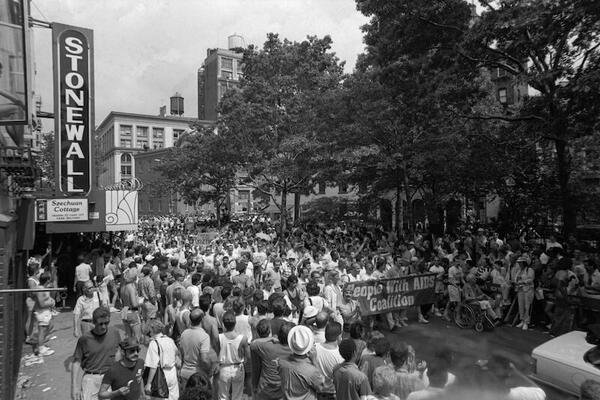
Stonewall is remembered for being the site of a riot. What I remember about that community is care.
By the time the New York Police Department entered the Stonewall Inn in lower Manhattan on June 28, 1969, a community already existed. The rebellion became famous because people fought back, but communities are not built in a single night. The Black and brown queer folk, transgender women, drag queens, sex workers, and young people who gathered at Stonewall had already spent years creating ways to survive. They had learned how to care for one another when families and churches would not and when the police attacked them. Stonewall was not the beginning of their steadfastness. It was the moment the rest of the world was finally forced to see it.
I have been thinking about what the church still has not learned from that historic moment. The church I am addressing here is not a monolith. I understand there are Christians for whom this entire conversation stops at the mention of the LGBTQ+ acronym. I am not writing for them today. I am writing for the rest of us. I am writing for people like me, who are resisting inequitable systems and imagining what liberation can look like for all that God has created.
I grew up in Newark, N.J., only a few miles from where LGBTQ+ activist Marsha P. Johnson once lived. Queer people were present in my childhood, but mostly as whispers. I remember family conversations about R&B singer Luther Vandross, how the discussions were carried out through coded language and unfinished sentences. Nobody ever said exactly what was bad, but it was clear they were debating whether he was gay and whether that mattered to his artistry. I defended Luther instinctively, not because I understood the conversation, but because I believed he needed defending. Years later, I realized there was someone else at the table who understood far more than I did: my uncle.
My Uncle Wade was a minister, politician, and beloved member of our family. As an adult, I would come to understand that he was queer himself. And after he passed, I learned that the multifaceted identity he built outside the church deserved recognition within it as well. For decades, he was serving faithfully while the church as a body debated whether people like him deserved to exist. I don’t know what that cost him. I do know he never stopped showing up. Looking back at the discussion about Luther with my family, I think about that moment when my uncle caught my eye and smiled. Now I see it less as an agreement and more as a recognition of Luther, of me, and a world of folk living at the margins.
My uncle was not a peripheral figure in the church. He held a Ph.D. in philosophy from the University of Chicago Divinity School and had studied at Princeton University and Princeton Theological Seminary, serving as one of the university’s founders of Black campus life. He read French, German, Hebrew, Latin, and Greek. He served on the city council, directed a state office for the aged and disabled, and returned Sunday after Sunday to Christ Baptist Church, a congregation founded by my family generations before him that served forgotten and marginalized people. When Uncle Wade died, they found him in his home office in the middle of writing a sermon.
He quietly carried something the institution he loved had never fully made room for. He never resolved that tension, as much as he simply lived in it. Showing up, week after week, is its own form of theology.
My formative years were shaped by other absences too. A neighbor named Sisqo disappeared from our lives. Nobody said HIV. Nobody said AIDS. Nobody explained where he had gone, but as a very young child, I knew that one day he was there and then he wasn’t. Like many younger folk, I accepted the silence because the adults around me did. This was the 1980s. It would take years for me to understand how many queer lives had been erased through a combination of disease, stigma, neglect, and fear.
At night, driving home from family dinners or church events, I would occasionally see trans women and sex workers walking in Newark or New York. During the day, they seemed to vanish. They were not visible in my schools. They were not in hospitals, banks, universities, or government offices. They existed in the same city I did, yet occupied an entirely different plane. Discrimination narrowed what was possible for many queer and trans people, but it never extinguished their gifts.
One place those gifts could be displayed and celebrated was in ballroom houses. Born in response to racial exclusion in mainstream drag culture, ballroom emerged in New York as a Black and Latino LGBTQ+ world organized around “houses,” which were chosen families that provided belonging, care, and shelter. Those houses gathered at balls, where participants competed for prizes in categories ranging from dance and fashion to beauty; the Latex Ball is among the scene’s most iconic annual events.
What I didn’t know until attending the event was that it was created specifically because of that silence that comes with discrimination. Gay Men’s Health Crisis, a New York-based non-profit dedicated to ending the AIDS epidemic, built the Latex Ball as infrastructure—a space where health resources could reach people the medical system had written off. The houses that competed there had spent the previous decade doing what hospitals and governments would not. They sat with the dying. They memorialized and kept names alive.
During a ball, people checked on one another. Resources were made available to attendees. Conversations about health, housing, and treatment existed alongside fun events. Mothers and fathers mentored younger members. People shared information, opportunities, and support. Like every human institution, the ballroom contained conflict, ego, and harm. Yet beneath all of it was a commitment to ensuring people survived and found ways to flourish. Sisqo had a name. Somewhere, someone involved with the Latex Ball likely kept it.
For decades, Christopher Street, home to the Stonewall Inn, was more than a street. Running to the Hudson River piers, it functioned as a public living room or sanctuary where Black and brown queer and trans folk gathered to build community before social media. Finding my way to Christopher Street as a teenager felt like entering another dimension. I spent time on the piers before they were transformed into the manicured waterfront parks they are today. Back then, they were worn down and neglected, old structures left to decay by a city that had disinvested in them. People gathered there because there were few other places to go. Folk came to party, make art, fall in love, have sex, deal drugs, argue, dance, and build community. The city had stopped caring for those spaces, so the people inside them had free rein to reimagine the space while also creating economies and networks of care.
I was about eighteen when a man a few years older than me approached me there and asked whether I had ever considered “walking face” at a ball. To “walk face” is to compete in a category that celebrates aesthetics and presence. For many in ballroom culture, it is also a way to declare worthiness in a society that seeks to deny their worthiness. I had done some modeling and had recently appeared in Seventeen magazine. I understood enough to know that the invitation was flattering, but I was unsure.
He sensed my hesitation. He explained that I could do well, that there was money to be made, that people would be excited about me. But I had already begun retreating. Not because I was afraid of him. I was cautious about anything that might alter the path I imagined for myself. I had family. I was in college. I was moving toward what seemed like a conventional future. Looking back, I realize I misunderstood the invitation entirely. I thought someone was asking me to compete for a prize. What he was really offering was extended family. In the language I would have understood better then, he was offering me a church.
READ MORE: LGBTQ+ Christians Can Build Bridges With Our Non-Affirming Family
The ballroom and the Black church exist in different worlds, yet they are also in conversation with one another. What surprises many people is that Black queer communities never fully abandoned Christianity. According to research from the UCLA Williams Institute, Black LGBTQ+ people remain Christian at more than twice the rate of white LGBTQ+ people. The popular narrative suggests that queer people left the church. The reality is often more complicated. Many, especially Black folk, stayed. They maintained faith even when institutions failed to maintain their faith in them. This is not incidental. The Black church has always had queer people at its center—directing choirs, leading auxiliaries, and occasionally preaching from the pulpit. The institution doesn’t simply tolerate their presence. In many cases, the church is sustained by LGBTQ+ people.
Both the Black church and the ballroom emerged from marginalized communities as a way to emphasize human dignity. Both understood survival and innovation as a collective act.
Howard Thurman wrote that the religion of Jesus emerged as a resource for people living under conditions designed to deny their dignity. He understood that communities pushed to the margins often develop forms of wisdom unavailable to those at the center. Queer folk of faith have understood that from the inside out. Ballroom houses remind me of that insight. They built chosen lineages when blood families failed. They buried their dead during the AIDS crisis when few others would. They organized systems of care when public institutions refused to acknowledge their humanity. While far from perfect, ballrooms practiced forms of beloved community that many churches still struggle to achieve.
Today, many congregations are working toward LGBTQ+ inclusion, and that work is vital. Yet inclusion is not the end of the conversation. There is a difference between opening a door and recognizing that the person walking through it is a blessing. Too often, Christians speak about queer people as recipients of ministry rather than creators of wisdom, culture, community, and yes, like my uncle, theology. He understood that God could be served fully by someone the church refused to fully see.
Jesus consistently moved among people his society had dismissed, not because they were objects of pity, but because they possessed experiences and gifts unavailable to the positionally powerful. If the church is serious about following him, it must reckon not only with who he spent time with but with what those communities revealed about God.
Jesus consistently moved among people his society had dismissed, not because they were objects of pity, but because they possessed experiences and gifts unavailable to the positionally powerful.
The question is not whether queer people belong in the church. Many of us settled that question long ago. The question is what the church missed while it was busy debating the issue; the question is whether we have the humility to learn from communities whose faithfulness often exceeded our own.
Sometimes I think back to that afternoon on the pier when I thought someone was simply inviting me to walk face. But he was really offering me belonging, lineage, responsibility, and care.
I think about what I received despite declining. The Latex Ball taught me something about what collective joy looks like when it is also tied to survival. My uncle’s quiet smile across the living room taught me that faith can be carried in silence without being diminished by it. The man on the pier taught me that belonging gets offered in languages we don’t always recognize at the moment.
Perhaps that is one of Pride’s great invitations, for churches not merely to become more welcoming but to become more curious. What might we learn from people whose faithfulness exceeded the institution’s capacity to fully see them? What might we learn from communities that built chosen families, cared for their sick, buried their dead, mentored their young and kept them from harm, and created pathways to belonging when exclusion left them little alternative?
The question is not whether ballroom house and the people who participate in it should look more like a church. The question is whether churches will dare to learn from beloved communities that exist outside the four walls of the church. Rather than the church and Christians assuming we are the sole source of wisdom, we might begin by seeking out, listening to, and partnering with the formal and informal institutions already helping people survive, heal, and live fully.
Did this article have an impact on you? Tell us how! Whether you’re moved to take action, have a question, or want to share a comment (good or bad), we value your feedback!