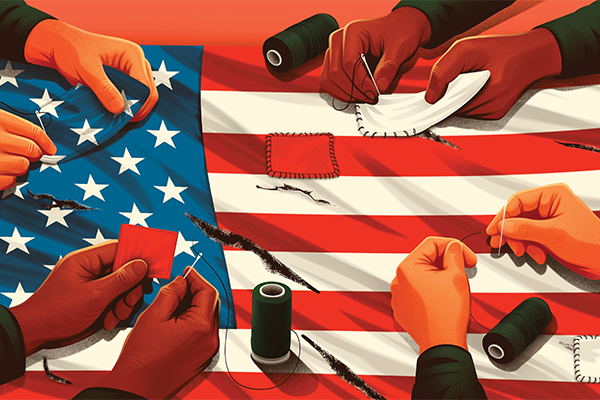
How do we commemorate the 250th birthday of the United States while resisting the extremes of either hubris and triumphalism or apathy and self-loathing? This semiquincentennial year arrives amid great peril and polarization: Our democratic freedoms and our system of checks and balances are under severe threat, distrust of institutions is pervasive, and even the term “democracy” has become fraught and partisan. So, perhaps one of the best and most unifying ways we can mark this birthday is to make this a year of civic renewal.
“Liberty and justice for all” is still an ideal worth celebrating.
This is about far more than the vital acts of voting and participating in elections. Civic renewal also includes the norms, practices, and actions that we can take every day to solve problems and advance the common good, from hyperlocal and community activities to state and national levels. According to the Democracy for All Project, a multiyear research initiative by the Kettering Foundation in partnership with Gallup, “while only one in four Americans believe the people’s role in the democratic process is working well, those who get involved in their communities and have meaningful civic education feel significantly more empowered to create change.” The project notes that “three in 10 (31%) have actively participated in organizations or groups aimed at improving community conditions in the past year” while “another 36% indicate they haven’t participated but have wanted to do so.” Authoritarianism gains traction when people feel powerless, exhausted, and demoralized. Closing this participation gap is critical for mitigating these forces and strengthening our democratic project.
From the perspective of Christian faith, civic renewal is a way to live out the call to truth-telling and loving our neighbors as ourselves. In a time when the full truth of our history is being contested and whitewashed, we must increasingly reckon with and teach the good, bad, and ugly parts. That truth-telling can happen in many ways—from writing letters to the editor or to our elected representatives to participating in freedom schools and civic education. We can love our neighbors through activism to defend and strengthen our democratic system and norms. Examples include advocating for local, state, and national legislation that protects and expands the right to vote and advocating against legislation such as the so-called “SAVE America Act,” which could disenfranchise millions of voters.
Authoritarianism gains traction when people feel powerless, exhausted, and demoralized.
Civic renewal also involves building bridges with people with different views, seeking to build greater empathy, understanding, and relationships in the process. Groups including the One America Movement and Braver Angels can help you get started. The Sojourners Faith and Practice Forum provides a suite of tools, resources, and curricula to help bridge divides and strengthen civic engagement in your congregation and community. Efforts to build greater belonging and break down our isolation—such as volunteering with a local community organization or joining a mutual aid network to care for vulnerable neighbors, including immigrants and people living in poverty—are also ways to support civic renewal.
One of the best 250th birthday presents we can give is to counter bombastic, nationalistic celebrations by practicing civic renewal. We can help our nation pursue “liberty and justice for all,” an ideal still worth celebrating.

Rev. Adam Russell Taylor is president of Sojourners and author of A More Perfect Union: A New Vision for Building the Beloved Community. Follow him on Bluesky @revadamtaylor.

Did this article have an impact on you? Tell us how! Whether you’re moved to take action, have a question, or want to share a comment (good or bad), we value your feedback!