SOME TRADITIONAL INTERPRETATIONS of parables that I grew up with leave me wanting. In particular, I can’t abide a God who is depicted as a vengeful king or a landowner with slaves—and I don’t think I’m wrong to feel uncomfortable here. What if the problem is not with the parables themselves, but with the way we have historically read them? Perhaps some of Jesus’ parables are less allegory and more Grapes of Wrath exposé.
Perhaps by exposing the brokenness of systems, Jesus is suggesting this: The kingdom—kin-dom—of God is not a mere improvement on the systems we serve today but a full reversal. (The systems should serve humanity, not the other way around!) God’s vision is fundamentally relational and always concerned with the well-being of the most vulnerable. Imagine it. What if kings were more like gardeners than landlords and cities were true refuges and parties were for everyone?
Reading the Bible faithfully has economic, physical, and political ramifications that ought not be reduced to a meaning that is “spiritual” only. This month’s scripture texts invite us to contemplate how radical it really is to love your neighbor. It can be uncomfortable to reread some of these texts through a liberation lens, but I believe it is the kind of discomfort that leads to transformation. Let’s explore these texts with fresh eyes, open minds, and receptive hearts, willing to hold the discomfort and willing to be reshaped by the word of God.
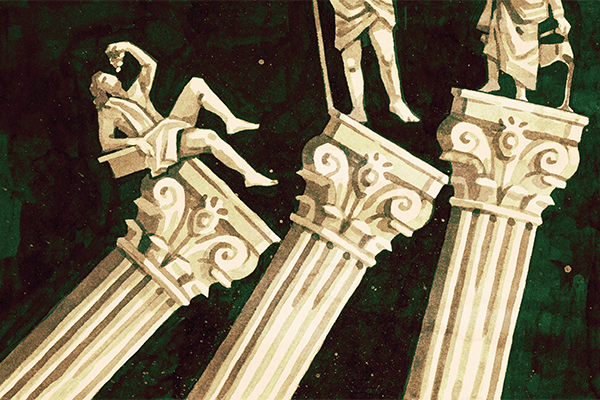
Some of Jesus’ parables are less allegory and more Grapes of Wrath exposé.
October 4
Good Grape, Bad Grape
Isaiah 5:1-7; Psalm 80:7-15; Philippians 3:4-14; Matthew 21:33-46
GOD IS LIKENED to a gardener in Isaiah 5 and Psalm 80. After God took such care to deliver the “vine” (i.e., the Hebrew people) from slavery in Egypt, the psalmist wants to know why the people are being ravaged again? Where has God’s protection gone, implores the psalmist? Imagine the Isaiah passage and the psalm in conversation. The problem, responds Isaiah, is that the Gardener took great care of the vineyard, but instead of producing good grapes, the vine produced rotten ones.
What does Isaiah mean by “rotten grapes” (verse 2)? God “expected justice, but saw bloodshed; righteousness, but heard a cry” (verse 7)! It is as if Isaiah replies to the psalmist, “Why should God continue to protect you when you have become the oppressors?” or as if God responds, “I cared for you, expecting you would, in turn, care for others, but you have not done so.”
At first glance, the parable in Matthew presents a similar theme, only God is likened to a landowner instead. However, comparing God to a slave-owning landlord rightly doesn’t land the same as picturing God as the gardener. Scholars such as William Herzog (in Parables as Subversive Speech) encourage us to read this parable not as a story about the character of God but as a story about the nature of unjust systems and the violence they perpetuate. Notice that the tenants—who were quite possibly indigenous farmers dispossessed of their ancestral lands—fight against the landlord’s slaves. This can be interpreted as the tenants revolting against the violence done to them by those who hoard wealth and land, but the revolt harms the landlord’s slaves, not the absentee landlord. Perhaps this parable reveals why Jesus arrived in Jerusalem like a “king” earlier in this chapter (verse 5). When the whole system is broken, people need a new way to revolt.
October 11
Dream a New World
Isaiah 25:1-9; Psalm 23; Philippians 4:1-9; Matthew 22:1-14
IF LAST WEEK’S Hebrew Bible passages were a frighteningly cautionary tale about what happens when God’s people produce bad fruit instead of justice, by contrast, this week’s Hebrew Bible texts are about the beauty that emerges when justice finally flourishes. The comfort and safety of the well-known Psalm 23 is complemented by the lesser-known Isaiah 25 in which God is praised for being a “refuge to the poor, a refuge to the needy in their distress, a shelter from the rainstorm and a shade from the heat” (verse 4). Isaiah describes a feast for all people, a place where death is swallowed up forever and tears and disgrace are wiped away.
However, Matthew’s parable of a strange, distorted wedding feast is not so lovely. I find it problematic to compare God to the king in this allegory—a king who returns violence for violence and condemns someone to suffer for wearing the wrong outfit. As New Testament scholar Stan Saunders wrote, “The scene is driven more by the king’s affronted honor than by any inclusive graciousness toward the little people who are now called to the banquet, as the final scene will make clear.” Perhaps this parable is a story that reveals the harsh, violent reality of a system beholden to power and prestige rather than kindness and compassion. The banquet in Matthew 22 decidedly does not become the refuge described in Isaiah 25, despite the guise of a wider welcome. The guest without a robe painfully discovers the welcome doesn’t really extend to him. Some interpreters transform this underdressed wedding guest into a metaphor. But what if we read the story as straightforward indictment? The world and its measurements of worth must change.
October 18
Modern Idolatry?
Isaiah 45:1-7; Psalm 96:1-13; 1 Thessalonians 1:1-10; Matthew 22:15-22
ONCE AGAIN, JESUS’ aim in Matthew 22 is to expose a broken system. The religious leaders want to trap Jesus with a trick question by forcing him to pick sides in a long-standing argument about whether paying taxes to Caesar is right or wrong. Instead of answering a binary question with a binary answer, Jesus challenges their assumptions, “Give therefore to Caesar the things that are Caesar’s and to God the things that are God’s” (verse 21). Perhaps what is wrong is not the individual person who either does or does not pay their taxes to Caesar. Instead, the unlawfulness is a system that demands such an accumulation of power and wealth for one man in the first place and the inherent idolatry therein.
All of the lectionary passages today address idolatry—the importance of turning away from idols and toward the one true God. Is there any greater threat to our world today than our subservience to the idols of wealth and power?
If I reimagine the religious leaders’ trick question for modern times, it might be, “Is it lawful to participate in this broken economy/system/institution/country?” If I’m being honest, it’s a real question I ask myself, though I don’t exactly know how not to participate in it. What happens if I think about that complex moral problem as Jesus suggests: “Give to the system the things that belong to the system and give to God the things that belong to God.” Then I start asking different questions: How much time, money, energy, and allegiance have I surrendered to the system? And what might it look like to return more of those things to God?
When the whole system is broken, people need a new way to revolt.
October 25
Economics of Love
Leviticus 19:1-2, 15-18; Psalm 1; 1 Thessalonians 2:1-8; Matthew 22:34-46
LEVITICUS GETS A bad rap, but we’d all do well to pay a little more attention to what God’s call to holiness looks like in Leviticus 19. Just this sentence alone: “You shall not stand idly by when the blood of your neighbor is at stake” (Leviticus 19:16) could be a wake-up call or the rallying cry of a revolution. Sections the lectionary skips bear repeating as well, such as “you shall not defraud your neighbor” and “you shall not keep for yourself the wages of a laborer” (Leviticus 19:13).
When asked what the greatest commandment is, Jesus quotes Leviticus: “Love your neighbor as yourself” (Leviticus 19:18; Matthew 22:39).
If we listen to Leviticus, “loving your neighbor” isn’t just about being polite. It’s about creating an equitable structure for mutual flourishing instead of contributing to an unjust system that accumulates wealth for the few while starving the many. In light of the parables earlier in Matthew, this understanding of neighbor-love is especially relevant.
Leviticus and Jesus assume that love of neighbor has economic consequences. You can’t love your neighbor while withholding fair wages. You can’t love your neighbor while benefiting from systems that exploit. You can’t love your neighbor while hoarding the wealth for yourself. You can’t love your neighbor while passively observing their oppression. To love your neighbor as yourself means you want the same treatment for others that you want for yourself.
The psalmist writes, “Happy are those ... [whose] delight is in the law of the Lord. ... They are like trees planted by streams of water, which yield their fruit in its season, and their leaves do not wither. In all that they do, they prosper” (1:1-3). I do not imagine this is a description of the lives of individuals, but the prosperity of entire communities.

Rev. Kyndall Rae Rothaus is a preacher, spiritual director, co-founder of Nevertheless She Preached, and author of Thy Queendom Come: Breaking Free from the Patriarchy to Save Your Soul.

Did this article have an impact on you? Tell us how! Whether you’re moved to take action, have a question, or want to share a comment (good or bad), we value your feedback!