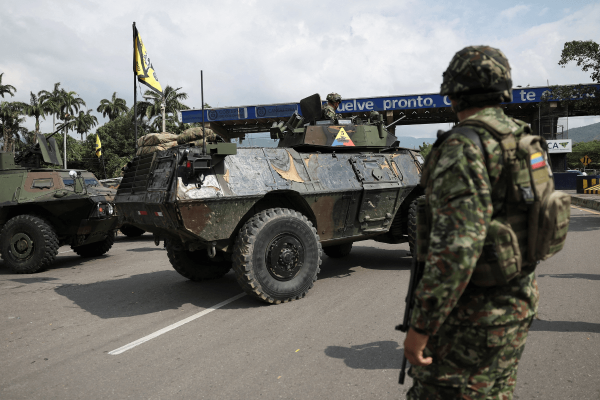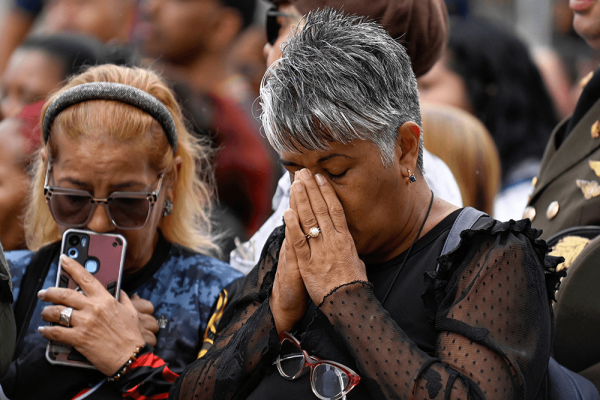
After the U.S. military’s abduction of Venezuelan President Nicolás Maduro, faith leaders are processing deep feelings of conflict, both with Maduro and with the U.S. intervention.
Rev. Ricardo Corzo Moreno is a Presbyterian pastor living in Caracas, Venezuela’s capital. Moreno’s apartment building is approximately one mile away from an air force base in La Carlota that was bombed in the attack. He described how shocked and terrified his neighborhood was as bombs started dropping and planes flew at low elevation over their buildings.
“After everything ended ... it was a total silence. Nobody went out in the street; everyone stayed in their buildings. For the next 24 to 48 hours, Caracas became like an empty city,” Moreno said. “A lot of churches here in Caracas, they decided to cancel Sunday service because people were afraid that something would start happening in the population.”
Moreno’s church cancelled service the Sunday after the attacks. They will hold an online service this Sunday, the 11th, and will continue to monitor the situation.
Rev. Antonio J. Gallardo is the bishop-elect of the Episcopal Diocese of Los Angeles and a Venezuelan American with family members living in the city of Barquisimeto, Venezuela. In a phone call with Sojourners, Gallardo said he “remains in tension” over what to feel since hearing of the U.S. raid in the early hours of Saturday morning.
Gallardo said many people he knows initially reacted with relief that Maduro had been ousted. “I want to join the joy of my people that live there. And I also am concerned about what the U.S. wants,” Gallardo said. “I don’t want Venezuela, or any country to become a colony of the U.S., right? So that’s a tension I live with.”
The overnight raid began late Friday, when U.S. forces captured Maduro and his wife, Cilia Flores. The military operation killed at least 80 people and followed U.S. strikes on more than 35 boats, killing more than 100 people in the region. The U.S. Constitution requires the president to consult Congress for acts of war, but the administration has claimed the capture amounted to “law enforcement” rather than military invasion.
Maduro, who succeeded President Hugo Chavez in 2013, has been accused of overseeing an increasingly autocratic regime responsible for numerous human rights violations. While some have been celebrating Maduro’s capture, there remain deep uncertainties as to whether life in Venezuela will actually improve for everyday citizens.
Supporting Venezuelans right “to determine their own destiny”
While recognizing the existence of “grave human rights violations” in Venezuela under Maduro, CELAM, the Catholic Council of Latin American Bishops, was quick to condemn the U.S. operation.
“In line with Catholic Social Teaching, we categorically reject any type of invasion or unilateral use of force that puts the right of any group of people to determine their own destiny at risk,” CELAM wrote in an online statement (translated from Spanish by Sojourners).
The general secretary of the World Council of Churches released a statement on Jan. 3 calling the U.S. attacks on Venezuela “stunningly flagrant violations of international law” that set a “dangerous precedent and example for others who seek to shrug off all constraints against the use of armed aggression and brute force to achieve political objectives.”
Speaking from St. Peter’s Square in the Vatican City on Sunday, Jan. 4, Pope Leo XIV said he was following the situation in Venezuela “with deep concern.”
“The good of the beloved Venezuelan people must prevail over every other consideration,” he said. “This must lead to the overcoming of violence, and to the pursuit of paths of justice and peace, guaranteeing the sovereignty of the country, ensuring the rule of law enshrined in its Constitution, respecting the human and civil rights of each and every person, and working together to build a peaceful future of cooperation, stability and harmony, with special attention to the poorest who are suffering because of the difficult economic situation.”
Elizabeth O’Donell Gandolfo, a professor of Latin American Studies at Wake Forest University, told Sojourners via email that claims that the U.S. will rule Venezuela after the capture of Maduro and Flores are “extreme extensions of more than a century of U.S. interference in Latin American political and economic affairs.” She sees the abduction of Maduro as connected to a long history of economic exploitation in Latin America, long criticized by Latin American theologians.
Borrowing language from theologian Walter Brueggemann, Gandolfo wrote she hopes to see a “prophetic denunciation” of the Trump administration’s “royal consciousness,” that defines the “violence, authoritarianism, and economic imperialism” throughout Latin America.
The Bartolome de las Casas Institute, a Peruvian organization founded by liberation theologian Gustavo Gutiérrez with the purpose of developing actively engaged citizens at the local and regional level in Latin America, published a statement condemning Maduro’s capture.
“The actions of the United States in Venezuela should be condemned without ambiguities” the statement (translated from Spanish by Sojourners) reads. “Not as an uncritical defense of any government, but as a firm positioning in favor of sovereignty, international law, and the lives of nations. The United States has not acted as a guarantor of freedom, but as an aggressor, and its historical responsibility will not be able to be hidden under any moral rhetoric.”
For Christians looking for clarity on how to react, Gallardo had this advice: “Try to find comfort in the scriptures, right? Because God has shown power. And then try to follow the advice and recommendations of those people who are the experts. Then try to get a better sense about the situation and what’s the most effective thing to do. And then pray a lot.”
Ripple effects
Moreno cautioned that a new era of U.S. interventionism is unlikely to stop in Venezuela.
“When you hear Mr. Trump, it’s not only about Venezuela. It’s Colombia, it’s Mexico, it’s Greenland ... He’s becoming like a Roman emperor who wants to impose his Pax Romana on the world, and as a person, I’m against that.” Moreno told Sojourners. “As a Christian, I want to be an agent of reconciliation, a bridge where people can come together, with no U.S.-directed interference in our country.”
Under Maduro, the economic and political crises have pushed many people out of Venezuela. In the past decade, nearly 8 million Venezuelans have left the country, mainly bound for other South American nations like Colombia, Peru, and Chile. According to 2024 reporting from the Miami Herald, as many as 40% of the Venezuelans who remained in the country at that time were also considering migrating elsewhere.
“You only need to have two Venezuelans together in a place to have three different opinions about politics or what’s going on in the country,” Moreno told Sojourners. “I don’t think there is any leader, any political leader in the country who will get the full support of the population.”
Venezuela held an election in 2024, which the opposition won according to independent investigators. However, Maduro has remained in power and claims victory in an election process that the U.S. State Department called “deeply flawed” in 2024.
Rev. Brian Strassburger is a Jesuit priest and the director of Del Camino Jesuit Border Ministries. He often works with migrants who left Venezuela because of the Maduro regime. Strassburger spoke to Sojourners via phone from a migrant shelter in Reynosa, Mexico, where he was visiting to celebrate Mass.
Strassburger said several people shared stories of newfound optimism. Many couldn’t think of any other way Maduro would have left power, he said. And yet, their feelings are complicated.
“When I shift [the question] to: ‘Okay, what now? How do you feel now?’ They don't feel great about the situation,” Strassburger told Sojourners. “They don't see it as a transition to greater democracy. They think that things are going to be really rough. They have family members who are in Venezuela who are scrambling to fill up their car with gas and buy groceries, because they don’t know what's going to happen to the economy in the coming days.”
Strassburger also noted the ripple effect Maduro’s ouster is having on migrants from other countries. When he offered up the prayer time for Venezuela, several Hondurans—processing the election of a Trump-aligned presidential candidate in Honduras—insisted on praying for their country too.
Strassburger was surprised by the hope he heard from those he celebrated Mass with. He’s had several tell him, “It's gonna be tougher now, but hopefully this will work out for the best.”
“I don’t necessarily share that optimism,” he said. “But the fact that they could maintain kind of that hopeful tone, I found surprising and encouraging.”
For Gallardo, he finds hope in the steady reminder that God is both present and active in the lives of all caught up in the unfolding situation.
“God is with the people of Venezuela,” he said. “God is with us, guiding us. So that gives me hope.”
EDITOR'S NOTE: An earlier version of this article stated that Rev. Moreno’s church would be holding services online for the foreseeable future. After publication, Moreno reached out to clarify they will hold an online service this Sunday, Jan. 11, and will continue to monitor the situation in the following weeks. The article was updated on Jan. 8, 2026.
Got something to say about what you're reading? We value your feedback!