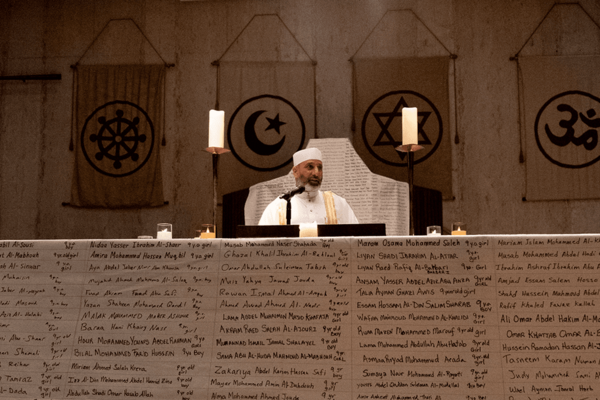
Earlier this month, a coalition of advocacy groups unveiled the Gaza Children’s Shroud, a linen assemblage bearing the names of 20,000 children killed in Gaza between October 2023 and August 2025—a staggering physical testament that when laid end-to-end, is 328 feet long. The names were handwritten by nearly 50 congregations and organizations across the U.S. and nine in Ireland, including churches, mosques, Buddhist centers, interfaith, and secular groups.
The Shroud is a collective effort by Priests Against Genocide, Doctors Against Genocide, and American Muslim nonprofit Justice for All. Imam Saffet Catovic, Justice for All’s director of U.N. operations, said Islamic tradition instructs mourners to shroud the dead in white cloth before announcing the names of the deceased, in order for them to be remembered and prayed for. The Shroud project is meant to honor the spirit of this tradition not only through the public exhibition of these names, but through the intimate act of inscribing each one.
Martha Thompson, a member of Doctors Against Genocide, helped facilitate inscription at her church, St. Cecilia Parish in Boston. She described the project as being one “against erasure,” propelling participants and viewers alike from remembrance towards further action.
The shroud was presented in New York City on Sept. 16, with an interfaith service and exhibition at the Church Center for the United Nations, a private Christian and interfaith center owned and operated by United Women in Faith (formerly United Methodist Women) supporting the human rights work of the U.N. Organizers behind the project hope its close proximity to the U.N., just days before world leaders arrive for the U.N. General Assembly, might push ambassadors and decision makers to confront the reality of these deaths.
“I hope they come and see these little shoes,” Rev. Dionne Boissière, the Chaplain of the Church Center, said. She looked down at a row of baby shoes that had been placed along the bottom of the shroud, symbolic of the lives lost. “I hope ... they will remember that there is human life behind the numbers, and that we are responsible for each other.”
The service, which included Quran and scripture readings, included Dr. Scott Hagaman, a key organizer for the shroud with DAG, who spoke about doctors in Gaza forced to conduct caesarean sections and pediatric amputations without access to anesthesia. During a reading of the poem “Write My Name” by Palestinian American poet Zeina Azzam, about Gazan parents who write their children's names on their legs so they can be identified if killed, attendees in keffiyehs wept in the chapel’s pews. Afterward, diplomats, nonprofit workers, clergy, and advocates were invited to inscribe a name of a child killed by an Israeli attack.
This June, an independent U.N. commission published a report that found a “consistent pattern of children being deliberately targeted by the Israeli security forces in Gaza.” Israel has called the report “defamatory” and a “libelous sham,” according to the French news wire Agence France-Presse.
Inscribing names on the shroud was inspired by a similar shroud in Italy that bore the names of 18,457 Gazan children killed in Gaza. Created by the group Carnia per la pace in the northeastern Italian town of Caneva di Tolmezzo, the Italian shroud was first unveiled at a demonstration against an Italy-Israel soccer match in Udine, Italy, on Oct. 14, 2025.
Following the lead of Carnia per la pace, the American-organized shroud has been a collective act of witness and remembrance, meant to express the weight of young lives taken. The 100-meter document was first presented on Sept. 1 at Philadelphia City Hall before being transported to New York. Children are listed by age, with each age spanning yards of cloth at a time: “Celia Musab Ahmed Al-Selakhi - 2”–“Hala Alaa Nabil Al-Sarsawi- 2”–“Lamar Ali Mahmoud Qashta - 2.” The names were verified by DAG, using data published by the Gaza Health Ministry and the Government Media Office in Gaza in 2025. It includes children with an official death certificate who were killed between October 2023 and August 2025—leaving aside thousands of missing children likely trapped under rubble and unaccounted for.
READ MORE: Israel Denies Entry to Delegation With Palestinian Liberation Theology Center
Members of Priests Against Genocide began working to remake the shroud in the U.S. in the spring, Catovic said. PAG approached him in hopes that Catovic could help ensure the shroud “honor[ed] the faith of those who were killed.” In figuring out how to put the memorial together, “there was a recognition by [DAG and PAG] that 98% of those children who were killed are Muslim.”
For Islamic burials, Catovic said, the dead should be shrouded in white material of natural fibers without stitching, which can be seen as symbolically tying the deceased to this world instead of ushering them into the next. In place of stitches, the shroud’s panels were fastened together using grommets. Muslim religious tradition, he said, instructs mourners to announce the names of the dead, remember them, and pray for them.
Inscribing these names is a continuation of this tradition and has been deeply meaningful to participants, including multiple families who have lost children in Gaza. In Paterson, N.J., Catovic said, some children at the Palestinian American Community Center wrote names of their relatives. But the act of handwriting a child’s name and age has moved those without family in Palestine too. “So many people just ended up in tears,” said Rev. Stephen Josoma of St. Susanna’s Parish in Dedham, Mass., where congregants volunteered to inscribe 1,000 names.
“I don’t think anybody really understood very much what it was going to feel like or what it would be like,” Thompson, who helped facilitate inscription at her church, St. Cecilia Parish, said. Before 20 minutes had gone by, “we had a line outside the door, and people were coming back and asking to write more names. And it was all done in silence.”
The experience was a “prayerful” entreaty towards further action against “erasure,” Thompson said. “I think it made people want to do more.”
In Ireland, Rev. Pat Colgan, director of Priests Against Genocide’s Ireland contingent, along with members of Irish groups Christians4Palestine and Gaels Against Genocide, organized signings of the shroud this year at nine different churches and community organizations across the country.
After the General Assembly, the coalition hopes to take the shroud to Washington, D.C., ahead of the midterm elections, after which the exhibition will spend nearly a year traveling around the U.S.
Catovic gestured to the UNGA building when asked of hopes for impact: “We wanted specifically to get the message across the street,” to heads of state gathering there, that “as a worldwide community, you have not done what you’re supposed to do.” In particular, Catovic said he hoped to hear names of Gazan children in speeches given at the General Assembly.
In some communities that have helped inscribe names, it’s seemed natural and necessary to invite their own children to participate. Catovic said families often incorporate their own religious context into discussions of what the shroud represents, explaining that those whose names are inked on the shroud are no longer with us, but with God. But that doesn’t mean hiding the truth—they didn’t just die, but were killed by somebody.
“I think the children can relate to the fact that there’s another child that was hurt and harmed,” Catovic said.
Thompson recalled what one mother at St. Cecilia told her: “I wanted my children to be here, to know what happens to other children.”
Editor’s note: This article was updated to correct the spelling of Celia Musab Ahmed Al-Selakhi’s name on Oct. 7, 2026.
“I wanted my children to be here, to know what happens to other children.” —Martha Thompson, Doctors Against Genocide
Sam Hsiaomei Lee is a photographer and journalist based in New York City, exploring topics of religion, politics, and culture, as well as questions of human rights and social justice.
Did this article have an impact on you? Tell us how! Whether you’re moved to take action, have a question, or want to share a comment (good or bad), we value your feedback!