Queer liberation theology has largely been ignored in many Catholic circles. It’s often treated as something external to the church, disconnected from Catholic history, or framed as a political identity that is incompatible with one’s identity in Christ. This has a lot to do with the Catholic voices that are deemed trustworthy and authoritative (especially on social media). Today, these voices dictate what questions we’re allowed to ask, and which sexual experiences are considered theologically orthodox (hint: the straight ones).
But as I recently wrote for National Catholic Reporter, queer liberation theology can help the Catholic church remember itself, recovering a tradition of radical solidarity that transcends our culture wars.
I grew up inside a fundamentalist, conservative Catholic bubble. In that world, queer liberation theology did not exist. Queer people were framed almost exclusively through spiritualized and moral language. “Love the sinner, hate the sin” was actually treated as an empathetic approach, even amid discussions about how to avoid attending a hypothetical relative’s same-sex marriage ceremony. Similarly, unwed mothers, women who’d had an abortion, or anyone whose life didn’t conform to church teaching were portrayed as sinners inherently incapable of making moral judgments.
When I began my gender transition, I stepped back from the church communities I had always known. I didn’t do this because I stopped caring about Catholicism. I did it because I needed space to survive. For me, deconstruction wasn’t about abandoning morality or Catholicism. It was about rethinking the rigid formula I’d been taught. It led me to move away from black-and-white checklists and toward discernment, responsibility, and care. One of the first things I went looking for was a church where I could show up exactly as I was. I wanted somewhere I could bring my messy questions, fears, hopes, and identity, which was still very much a work in progress.
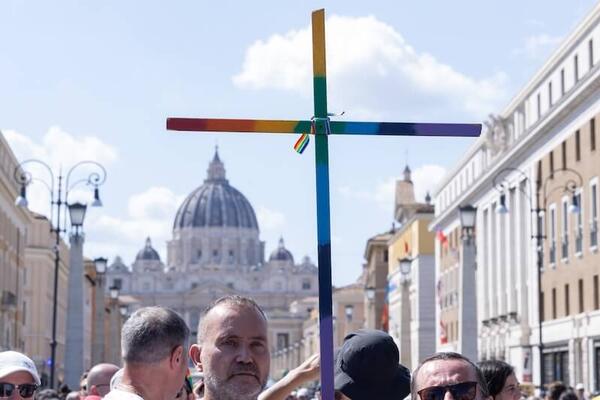
It was in Protestant spaces that I first found that kind of safety. I encountered the Metropolitan Community Churches, founded in 1968 and widely considered to be the first openly inclusive and gay affirming denomination in the U.S. I walked through their doors and saw a rainbow cross hanging above the sanctuary, and I was immediately welcomed with open arms. Affirming churches were engaging queer theology with a depth and honesty I had never encountered before.
Online, it was ex-vangelical communities—hashtags, shared language, long discussion threads—where I first heard people talk seriously about purity culture and spiritual abuse. So, even though I still identify as Catholic today, Protestant theology has had a profound impact on me. That spirituality nourished me at a moment when I needed it most.
But what I didn’t know then, I know now: There are Catholics who are deeply invested in the work of queer liberation theology, too.
Liberation theology was born in the wake of Vatican II, through the work of Peruvian-Dominican priest Gustavo Gutiérrez, who argued that theology must begin with the lived realities of the poor, oppressed, and excluded. This theological vision was embodied pastorally by figures like Óscar Romero, whose public witness and eventual martyrdom were reminders of what it looks like when the church sides openly with the vulnerable.
This approach would later be challenged by the Vatican when it emphasized the necessity of spiritual formation versus overt political activism. Discovering Catholic influences on queer liberation theology is what led me back to Catholicism.
John J. McNeill, an openly gay Jesuit priest, was raising the question of LGBTQ+ Catholic participation decades ago through a wide body of theological, pastoral, and psychological work. His publication of The Church and the Homosexual was a watershed moment, but it was part of a longer effort to push the church toward honest moral reckoning rather than silence or suppression. Writing more than a decade later, McNeill argued plainly that “there can be no valid moral debate on these issues that does not include lesbian and gay people as full participants,” insisting that dialogue was necessary precisely because the Holy Spirit speaks through the lived experience of queer Christians. His work illustrates the deeper question still facing Catholicism today: Will queer Catholics be treated merely as subjects of debate, or recognized as theologians, ministers, and leaders capable of helping shape the church itself?
READ MORE: Justin Giboney Wants Us to Stop Co-opting the Civil Rights Movement
Today, queer Catholic theologians such as Jason Steidl Jack and Flora X. Tang extend this tradition by engaging their Catholic faith through queer experience, showing that LGBTQ+ lives are sites of theological truth, resistance, and grace.
Thanks in part to Steidl Jack and Tang, I discovered a Catholicism that was far more expansive. They helped me realize that Catholicism contains robust social teaching that acts as a roadmap of what it means to embody the teachings of Jesus in public life. This is a Catholicism with a global history of colonialist projects and a rich tradition of liberation movements and struggles for justice. When contemporary nationalist ideologues try to flatten it into something rigid and exclusionary, they are engaging in erasure.
That is what drew me to queer liberation theology. Queer theology begins from a simple but radical assumption: Gender variance and queer desire have always existed, including within our sacred texts and faith traditions. The question isn’t whether queerness belongs in Christianity, but how long we’ve been ignoring the connections. Yet queer theology has mostly stayed on the margins of the Catholic church. In the U.S., the growing strain of nationalist, reactionary Catholicism has taken hold, in part, as a backlash to the openness of the Second Vatican Council. In the global church, there are places where openly identifying as LGBTQ+ is still illegal, and local bishops are unapologetically hostile to LGBTQ+ people. In this landscape, even a small step like Father James Martin founding Outreach—a Catholic site dedicated to welcoming LGBTQ+ people and discussing LGBTQ+ issues related to Catholicism—can feel radical. The Catholic church has yet to engage queer theology with the seriousness it deserves.
But even though queer liberation theology is not widely embraced among Catholics, Catholicism has the infrastructure and the history to connect it to this version of liberation theology. Moral theology, the primacy of conscience, Catholic social teaching, and the church’s long tradition of synodality all create space for lived experience to shape theological reflection.
But some progressive Catholics don’t know this history. Many see queer liberation as disconnected from the movements many Catholics are already involved in: labor and racial justice, civil rights, anti-war organizing, and advocacy for the poor. Too often, queer Catholics themselves are still poring over conservative websites and texts, trying to contort themselves into frameworks that were never designed to accommodate them. It reminds me of the late writer Toni Morrison’s line about racism: “The very serious function of racism … is distraction.” In the same way, endless arguments about whether queer people should be included in the church distract us from doing the work of organizing for justice.
Some queer Catholics want to assimilate quietly and want to avoid organizing for broader acceptance in the church. They don’t want to ruffle feathers. I understand that impulse—it’s often a survival strategy. But assimilation alone won’t save us. Conservative resistance to queer theology isn’t really about doctrine; it’s about the fear of what happens when morality and orthodoxy stop being reduced to heterosexuality and, instead, start centering the human need for love, belonging, and truth.
Catholics need to point to how queer liberation theology has impacted our own history, traditions, and movements. Importantly, queer Catholic liberation can’t remain a niche academic pursuit. It needs to become something Catholics can organize around the same way that people have organized around the Catholic Worker movement or the historic organizing around liberation theology in Latin America.
Catholics need to point to how queer liberation theology has impacted our own history, traditions, and movements.
Queer liberation theology isn’t foreign to Catholicism. It’s been here all along. The work now is connective—helping Catholics see that the theology capable of sustaining queer lives is the same theology that has always pushed the church closer to justice, honesty, and the radical love at the heart of the gospel.

Max Kuzma is a transgender man and lifelong Catholic who advocates for LGBTQ+ inclusion in the church and writes about the unique gifts of queer people and the beauty of diversity in God’s creation.
Did this article have an impact on you? Tell us how! Whether you’re moved to take action, have a question, or want to share a comment (good or bad), we value your feedback!