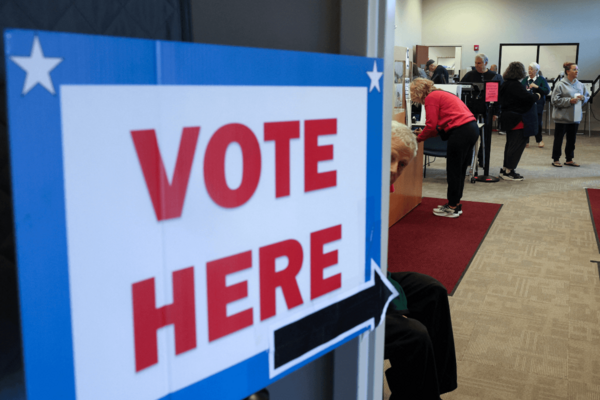
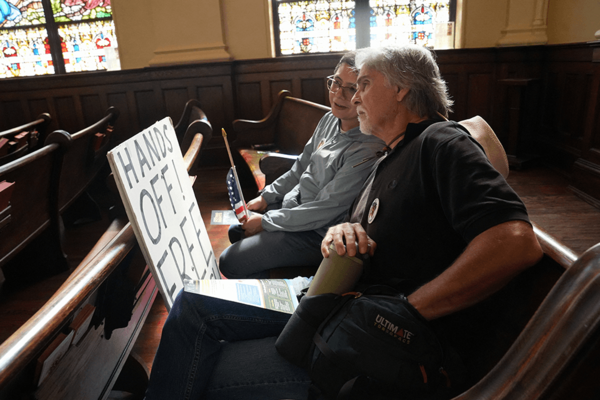
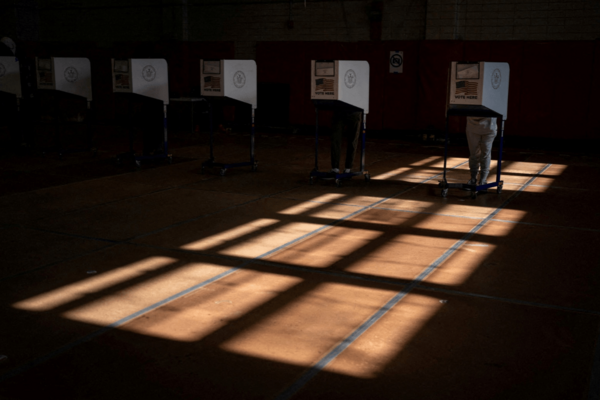
There’s a lot of buildup leading up to Election Day—and rightfully so. Many of us in the faith community have helped by volunteering as poll workers, serving as poll chaplains, working to “get out the vote,” and praying that all will be able to cast their ballot in fair elections.
But in the face of the threats and efforts we’ve seen to disrupt these elections, the hard work of preserving, strengthening, and ultimately transforming our democracy isn’t over on Election Day; it must continue through the post-election period to ensure that every vote is counted and certified, and that a new Congress is seated on Jan. 3, 2027. As Christians, we don’t engage in this process out of loyalty to a certain candidate or political party; instead, our loyalty is to a God who calls us to stand up for human dignity and advance the common good. During election season, that means ensuring voters have a right to decide their leaders—and shape our shared future.
In the 61 days between the midterms and Jan. 3, there are lots of ways we can help ensure the election results are honored and we see an orderly, peaceful transfer of power to the next Congress.
1. Stay informed with reliable information
In this post-election period, we may see floods of misinformation and disinformation that sow confusion, chaos, and uncertainty; think through where you will turn for accurate information. In a recent issue of Sojourners, journalism and religion professor Christina Littlefield offers practical tips to spot quality, reliable news in a media environment where a host of “news influencers, Substacks or blogs, and news sites, plus the rise of AI, makes it hard to discern what is factual and true.” Brush up on how to spot misleading information generated by AI. Set limits on your news intake and resist the temptation to constantly scroll—or share that sensational meme you haven’t verified. While it will be important to consume news, we can do so in ways that help us discern the truth.
And though I’ll admit I’m biased, you can also subscribe to Truth and Action Roundup, a newsletter first launched during the 2020 election by SojoAction, Sojourners’ mobilizing and advocacy team. During the post-election season, we’re sending it three times a week to provide trustworthy news and updates, calls to action, and spiritual inspiration. Get it free here.
261103 - Taylor, Voted, mail in ballots.png

2. Know what to expect
Learn what to expect about the post-election period and how to talk about it with your family, friends, community, and congregation. For example, it’s critical to remember that it may take a while to count the vote: Elections are run by state and local officials across more than 3,000 counties and 175,000 precincts, with nearly every ballot recorded on paper so a count can be easily checked. A longer count can mean a race is close and officials are checking their work—a standard and important part of the process. A longer count is also normal in states that have a high proportion of mail-in ballots, as well as states such as Pennsylvania, which by law doesn’t allow mail-in ballots to be counted until Election Day.
Based on what we’ve already seen the Trump administration say and do, we can also expect possible efforts to challenge the legitimate outcome of the election, including unsubstantiated allegations of voter fraud, seizing ballots, or declaring an emergency. That’s why we must be both clear and bold with our message that every eligible vote must be counted.
Protect Democracy, a nonpartisan, anti-authoritarianism group, put together an excellent guide to every phase of election season that outlines things you might hear, what they mean, and how to help others with questions they might have.
261103 - Taylor, Voted, count ballots.png

3. Call for every vote to be counted and certified
After ballots are cast, the votes are counted and a process called “canvassing” offers checks and balances to ensure they are counted accurately. We must insist that every eligible ballot is counted, especially in states such as California, where the counting and canvassing of ballots often takes longer.
Once the count has been “repeatedly verified,” Protect Democracy explains that county election officials are then mandated to certify the results, “not to verify the final vote count, but simply to sign off on the comprehensive verification process already performed.” It’s an official, administrative way to attest that the previous steps were completed.
However, the certification process has come under scrutiny since the 2020 presidential election, when Donald Trump and his allies tried—without success—to pressure local officials around the country not to certify the results. This year, Trump has doubled down on the lie of widespread voter fraud and has said he will only accept results that are “honest.” With many election deniers now occupying key election supervision roles across the country, it is imperative that we remain vigilant to ensure a smooth certification.
Officials charged with certifying the election need to hear from as many of the people who live in their jurisdiction as possible, with a clear message: Election certification is your duty—and it’s not optional. Your voice can make a difference by ensuring your certifiers hear that message. Faith Communities for Free and Fair Elections, a project of the nonpartisan group Powered By Faith, has a free tool for finding and contacting your election certifier by sending them an email.
261103 - Taylor, Voted, keep neighbors safe.png

4. Help keep neighbors safe
Learn how to engage in nonviolent community resistance and mutual aid. If Immigration and Customs Enforcement or other federal agents step up their presence in your community under a pretext of protecting the election results from ineligible voters, your solidarity with undocumented neighbors will be crucial. Organizations like the Catholic Legal Immigration Network, Inc. and the California Collaborative for Immigrant Justice have useful toolkits that can help you get started. For a deeper dive into the theory and proven methods of nonviolent resistance, try the Resistance Hub.
5. Stay spiritually grounded
This is likely to be a stressful season for us all. It brings to mind Galatians 6:9, one of my favorite verses in scripture: “Let us not become weary in doing good, for at the proper time we will reap a harvest if we do not give up.” But if we’re not giving up, we need to sustain ourselves and each other spiritually. That will look different for each of us, of course. For me, it looks like starting my day in prayer and reflecting on scripture. For someone else, it might look like connecting to God through running or music or reading a daily meditation or yoga or anything else that helps to center you in God’s presence and makes you feel closer to the divine.
At the end of the day, the way we get through another tumultuous and potentially volatile post-election period is by staying informed and showing up for one another. Voting and elections are an essential way that we pick our leaders and hold them accountable. Behind every vote is a person made in God’s image. Together, we can see to it that every eligible vote is counted. We must refuse to be manipulated, intimidated, or silenced. In this post-election period, we can all take concrete and increasingly courageous action to ensure that everyone’s freedoms are protected and our democracy prevails.

Rev. Adam Russell Taylor is president of Sojourners and author of A More Perfect Union: A New Vision for Building the Beloved Community. Follow him on Bluesky @revadamtaylor.
Did this article have an impact on you? Tell us how! Whether you’re moved to take action, have a question, or want to share a comment (good or bad), we value your feedback!