IN ADVENT, I remember and am grateful for all the prophets who show us the way of the divine. They invite us to remember and live out God’s command to love each other as much as we love God. I call to mind biblical scholar Walter Brueggemann, who passed away this year. He was a mentor, teacher, and colleague to many, including me. He taught us to prophetically reimagine a world where we challenge dominant and oppressive ideologies while compassionately re-envisioning a more just world. His magnanimous presence and prophetic words will be missed.
I also remember the young—led by Mary, the mother of Jesus—who invite us to be prophetic during adversity. With the guidance of Osvaldo D. Vena, we are invited to dream dreams in the joyous playground of God. Grounded in the abundance of God in our lives, I celebrate with Son Kyung Min’s praise song “Grace,” which I highly recommend for personal devotion and corporate worship services. The music grounds me in my faith and prompts me to remember how surrounded I am by God’s love.
As we approach the season of Christmas, let us pay close attention to the needs of our neighbors, especially our international students and immigrant neighbors. Every moment provides an opportunity for us to share the gift of the redemptive love of God.
December 7
Lament to Liberation
Isaiah 11:1-10; Psalm 72:1-7, 18-19; Romans 15:4-13; Matthew 3:1-12
I AM GRATEFUL for the opportunities I had to read Walter Brueggemann’s writing, listen to his lectures and sermons, and converse with him personally during his tenure at Columbia Theological Seminary. Among his many engaging books, The Prophetic Imagination is as relevant and important today as it was when it was published in 1978. Brueggemann’s approach to the prophetic in scripture begins with lament. Mourning enables oppressed communities to break free from denial and indifference. To break free reinvigorates hope—a hope that seeks liberation. As Brueggemann traces the history of the Israelites through the monarchical period, he warns about the temptation for formerly oppressed people to act in neocolonial ways themselves. Historically, when oppressed communities used violence to achieve dominance in a society, they also silenced dissent and subjugated ideological opponents. Brueggemann reminds us that the most effective rebuttal to oppressive action is to be in solidarity with marginalized and vulnerable people.
This year has been a rough one for prophets and those who seek to care for people who are poor and oppressed. And yet I hold on to the counter-dominant wisdom of our prophets, such as Brueggemann, who declared that “kings never seem able to silence the prophets for long.” As Isaiah 11:4 says, “with righteousness [God] shall judge for the poor and decide with equity for the oppressed of the earth.” I am grateful for modern-day prophets who, like John the Baptist in Matthew’s gospel, have been crying in the wilderness and preparing us to hear good news. I lift up all the unknown prophets welcoming the downtrodden, just as Christ has welcomed us (Romans 15:7).
“Kings never seem able to silence the prophets for long.”
December 14
Children Shall Lead
Isaiah 35:1-10; Luke 1:46-55; James 5:7-10; Matthew 11:2-11
MARY, THE MOTHER of Jesus, was a parthenos (“young girl”) when the angel declared that she was going to be the mother of the Savior. Some scholars surmise that she might have been as young as 12 to 14 years old. Young girls during the time of Mary were among the most vulnerable and oppressed people. They were “owned” by the patriarch of the family. On many occasions, they were traded or sold into marriage without their consent. Their voices were muted and overshadowed. And yet the gospel of Luke remembers and records the liberating poem of Mary, a young girl who believes that God’s redemption is at hand. God strengthened Mary’s hands, knees (Isaiah 35:3), and voice so that she is able to sing, shout, and lift up the Magnificat.
Osvaldo D. Vena’s book The Gospel and the Playground points out that we need to listen to and heed the prophetic voices of children and the young. Vena rereads the gospel of Mark from the perspective of the poetry of children from Israel, Palestine, and Argentina. Vena’s cultural, artistic, and intertextual hermeneutics helps us follow children into the joyous and liberating playground of the gospel.
Even in Mary’s vulnerable state, she declares that God has not abandoned her and her people. As part of the people whose only hope is God, Mary believes that God will lift up the lowly, feed the hungry, and liberate the oppressed (Luke 1:51-54). Mary’s declaration that she is also a descendant of Abraham (verse 55) and Sarah was an assurance that many children needed to hear at that time and still do today, especially in this season of Advent.
December 21
Centered on Grace
Isaiah 7:10-16; Psalm 80:1-7, 17-19; Romans 1:1-7; Matthew 1:18-25
IN MOMENTS OF chaos and despair, I intentionally recall times when I felt God’s presence deeply. As a missionary kid who grew up in the Philippines, I almost died from dengue fever when I was around 9 years old. My parents’ faith was tested. They feared their only child was about to die in the mission field. Death is around us all the time, but it feels different when a loved one is about to pass away. To this day, I thank God for the opportunity to live my full life. I relish the joy of getting old and living out my calling. My parents and I still reflect on that time. Yes, I say that God was with me, literally saving my life that day. And I am aware that I say that with caution and humility because being cured of dengue should not be equated with divine preferential treatment. My prayer was not favored over others. I do not know God’s plan.
I am passionate about my calling as a teacher and scholar because I have experienced God’s presence deeply. God has protected, guided, and healed me. With such divine love, which was given and received freely, I feel called to share God’s love with others.
These scriptures remind me of Son Kyung Min’s “Grace,” the Korean Christian praise song I mentioned earlier. It reminds me to center my life around the “fathomless grace” of God. Yes, I thank the advances in medicine that saved my young life, but I never take for granted how much God’s grace has saved me all the days of my life. What are your Immanuel moments? When have you experienced God’s presence deeply and fully?
Jesus and his parents were asylum-seeking migrants who found refuge in another nation.
December 28
Warnings From Angels
Isaiah 63:7-9; Psalm 148; Hebrews 2:10-18; Matthew 2:13-23
WHO IS OUR neighbor? This gospel question is at the heart of many current political troubles. The U.S. government decided that some “neighbors” from other countries are more acceptable than others, due to the color of their skin or the size of their bank account. Hating the other in the name of loving one’s community has become an ironic rallying cry.
At the seminary where I teach, many of the international students have been in a predicament about travel. During school breaks, they usually return home to visit family and to save money on housing costs here in Illinois. However, the harsh immigration climate in the U.S. is making travel difficult. So, the seminary invited our international students to remain on campus during their break and also collected funds to support their stay. Without fail, the community is manifesting a spirit of Christmas, a spirit of giving and gratefulness. That’s hospitality.
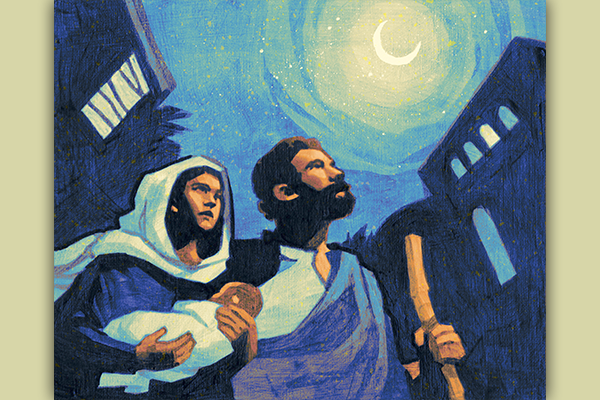
Matthew’s gospel reminds us that there are neighbors in our midst who are hiding, struggling, and hurting as a result of the new, cruel immigration policies. The writer of Matthew recalls the “massacre of the innocents,” a mass killing of children in and around Bethlehem by Herod the Great to destroy any potential threats to his power. In the deep of the night, an angel warned Mary and Joseph to escape with their child to Egypt until the slaughter was over. Jesus and his parents were asylum seekers who found refuge in a nation where their people had been formerly enslaved. In this season of welcome, we too remember those who are fleeing imperial raids. We can become the angels of God who witness, protect, warn, and show the path of safety and salvation to others.

Dong Hyeon Jeong is an associate professor of New Testament Interpretation at Garrett-Evangelical Theological Seminary in Illinois. He is the author of Embracing the Nonhuman in the Gospel of Mark.

Did this article have an impact on you? Tell us how! Whether you’re moved to take action, have a question, or want to share a comment (good or bad), we value your feedback!