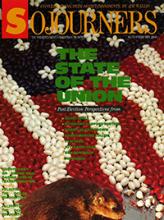
A FRIEND OF MINE WHO HAPPENS TO WORK ON WALL Street tells me that back in early September, when Dukakis was taking his nose dive in popularity, a private political newsletter aimed at the Wall Street crowd wrote that the only thing which could save the Democratic campaign was for the Duke to run on a platform of class-based, economic populism. Furthermore, the newsletter said, if the Democrats ran such a campaign the captains of finance should start worrying because it would work. The author recognized that somewhere among those statistics about declining real wages and two-job families without child care a deep popular anger existed about our era of supposed prosperity, and it was just waiting to be exploited.
About three weeks before the election, in a fit of apparent desperation, Michael Dukakis finally condescended to address the American people eye to eye. He came out with--what else?--a message of tub-thumping economic populism. And--surprise, surprise--it worked. In just over a week, he cut Bush's lead in half.
I think that's about all we need to know about the 1988 campaign. The American people didn't want to vote for George Bush. They were forced into his arms by the elitist technocrat at the top of the Democratic ticket who, until it was too late, betrayed no understanding of, or interest in, the felt needs and aspirations of average Americans.
The Bush victory will undoubtedly be read by some as further confirmation of the entrenched, and perhaps incurable, racism, jingoism, and selfishness of the vast white, middle-class sector of the American electorate. But let's break that down for a minute, starting with racism. George Bush ran a racist campaign. That's a fact. But Michael Dukakis ran a racist campaign, too. Dukakis' sins were mostly those of silence. His strategy, only slightly caricatured, was to pretend that black America, its problems and its spokesperson Jesse Jackson, simply didn't exist.
You don't counter racist tactics by ignoring them, or worse yet, by caving in to them. You have to stand up and fight them with the strong medicine of Judeo-Christian and American democratic values, prominent among which are equality, tolerance, and diversity. It helps if you can add to that brew a good dose of shared economic self-interest.
And speaking of American values, what about jingoism? That is, the George Bush foreign policy of "We're number one!" and "USA! USA!" The fact is that, as public opinion polls have confirmed repeatedly, the American people disagree with George Bush on foreign and military policy. They don't want their country mucking around with drug-running gun thugs in Central America or totalitarian racists in South Africa. They want defense spending held down.
But any potential revulsion the electorate might have felt at Bush's foreign policy record faded in a dewy-eyed mist over the Pledge of Allegiance. Dukakis insulted a large slice of the electorate when he seemed to find the whole Pledge of Allegiance flap just too corny for words. Then he compounded the problem by casting his arms control and non-interventionist policies solely in managerial and budgetary terms. He displayed no moral conviction that a less militaristic foreign policy would, to borrow Jesse Jackson's mantra, "make America stronger and make America better."
That leaves selfishness. Supposedly what we witnessed in November was a mandate for Reagan-era prosperity--an "I've got mine" vote. That's certainly true of the upper-income section of the populace which has in fact benefited from Reaganomics. But a majority of the American people haven't. That's what the Wall Street analyst was worried about.
PARTLY THE PROCESS IS skewed by the fact that such a high percentage of the affluent actually turn out to vote. Expanding the electorate is still a top priority. But it is also a fact that a lot of white, working-class people who voted for Bush voted against their economic self-interest. They were voting on values, or what the pundits call "cultural" issues. These range from gun control to prayer in the schools. But, by far, the biggest cultural issue is abortion.
The week after the election, economist Robert Kuttner astutely pointed out that the Democratic Party persists in putting forward presidential candidates who are culturally left and economically centrist, when, to succeed, they need to reverse those labels. Certainly any progressive, populist majority will have to include very heavy support from white, working-class Catholics, and that will never happen as long as Democratic politicians are completely one-sided and close-minded on abortion.
In my view the 1988 election was mostly a holding action. There was an opportunity for a credible, positive alternative to Reaganism to succeed. It didn't happen because the only candidate last year who even began to define such an alternative was a black man who has never held elected office. But the opening for something new under the American political sun remains, even in the Bush era.
There's an opening out there because America is faced with two looming long-term crises. One is economic. The current appearance of prosperity was, as Lloyd Bentsen said, purchased with hot checks. The real picture is one of long-term stagnation and a long-term decline in the standard of living for the majority.
The other crisis is cultural, a crisis of values. Much of what America was presumed to stand for--to put it crudely, the holy trinity of flag, family, and faith--was, often correctly, debunked in the 1960s. But no constructive vision of national identity and community life ever materialized to fill the vacuum. What's left in American culture is fragmentation, isolation, and withdrawal.
Nobody in American politics has sufficiently come to terms with these changed cultural and economic realities. The Right has successfully capitalized on cultural anomie, while hitching it to an economic policy aimed at keeping prosperity for the few at the expense of the many. The Left, such as it is, remains lost in the '60s, with a self-marginalizing cultural agenda and a distributionist economic perspective formed in the now-dead postwar economic expansion.
The interlocking of these twin crises presents an obvious opportunity for a populist movement aimed at rebuilding the fabric of American life, economic and cultural, on new terms. A progressive, anti-corporate, populist movement unashamedly rooted in the values of community, interdependence, and democracy could appeal to a broad population both on grounds of economic self-interest and of moral and democratic values.
One of Jesse Jackson's top aides said recently that the Jackson campaign of 1988 was, in fact, the first political event of the 1990s. I tend to think he was right. Whatever becomes of Jesse Jackson's career in the next decade, the American political future belongs to the movement that can define a cultural common ground based on the shared democratic values and economic interests of a multiracial, middle- and lower-income majority.
Danny Duncan Collum is a Sojourners contributing editor.
Got something to say about what you're reading? We value your feedback!