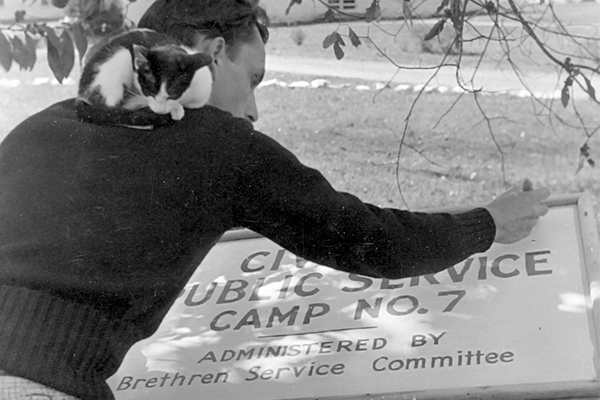
DURING WORLD WAR II, my grandmother worked as a nurse and office clerk at Civilian Public Service Camp No. 7 in Magnolia, Ark., the only one of more than 150 CPS work camps across the United States that exclusively held religious conscientious objectors to war.
In every war, people resist military service for reasons of religion or ethics. During the Civil War, COs were legally recognized but were imprisoned and tortured. During World War I, there were more than 20,000 registered COs; they too faced harsh treatment while imprisoned on military bases.
The historic peace churches (Brethren, Anabaptist, and Quaker) have long been recognized for refusing to serve in the military as a matter of religious freedom. A 1918 Church of the Brethren statement urged its members not to enlist in any service that compromises their pacifism: “The tenets of the church forbid military drilling, or learning the art or arts of war, or doing anything which contributes to the destruction of human life or property.”
In the run-up to WWII, the peace churches developed an alternative service program rigorous enough to be “the moral equivalent of war,” as Quaker Clarence Pickett put it. By executive order, President Roosevelt inaugurated a unique church-state partnership called Civilian Public Service (paid for by the peace churches) to accommodate “persons conscientiously opposed to combatant and non-combatant service in the land or naval forces of the United States.”
Most of the 407 men at Camp Magnolia were in their mid-20s and came from farming backgrounds. They dug ditches, terraced hillsides, planted trees, and cleared brush at the camp. They represented 20 Christian denominations—including Brethren, Methodist, Lutheran, Presbyterian, Jehovah’s Witness, Christadelphian, Holiness, Baptist, and Nazarene.
The draft ended in 1947 and was reestablished in 1948. Nearly 10,000 men were classified as COs at the end of the Korean War, and roughly 170,000 during the Vietnam War. Military service has been voluntary since 1973.
Secretary of Defense Pete Hegseth plans to change that. On Dec. 18 (as part of the 2026 National Defense Authorization Act), all men 18 to 25—citizen and noncitizen—will be automatically registered for military conscription. The Selective Service will have unprecedented access to personal information, such as from Social Security, IRS, Citizenship and Immigration Services, and driver’s license records.
This is not a draft. This is the precursor to a draft.
In May, Hegseth addressed U.S. military academy graduates, quoting Isaiah 6:8: “Then I heard the voice of the Lord saying, ‘Whom shall I send? And who will go for us?’ And I said, ‘Here I am, send me.’” He continued, “Four years ago, you raised your right hand; swore an oath to preserve and defend the Constitution, and ... you said to your country: Send me.” For Hegseth, reinstituting a military draft appears to be a federally funded “soul saving” project. But many Christians strongly believe otherwise.
Now is the time for our churches to publicly declare our conscientious objection to war—and train our youth in examining their conscience, completing CO paperwork, and filing their refusal to study the “art of war.”
The Center on Conscience & War provides CO training and counseling.
Editor’s note: This article originally misspelled Clarence Pickett’s name; the error has been corrected.

Rose Marie Berger, a Catholic peace activist and poet, is senior editor of Sojourners magazine. She is author ofBending the Arch: Poems.
Did this article have an impact on you? Tell us how! Whether you’re moved to take action, have a question, or want to share a comment (good or bad), we value your feedback!