Subscribe and Get Our New Book Subscribe

A Higher Law

Charles Finney held the conviction that the moral law announced in the Ten Commandments is both the ground and the goal of all human laws. He popularized the notion (soon to pervade the debates over slavery) that there is indeed a higher law than the Constitution of the United States. And he and his associates translated that principle into a denunciation of all laws and customs that exploit or abuse human beings—whether in the enslavement of black people, discrimination against women, land speculation that deprived newcomers of the privileges that earlier settlers had enjoyed, or in the exploitation of the poor that flowed from a single-minded pursuit of profits in business or industry.

These denunciations flowed directly from the book of Deuteronomy and from the prophets Amos and Hosea. In essays on Christian holiness written in 1839, Finney reminded his readers that the ideology of the free market was the creation of modern secular enterprise. The principle of love, he wrote, condemned those who believed that charging what the market will bear is somehow a Christian's privilege, implicit in the biblical sanction of private property. Indeed, right down to the beginning of the 19th century, Christian and Jewish ethical thinkers of all persuasions had waged unremitting warfare against this secular dogma spawned by the marketplace.

The doctrine of the higher law also challenged the pretensions of the modern nation state. Amoral nationalism contradicted both the promise of the Old Testament and the call of the New for a world order grounded upon the laws of God. In Finney's view to "fulfill the law of Christ" (Galatians 6:2) was to begin living now by the rules of that kingdom in which neither male, female, Greek, Jew, Roman, nor barbarian is an outsider. In that emerging kingdom, discrimination on account of either race or nationality would be abolished, as would the human and economic desolation of warfare.

Finney speaks to us today because he recognized the personal character of the spirituality that unites individual with social salvation. From his earliest days to his last breath, this champion of all kinds of social reforms—aid to dependent and unwed mothers, restraints upon liquor traffic, freedom for the slaves, free public education, justice for land-hungry settlers, peace among nations, and the liberty of women to share in the spiritual leadership of the church—insisted that the primary task of those who would change the world must ever remain in the conversion of sinners through preaching the gospel in the power of the Holy Spirit.

Secular-minded scholars often fault this setting of priorities by one whom they admire for his uncompromising stand against social evils. But Finney, immersed in Scripture and drawn throughout his life to the quest of holiness in his own heart and life, understood the spiritual sources of social regeneration precisely because he saw the biblical connections between God's grace, individual accountability, and the covenants of righteousness that are the focus of sacred history.

Good men and women are, in his understanding of biblical promises, bound to work in every way for a righteous society. Sustained by the grace that affirms their moral freedom, inspired by the hope of God's kingdom coming and God's will being done on earth, they know that mere understanding of social problems or human laws prescribing technical justice cannot bring shalom. Peace and wholeness for humanity require men and women who are willing to go those millions of second miles that Christians must travel to relieve the hurts and angers that no legislation can heal.

What once seemed to historians an inescapable tug-of-war between unworldly spirituality and social realism, between "piety and moralism," generated, in Finney's case as in those of many others who sought to follow Christ completely, a dawning awareness that individual regeneration and the redemption of human society were two parts of a single task. He was a man for his times, to be sure. He is also, because of his firm grasp of who Jesus was and what the Scriptures taught, someone for ours.

When this article appeared, Timothy Smith was professor of history and director of the Program in American Religious History at the Johns Hopkins University, and his book Revivalism and Social Reform had recently been reissued in paperback at the Johns Hopkins University Press.

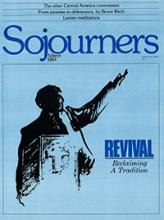
This appears in the March 1984 issue of Sojourners