WE OFTEN WEIGH the cost of speaking up, considering the potential pitfalls of revealing our real thoughts or feelings when we think doing so carries risk. But do we consider carefully enough the cost of staying silent? And do we factor in the potential benefits of revealing our true selves?
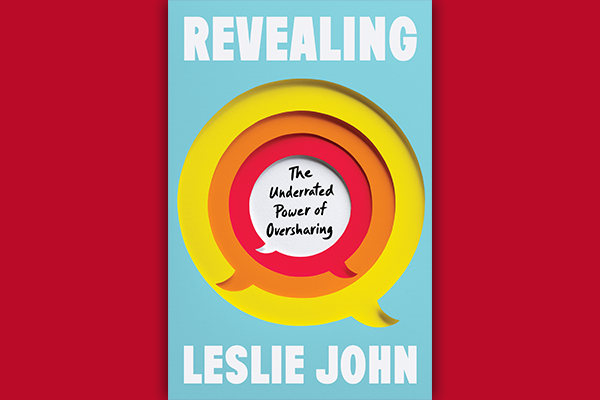
These are questions Harvard Business School professor Leslie John explores in Revealing. Walking the “gossamer-thin line” between offering too much information (“TMI”) and too little information (which John dubs “TLI”) is tricky. While many worry about sharing TMI, John sees TLI as a “persistent, under-recognized problem.”
Drawing on psychological research, game theory, and personal stories, John shows how we might embrace a practice of “thoughtful revealing” that “builds trust [and] deepens connection.” She invites readers to examine the reasons for concealing thoughts or feelings and to think more analytically about what we want to share. If we learn to engage our various “disclosure dilemmas” in this way, we tend to “feel better about whatever [we] choose.”
In the last four chapters, John explores disclosure dilemmas in friendship, romance, work, and leadership. She shares, for example, about her decision to disclose her previous divorce while on a second date with the man who would become her second husband. Though she was nervous to share this, he was undisturbed by the revelation and reciprocated her vulnerability by disclosing a sensitive story from his own life. In another example, John describes how a former colleague, Christine, decided not to disclose in her initial employment interview that she had a condition called retinitis pigmentosa and was legally blind. Once Christine was hired, she initiated the necessary conversations to obtain the accommodations she would need; it was then that she felt safe to do so.
As a Christian, I read Revealing and thought about how the words “authenticity” and “vulnerability” are buzzwords in some church communities. “We are a safe place where people can be themselves,” a church website might claim. Or a pastor might preach that greater vulnerability in the church will allow more healing. While authenticity and vulnerability are qualities appropriate to deepening relationships, they can be also be cultivated in some settings to exploit the wounded or abuse religious power. Spiritual leaders often come to know more about the personal lives of their congregants than vice versa. In the absence of strong accountability structures, this power differential can lead to all kinds of evil.
John’s approach guards against abuse of power. She respects and encourages the agency of each person to choose what they want to reveal or conceal (and when, how, and why). Revealing shows how we might engage with openness in ways that feel—and are—empowering, helping us gain clarity about our own goals rather than making us easily manipulated to serve someone else’s goals.
John suggests that while opening up involves real risk, risk is also where life’s greatest rewards are found. If Jesus came so that we might have “life abundantly,” then perhaps people of faith are invited to examine our hesitancy to reveal our true selves—and to see what possibilities for clarity, connection, and justice may lie on the other side.

Liz Cooledge Jenkins is the Seattle-based author of Nice Churchy Patriarchy and the forthcoming Maybe We Could Pray Again (Broadleaf, Spring 2027). She blogs at growingintokinship.substack.com.

Did this article have an impact on you? Tell us how! Whether you’re moved to take action, have a question, or want to share a comment (good or bad), we value your feedback!