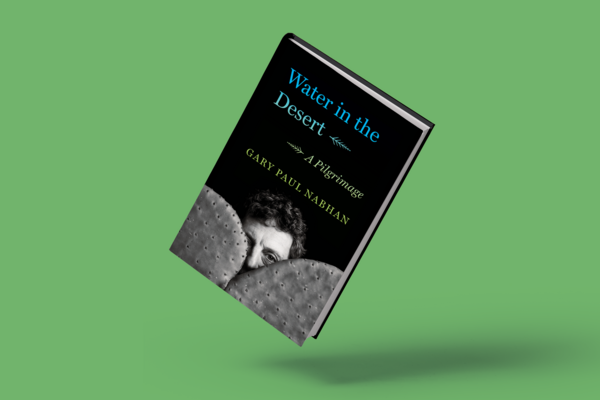
I CAN’T REMEMBER where I first came across the term “eco-autobiography.” But, like a longspine sandbur stuck to my sock, it’s a word that I can’t let go of.
Eco-autobiography narrates one’s life in relationship to land, ancestors, and the more-than-human world. It includes both the good, those literal mountaintop moments of connection to creation, and the bad, those moments when one encounters the destruction of a beloved tract of land or water.
Gary Paul Nabhan’s Water in the Desert is a master class on how to write a spiritual eco-autobiography.
Nabhan is an ecologist, writer, and Ecumenical Franciscan brother who has spent his life learning from and advocating for threatened, sacred places and the communities—most often Indigenous—who care for those places.
Early in his life, Nabhan was shaped by Tiburón Island in the Gulf of California, which he describes as an “ecotone, meaning a place rife with ecological edge effects.” An ecological edge effect occurs where two ecosystems meet, and, because of that overlap, life becomes more abundant and dynamic. “It was exactly the kind of place where I felt most at home,” he writes.
Nabhan’s life is a sort of ecotone: It is lived at the confluence of several streams of identity and experience. He is first-generation Lebanese American who grew up in the industrial Midwest. He is both a scientist and a contemplative.
A spiritual eco-autobiography asks different questions than a standard memoir.
Autobiography, at its best, does not merely recount events; it reorders perception. It has a specular quality that invites readers into deeper attention to their own lives. We see where our lives resonate and where there are gaps between the dull life one is living and the lustrous life of the author.
I resonate with much of Water in the Desert: I’m drawn to the same authors Nabhan references (Pierre Teilhard de Chardin and N. Scott Momaday, for starters); I feel a weird connection with plants; and I’ve felt most alive at the meeting point of ecology and theology.
And still, there are aspects of Nabhan’s life that inspire me to change my way of living. Nabhan spends his time with Indigenous communities, sitting at their feet to learn. Too often, I think reading the book is enough. Nabhan cultivates practices of ecological attention, such as seed-saving, long walks in arid borderlands, and careful listening to elders. He binds contemplation to advocacy and grafts reverence onto restoration. His spirituality is irrigated by soil, rain, and relationship.
He lives an integrated life of contemplation and action that I aspire to.
A spiritual eco-autobiography asks different questions than a standard memoir. Not simply, “What happened to me?” But also, “Where have I been placed? What landscapes have shaped my soul? What creatures have made a claim on my life?”
Maybe that’s why the word eco-autobiography won’t let go of me. It clings like a sandbur because the land is always in me, and I am always in the land. To tell the story of oneself without that grounding ignores a fundamental truth about human life: Our story can only ever be told through the places that have shaped us.

Avery Davis Lamb is an activist, ecologist, and public theologian working at the intersection of Christianity and environmental justice. He is the executive director of Creation Justice, whose mission is to educate, equip and mobilize Christians to protect, restore, and rightly share God's creation.
Did this article have an impact on you? Tell us how! Whether you’re moved to take action, have a question, or want to share a comment (good or bad), we value your feedback!