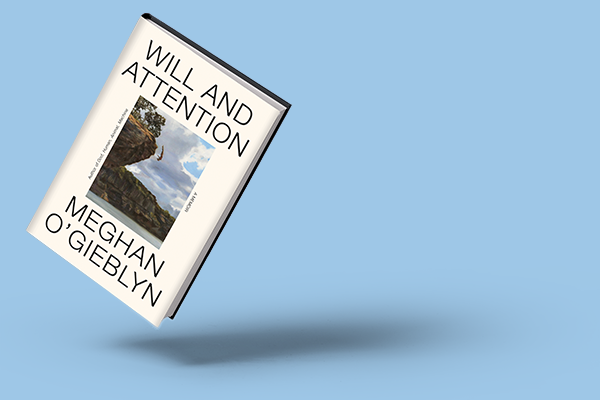
FOR THE ANCIENT Greeks, to know better was to do better. The possession of right knowledge would inevitably lead to right action.
“This idea is totally alien to me—I don’t understand it at all,” writes essayist Meghan O’Gieblyn in her bracing new memoir of addiction, Will and Attention. “What I understand is the bewilderment of the apostle Paul in his letter to the Romans: ‘I do not understand what I do. For what I want to do I do not do, but what I hate I do.’”
After leaving behind her fundamentalist evangelical upbringing, O’Gieblyn finds herself drawn back to faith in her late 30s, when she begins to attend Catholic Mass and keeps it from her husband. This brief, secretive return to religion prefigures her return to alcohol, from which she’d been sober for more than a decade. For the author, both events represent a lapse of the will. She ends up giving in to the two things she had spent her adult life resisting, bifurcating her life and mind. “I felt like a marine crustacean whose shell remains on shore, a solid proxy for its being, while the animal inside slithers off into the sea,” she writes.
“Memoir” may be too limiting of a category for the kind of book O’Gieblyn has written. Will and Attention is a raw account of the author’s mid-life relapse, rich in first-person detail like any good memoir. It’s also a probing examination of the concept of the will itself.
“It’s baffling to me that we use the same word to describe two seemingly contradictory things,” she writes. “To say that someone has a strong will means that she desires fiercely. Or it means that she has conquered her desires and is no longer their servant.” This contradiction hovers over O’Gieblyn as she strives to quit drinking, again, and orient her life toward the good.
This brief, secretive return to religion prefigures her return to alcohol.
One of the thrills of this book is the sheer range of religious and philosophical texts O’Gieblyn scours for answers—or for the kind of wisdom you can get only after answers make themselves scarce. She draws on the severe and complicated writings of French ascetic Simone Weil. She also converses with Augustine, Meister Eckhart, Julian of Norwich, Pliny the Elder, Dante, Carl Jung, T.S. Eliot, Arthur Schopenhauer, and Iris Murdoch, among others. O’Gieblyn’s reading of these thinkers is personal and exacting; she plays both seeker and skeptic.
The book title is drawn from a quote by Weil: “We have to try to cure our faults by attention and not by will.” For Weil, paying attention—to anything, the particular object was not supremely important to her—was a form of prayer that could lead to transformation where the will fails. “It’s a willingness to remain at the doorstep of truth, without consolation or reward, to ignore the voice that is constantly whispering in your ear that there’s something better around the next corner,” O’Gieblyn writes.
The writer takes her teacher’s advice, diligently combing through her own mind and reverently regarding the beauty around her: her husband’s steadfastness as she confesses on the kitchen floor, the flocks of swans descending on Lake Michigan like “billowing bridal veils.”
Will and Attention is an extraordinary exercise in paying attention. There’s unlikely to be anything quite like it around the next corner.

Did this article have an impact on you? Tell us how! Whether you’re moved to take action, have a question, or want to share a comment (good or bad), we value your feedback!