
One night after working a college basketball game, I stopped to use the restroom before heading out of the arena and making the drive home. I pushed on the heavy, gray door and found that it was locked.
Uh-oh. This isn’t good.
Neither were my options.
I could wander around the arena hoping to find an unlocked restroom; they might all be locked by now. I could try to make it home — probably wouldn’t work. As I stood in front of the locked door trying to decide what to do, I heard a woman’s voice from down the hall.
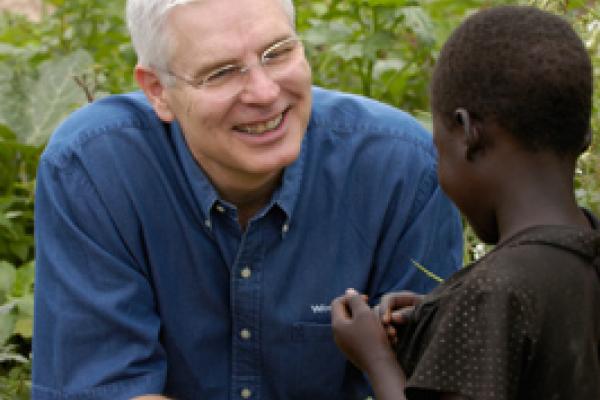
In an attempt to create unity, World Vision managed to create a hornet’s nest around the issue of same-sex marriage. Its president Rich Stearns openly acknowledges the mistakes the relief organization made while flip-flopping on the issue.
Earlier this week, the World Vision announced that it would allow employees to be in same-sex marriages. Within 48 hours, the $1 billion Christian organization reversed course, saying on Wednesday that it had made a mistake. The backlash illustrated how evangelicals will continue to wrestle with a growing cultural acceptance of same-sex marriage.
In an interview with RNS on Thursday, Stearns suggested that the number of sponsors lost was under but around 5,000. Those who sponsor a child pay $35 each month, so the loss could have tallied up to $2.1 million a year.
Stearns also spoke with RNS on how the decision and its reversal has impacted the organization, the number of staff who have resigned and the regret he has had this week. Some answers have been edited for length and clarity.

As preoccupied as I get with working, I love the deadly sin of sloth.
Rather, I love to think that I’m above it. I value hard work and I work hard. I judge my days by my to-do lists and the number of items crossed off at the end of the day. It doesn’t matter if my lists are for work during the day, relaxing in the evenings, or even my time off.
On Saturdays I have a list of friends I need to email and get-togethers I want to plan for the coming week. Usually reading at least one chapter of a book makes the list. So do the normal chores of tidying my room and doing the week’s laundry. Not to mention the long list of news articles or theological blog posts I have constantly open on my computer for reading at any resting moment.
And that’s what my rest looks like.
Now that I’ve made myself look like an industrious and hardworking person, let me be the first to say these lists don’t get done. Note I didn’t say they sometimes don’t get finished. I never finish them.

Millennials are the worst generation ever, a recent study by the Pew Research Center confirmed. The other generations already knew that, of course, but the study has given them new insights into what characterizes me and my fellow Millennials beyond “They freaking love Starbucks” and “They refuse to move out of my basement.”
The study’s revelations include that we’re not making all that much money, we have tons of debt, we’re racially diverse, and we use the Internet a lot (curiously absent was the fact that 97 percent of us do not like being broadly defined or labeled or otherwise demographed). We also tend to shun institutions, including religious ones, at rates far surpassing our parents and grandparents.
This last little detail has not escaped the notice of conservative media outlets, whose reactions have ranged from cautious reserved judgment to something bordering on full-blown alarm.
Like a true Millennial, I don’t think things are all that bad (heck, I wouldn’t know where the panic button is even if I wanted to press it). Actually, as a Christian, I think there is a lot to be excited about in the generation that’s poised to inherit the world … after we move out of our parents’ houses, that is.

Andrew Bird is one of my favorite musicians. I love the way he makes a one-man band, looping over his own violin playing, singing, whistling, and stomping to create beautiful songs. No two live performances are the same. And once, when I saw him in D.C., he played a new song that was still being written — one that had come from his heart, but he hadn’t yet finished and didn’t think it had an end.
He told us he wrote the song during the BP oil spill, often called “Deepwater Horizon,” that happened in the Gulf of Mexico. During that disaster, over 200 million gallons of crude oil spewed into the Gulf for days on end from a hole nobody could plug, and the whole country watched it happening live.

I’ll begin by cutting to the chase: Forget most of what you’ve read about Darren Aronofsky’s new film, Noah. It opens Friday. Go see it and decide for yourself.
Having said that, in my opinion Aronofksy’s Noah is a beautiful, powerful, difficult film worthy of the “epic” label. A vivid, visually spectacular reimagining of an ancient story held as sacred by all three Abrahamic religious traditions, it also is the most spiritually nuanced, exquisitely articulated exploration of the ideas of justice and mercy I’ve ever seen on a movie screen.
And despite what you may have heard elsewhere, Noah is deeply, passionately biblical.

I think what lies at the heart of the mix-up between jealousy and envy is not only the result of many of us zoning out during English class, but may also be a consequence of the way our culture objectifies people. An easy example of cultural objectification is the way women are often portrayed in movies, TV shows, ads, and other forms of media. Women are often the passive recipients of a man’s sexual desire, a designer’s clothing, or a corporation’s product. The message communicated through these portrayals is that women are not people who have dignity, but are objects waiting, and wanting, to be used. Other examples of objectification are bountiful and are sadly all too common in our world.
The objectification of another human being runs directly counter to the Gospel message. By virtue of the fact that all people are created by God — and even made in God’s image, as we are told in Genesis 1:27 — all humans possess a God-given dignity that should not be overlooked. This dignity includes being seen as a unique person with whom a relationship can be nurtured, the ability to lead and contribute to a community, and just being valued and loved for the very fact that the person is God’s creation.