For many, including myself, the past few weeks have been discouraging, given the state of our politics and culture and what many vulnerable people across the country are experiencing. But despite the frustration and even grief sometimes I have been reminded of the importance of “saving faith.”
My favorite Twitter response last week said this, “If all American Christians behaved as you do, I wouldn’t have to be such a huge a**hole of an atheist.” (Edits mine.) It came in response to a column I wrote about the new film, 12 Years A Slave (see it if you haven’t yet!), the continuing realities of racism in America that we still tolerate, and the need for churches to provide leadership in the changing demographics of the country by becoming the multiracial faith communities we were intended to be.
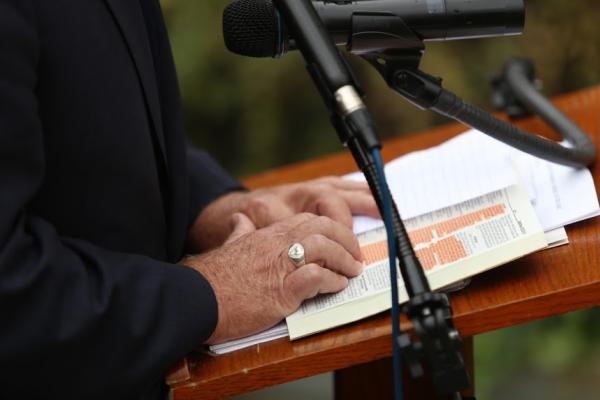
The week before saw many of faith leaders, pastors, and young people out in the rain at the U.S. Capitol during the government shutdown in a “Faithful Filibuster,” reading each day through the 2,000 verses in the Bible that speak of how we should treat the poor and vulnerable. One of those nights a family friend, the father of one of the boys I have coached in Little League baseball, came over to our house. He said, “You know I am an atheist, but I really admire what you are doing at the Capitol — that’s what Christians ought to be doing.”
Right after the government shutdown ended, Sojourners had our annual staff orientation. The program included each staff member telling their story of when and why they came to join us. Listening carefully, I was struck by how many Sojourners staffers recalled times in their lives when they were about to lose their faith, but rediscovered it after stumbling upon Sojourners. In my remarks to them that day, I also told stories of a few of the legion of people who have told me over the years of how they had lost or were about to lose their faith until they heard the messages about a faith that does justice.
It has all reminded me again how Sojourners began.
American Promise spans 13 years as Joe Brewster and Michèle Stephenson, middle-class African-American parents in Brooklyn, N.Y., turn their cameras on their son, Idris, and his best friend, Seun, who make their way through one of the most prestigious private schools in the country. Chronicling the boys’ divergent paths from kindergarten through high school graduation at Manhattan’s Dalton School, the documentary presents complicated truths about America’s struggle to come of age on issues of race, class, and opportunity. American Promise is an Official Selection of the 2013 Sundance Film Festival.

As if it wasn’t chilling enough to learn that NSA cronies are poring over your web browser history, now we discover that Barack Obama sits in bed at night and listens in on German Chancellor Angela Merkel’s cell phone calls to Domino’s.
Okay, maybe those are a bit of a stretch, but quite a buzz has been generated as of late about the revelation that the United States does, indeed, monitor the communications of leaders from allied nations, including the cell phone activity of Chancellor Merkel. For some, the collective reaction has been more of a collective shrug, as if such impositions should be expected from a global superpower that generally prefers to maintain that status. But for others, there’s a clear sense of shock and outrage.
For starters, let's clarify: nations cannot be friends.
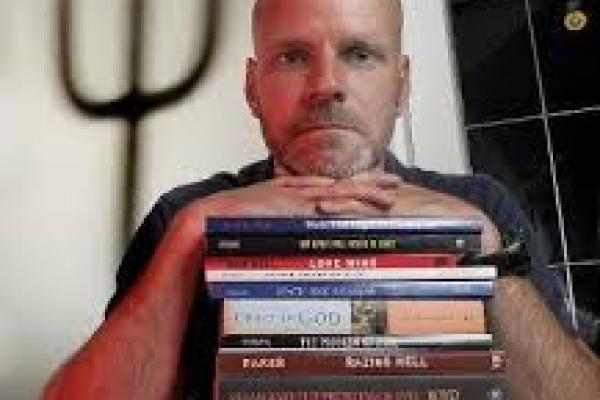
This year we are presenting the Raven Award on Nov. 12 to Kevin Miller for his documentary with a question for a title: Hellbound?. Autocorrect doesn’t like the question mark, especially when it’s followed by a period, but I’m glad Kevin used it. Because the idea of hell raises all kinds of questions, particularly about the relationship of God to sin. (For Adam, it raises questions about God’s justice – read his reflections here.) For me, the idea of hell raises questions about punishment, like these:
Does God punish sin in this life and if so, how?
Does God punish unrepentant sinners in the next life with eternal suffering?
These questions have corollaries, of course:
Does God reward the righteous in this life and if so, how?
Does God reward a life of righteousness with eternal bliss?

AshleyMadison.com is an online dating site that boasts millions of users worldwide. While online dating has become commonplace in today’s wired society, AshleyMadison has added a shocking twist to what has become mundane. Rather than promising to join together singles of similar faiths and interests, AshleyMadison.com is an online site for married people seeking extramarital relations. Its tagline is simple: “Life is Short. Have an Affair.”
The majority of Americans view adultery as wrong, which, by extrapolation, means that most Americans can see the glaring immorality in AshleyMadison’s business model. There are, however, many more reasons beside adultery to be concerned with AshleyMadison’s creation and far-reaching success.
The founder and CEO of AshleyMadison.com, Noel Biderman, has been “happily married” for ten years to his wife, Amanda, and they have two children. Both he and his wife confess they would be “devastated” if the other used the website’s services. When asked how she felt when Biderman first presented his idea for the website to her, Amanda recalled feeling concerned, thinking the idea implied something unhealthy about Biderman. However, once Amanda realized that it was a “sound business, that there was an [underserved] market,” she was “totally behind” the website’s creation.
The Bidermans actually see the website as altruistic: they believe that an affair can save a marriage.
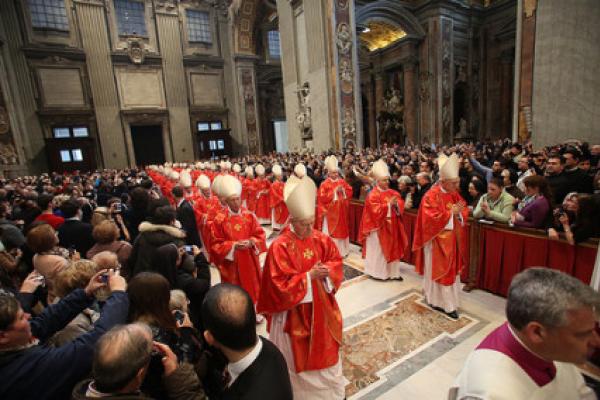
The National Security Agency spied on cardinals as they prepared to select the new pope — perhaps including even Cardinal Jorge Bergoglio, who emerged from last spring’s conclave as Pope Francis, a leading Italian news magazine reported in Wednesday’s editions.
Pope Francis still lives in the guesthouse, but the magazine did not speculate whether the phones there were still tapped.

It last happened in 1888 and, according to one calculation, won’t happen again for another 77,798 years: the convergence of Thanksgiving and Hanukkah.
This year, Nov. 28 is Thanksgiving and the first full day of the eight-day Jewish festival of lights, which begins at sundown the previous night.
For many Jewish Americans, this is no trivial convergence, but a once-in-an-eternity opportunity to simultaneously celebrate two favorite holidays, one quintessentially American, the other quintessentially Jewish.