
At the 2012 Wild Goose, for an afternoon set at a tent tucked away on the backwoods of the festival site, a young North Carolina band blew minds and won fans. More than just a band — more like a multicolored movement of sonic jubilee — David Wimbish and the Collection carry the celebratory consciousness, lyrical significance, and live energy that have made bands like Mumford & Sons or Edward Sharpe & the Magnetic Zeros the darlings of the current folk-pop moment.
In August 2013, the Collection will open this year’s festival on the main stage with a Thursday night set sure to thrill us. Then, they will support Phil Madeira’s Friday night set. In the meantime, the Collection are furiously raising funds on Kickstarter for their next album, a surprisingly hopeful take on death called Ares Moriendi. I recently caught up with David Wimbish and convinced him to take a break from writing, recording, fundraising, and preparing for Wild Goose to answer a few questions.

Jesus never said “I’m sorry.” Sure, when he was being crucified, he cried out: “Father, forgive them, for they do not know what they are doing (NIV).” But technically he was apologizing on behalf of others and not for a sin he actually committed.
Apologizing is one of the only Christian virtues Jesus didn’t do himself.
Maybe this is why Christians rarely hear sermons or teachings about apologizing to non-Christians. Mainstream Christian culture teaches the opposite: believers are always right. The inner-circle perception is that Christians don’t make mistakes — only non-Christians do.
As children we’re taught to apologize for lying, stealing, hitting our little brother, budging in line, cheating on a test, and swearing (among other things). Most people with common decency apologize to each other for these trivial wrongdoings, but when it comes to spiritual things — especially on a widespread and corporate level — Christians rarely apologize to people beyond their faith.
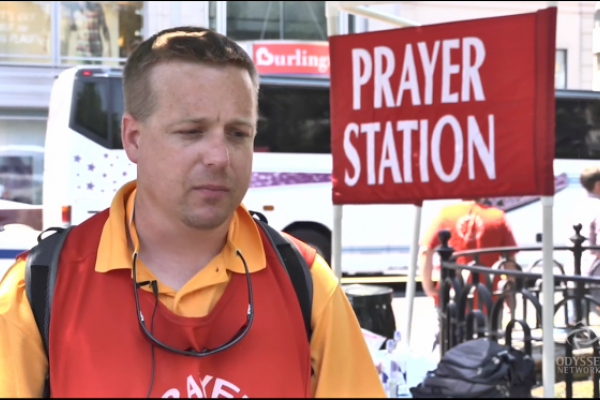
When I want to remind myself of the power of prayer, I go to the Astor Place Kmart on the lower east side of Manhattan. Sure, I could read Kierkegaard or Augustine, but I prefer the Kmart. Specifically I favor an area in the far back corner of the basement. It is devoid of windows or natural light with a back wall of clear glass that faces the dungeon-like dark tunnel of the Number 6 subway train. There, you will find the most unexpected of things — like a plant nursery.
Sprouting out of this dreary prison are tender green leaves of ficus trees and the vibrant gold blossoms of marigolds. A tiny plastic tab peeks out of each pot with an image of what that particular plant could grow into if it received proper light and care; a cruel irony, as there is little hope in this place that such care or light will be offered. Even amid the bleak circumstances, these tiny members of creation still struggle, every moment of every day, to tap into the energy around them so that they might grow into that potential.
In short, they pray.
More than 1,200 people have signed an online petition decrying the “silence” and “inattention” of evangelical leaders to sexual abuse in their churches.
The statement was prompted by recent child abuse allegations against Sovereign Grace Ministries, an umbrella group of 80 Reformed evangelical churches based in Louisville, Ky.
“Recent allegations of sexual abuse and cover-up within a well known international ministry and subsequent public statements by several evangelical leaders have angered and distressed many, both inside and outside of the Church,” reads the three-page statement spearheaded by GRACE (Godly Response to Abuse in the Christian Environment).
“These events expose the troubling reality that, far too often, the Church’s instincts are no different than from those of many other institutions, responding to such allegations by moving to protect her structures rather than her children.”
I used to be a Bible study leader.
And per the undergraduate campus fellowship tradition, it kept me busy: Sunday brunch community building, Monday night small groups, Tuesday leadership meetings, and Wednesday training sessions. Discipleship, one-on-ones, social activities, all-campus worship, weekend retreats, week-long retreats, all-day retreats, evangelism workshops, work day, capture the flag, scavenger hunts, and prayer meetings.
But what I remember most vividly are Thursdays.
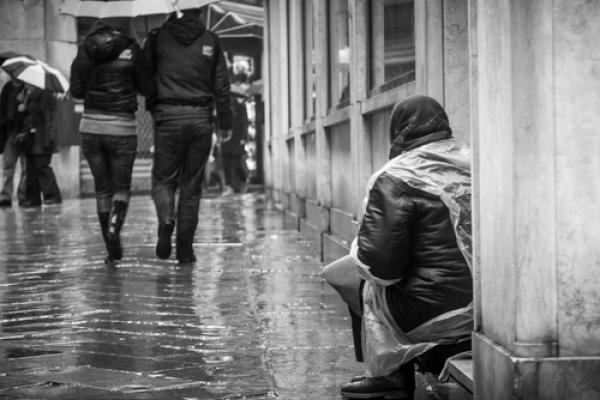
Every Thursday. The evening walk through campus, past bars and restaurants beginning to fill with my peers, through a door almost hidden to the unaware, flanked by a man sitting on the ground. The man is dirty and unkempt. Sometimes he’s panhandling. Sometimes he’s asleep. On one occasion, he eats, still alone, from a small bag of popcorn one of my fellow Bible study leaders had brought to him.
The man catches my attention, yet I don’t show it. I don’t ask his name, or where he goes when he doesn’t sit by the door, or how he manages to stay warm through Midwestern winters. Thursdays are obligatory for Bible study leaders, so maybe that’s why I try to ignore the man. Maybe that’s why I feel I can’t stop to ask him his name. Or maybe being a Bible study leader is just a convenient excuse to keep walking.
So every Thursday I climb the stairs behind that door, leaving the man below, allowing him to fade into the background until he is just another distant person, indistinguishable from those filling the pub across the street or sleeping on their textbooks in the library across the quad. Suddenly the band is on stage, the rhythm of worship distracts me, channeling an energy that gives way to reflection, to reverence, to calm. Every Thursday.
And then it’s over. And like all good Bible study leaders, I greet friends, practice fellowship, welcome newcomers. We leave in groups to study or socialize. I don’t notice if the man is still there when we leave.
This man has come to represent many things to me in my faith journey, and something I’ve encountered this week brings my thoughts back to him.
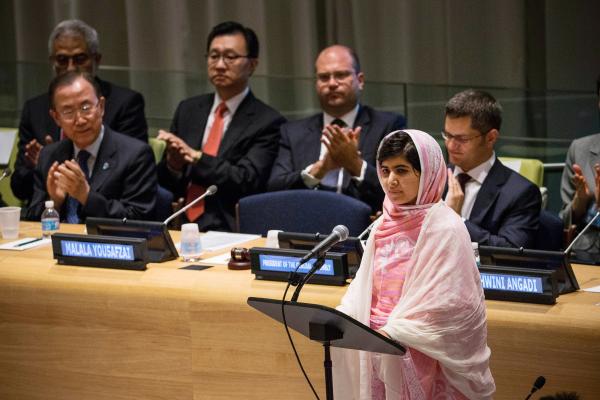
On October 9, 2012, Pakistani teenager Malala Yousafzai was shot in the head by Taliban for advocating for girls' right to attend school. Malala survived the attack, and earlier this month she celebrated her 16th birthday by giving an impassioned speech to the United Nations, advocating for equal rights to education.
This 16-year-old girl was as eloquent and passionate as a seasoned statesman. Her words rang with truth and power. She reminded us that the world is full of vitriol and violence, hate and ignorance — that this is true for people of all faiths, all backgrounds, all political parties. That there is no corner untouched by darkness.
But at the U.N., celebrating her sweet 16, Malala was a light.
I listened to Malala’s story and got chills. As children, before we learned to use politics and policy to defend the lesser inclinations of the heart, we asked: why do people hate? Why do they do harm?

While many groups are focused on the upcoming congressional recess and on outreach efforts to their members of Congress in their home districts, evangelical Christians have another priority in mind this week.
Today, hundreds of evangelicals from across the country will gather on Capitol Hill to host the Pray4Reform Evangelical Day of Prayer and Action. The day includes a press conference, worship service, and a full day of meetings at congressional offices to urge immigration reform.
You can follow the day’s events by visiting http://pray4reform.org/, where the news conference and worship service will be live streamed. Also, follow and join the conversation via social media by following the hashtag #pray4reform.