President Barack Obama revealed his approval of the Keystone XL pipeline project during his climate change speech on Tuesday. With the effort to reduce carbon pollution, Obama has agreed to move forward with the process providing that the Keystone XL pipeline doesn’t release an increasing amount of greenhouse gasses into the environment. The Hill reports:
“Our national interest will be served only if this project doesn't significantly exacerbate the problem of carbon pollution,” Obama said in speech laying out his second-term climate agenda, including greenhouse gas emissions for power plants.
“The net effects of the pipeline's impact on our climate will be absolutely critical to determining whether this project can go forward.”
Read more here.
On Tuesday, the Supreme Court struck down part of the Voting Rights Act that was enacted in 1965 to root out racial discrimination in voting. The specific section of the Act that was stricken — Section 4 — set forth a formula for determining which jurisdictions need federal clearance before making even minor changes to voting procedures. The impact of striking Section 4 is that the most important part of the Act, Section 5, is now rendered useless. Section 5 provides that states, cities, and counties with a history of racial discrimination in voting must “pre-clear” changes to voting procedures with the Department of Justice or a special court in Washington, D.C. Without the formula in Section 4 to determine which states, cities, and counties the preclearance should apply to, the preemptive protection provided by Section 5 no longer exists, and any future challenges to changes in voting procedure must happen after such changes are already in effect.
The majority of the Court felt that racial minorities do not continue to face discriminatory voting practices, and that the preclearance requirement was based on 40-year-old facts that had no logical bearing on present day. Chief Justice Roberts, Jr., wrote:
“Our country has changed. While any racial discrimination in voting is too much, Congress must ensure that the legislation it passes to remedy that problem speaks to current conditions.”
The practical application of Tuesday's decision is that states will be able to enact potentially discriminatory laws that previously had been blocked. This was made immediately apparent in Texas, which announced after the ruling that voter identification laws would go into effect immediately.
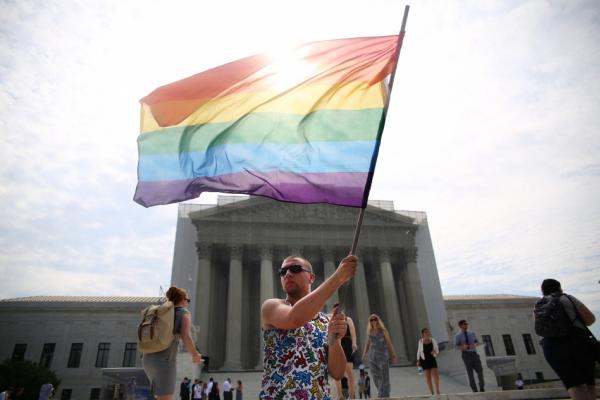
The Supreme Court this morning struck down the Defense of Marriage Act, 5-4, which prohibits the federal government from recognizing same-sex marriages performed in states.
From the opinion:
"DOMA violates basic due process and equal protection principles applicable to the Federal Government. The Constitution’s guarantee of equality 'must at the very least mean that a bare congressional desire to harm a politically unpopular group cannot' justify disparate treatment of that group."
Read the full opinion here.
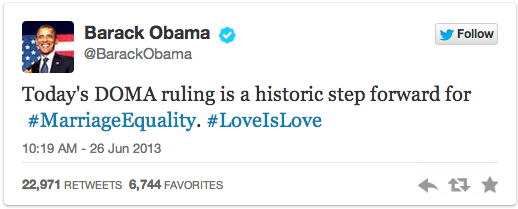
Following the court's announcement, President Barack Obama Tweeted his support.
The Washington Post reports:
“The federal statute is invalid,” wrote Anthony Kennedy in his majority opinion, “for no legitimate purpose overcomes the purpose and effect to disparage and to injure those whom the State, by its marriage laws, sought to protect in personhood and dignity.”
Read more here.
Also on Wednesday, in another 5-4 decision, the Court ruled that the appeal to the lower court's decision overturning California's Proposiion 8 — the state ballot measure that ruled that only marriage between a man and a woman would be recognized — had no standing, in effect, allowing same-sex marriage to continue on the state.
Read the opinion here.

Whenever I hear someone lament that kids these days need to read their Bibles, I tell them that the Bible should be rated R for violence, nudity, rape, drug deals, and even genocide – and that’s just in the first book! Of course, as a youth pastor, I’ve found that the best way to get kids interested in the Bible is to tell them that if someone made it into a movie, it would be rated R.
The Bible and movies tell stories. Gareth points out the importance of stories in his article “It’s the Movies’ Fault/It’s not the Movies’ Fault” in which he brilliantly states that, “we could benefit from recognizing that the relationship between storytelling and the formation of human identity is crucial.” Indeed, the stories we tell are crucial to the formation of human identity, but the Bible and movies tell stories that are permeated with violence. So, the question becomes, how do we make sense of those violent stories in terms of human identity?
There are lots of biases and assumptions about Christians out there, many of which are founded in real-life experience. And yes, we Christians have done our share of damage when it comes to tarnishing our so-called “brand.” But there also seems to be this tendency to understand Christianity and its adherents as one generally monolithic group that can be described in simple (often negative) terms that they would never be acceptable to apply to any other group.
Part of this is because of the historic dominance of the Christian culture in the modern Western world. It’s the same reason that stereotypes of men on network sitcoms are pervasively unflattering, while the same stereotypes would cause a firestorm of negative publicity if applied to the female counterparts. Some of this is entirely warranted and necessary in tearing down false or damaging constructs of power. But sometimes, if we’re being honest, they’re just wrong. And stupid.
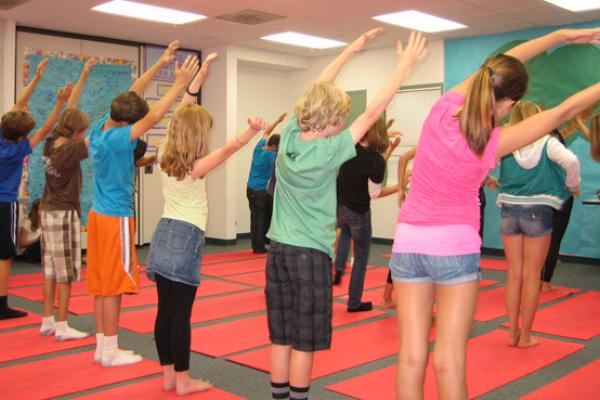
In an elementary school classroom with an American flag draped over one wall, a couple dozen students rose to standing positions. Then they shifted into poses called “volcano part one,” “silent gorilla,” and “rag doll.”
Some students may not realize it, but the semiweekly, half-hour course might be gone by the time they return in the fall.
In this upscale, seaside suburb just north of San Diego, parents have filed a lawsuit arguing the Encinitas Union School District should do away with the yoga elective because the discipline is inherently religious, and the teaching of it in the public schools violates the First Amendment.
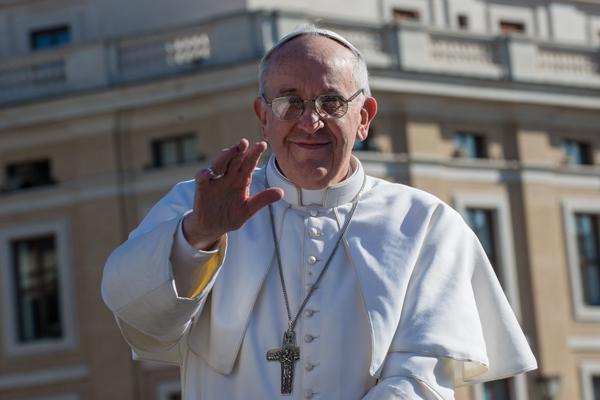
In his first official meeting with a Jewish delegation, Pope Francis on Monday reaffirmed the Catholic Church’s condemnation of anti-Semitism and vowed to further deepen Catholic-Jewish relations.
“Due to our common roots, a Christian cannot be anti-Semitic!” he told a delegation of the International Jewish Committee for Interreligious Consultations, the Vatican’s official partner for interfaith dialogue with the world’s Jews.
In his speech, Francis stated that the church condemns “hate, persecution, and all manifestations of antisemitism.”