
I’ve written before about the seemingly contrasting messages we offer to young people in church about sex and sexuality:
Sex is dirty; save it for someone you marry someday.
Umm, what? Granted, we walk a narrow rhetorical tightrope when discussing sex with our kids. If we tell them it’s actually pretty awesome, and then tell them they can’t do it, that’s a setup for failure. On the other hand, if we focus on the negatives, we risk scarring and shaming them into a life of emotional conflict and struggle when it comes to sexual intimacy.
What we end up with, often times, is a vacuous silence when it comes to the real, difficult issues of sexual identity, impulse, and expression. Add to that the Christian emphasis on marriage, and the result in many cases is scads of unhealthy, sexually awkward young people, married far too early with no idea why.
Many of my liberal friends never call themselves “Christians.” Their hesitancy is usually a reaction against conservative Christians who, let’s face it, are an embarrassment to the name. You know what I’m talking about – those who make crazy claims like natural disasters occur because God is angry at homosexuals. And then there are those who use phrases like, “legitimate rape.”
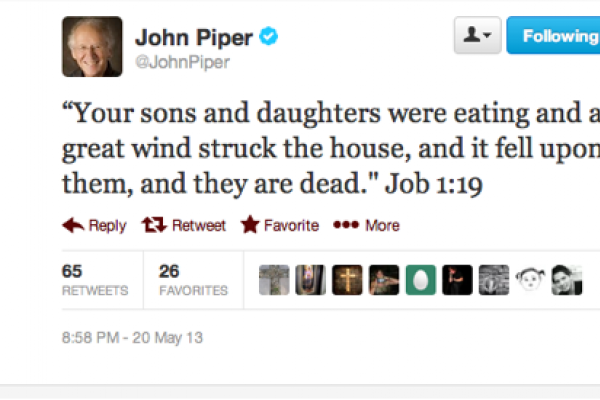
Influential pastor John Piper provides the latest example. While most of my friends on Facebook and Twitter lamented the devastation wrought by the Oklahoma City tornado, Piper decided to show off his biblical acumen with this tweet:
"Your sons and daughters were eating and a great wind struck the house, and it fell upon them, and they are dead." -Job 1:19
Piper’s tweet is a bit ambiguous. His reference to Job doesn’t say that God caused the tornado, but Piper has historically claimed that God causes these types of disasters. In fact, this wouldn’t be the first time Piper has tweeted something so theologically insensitive. A few years ago Piper claimed God caused a tornado in Minnesota because God was angry at homosexuals. Piper’s god is a fickle Cosmic Jerk.

I remembered after the first lecture I came home and told my husband about the pronoun, but as I read through all 20-something lectures, I noticed it again and again. I was the theologian; I was the believer.
Was this difficult for my professors to do? Did it take lots of conceding to women’s different or special needs? Or, rather, was it a possible and reasonable upsetting the “status-quo” that still often tells us that “he” or “man” means everyone and that I’m just too touchy if I refuse to accept that.
This small kindness was, I think, one of the best things about my first semester of seminary. These two white men — one in his early 60s and one in his early 30s — were incredibly intentional about the female pronoun being the “default” for the generic personal pronoun.

A tipping point has been reached, not only on the issue of marriage equality, but on the broader political force of bully Christianity, a pernicious brand of the faith that tells people who don't have conservative social and political views that they "aren't Christian." That model has now failed where it used to work reliably; Waterloo has been reached.
To be clear, not all of those who sought to protect traditional man-woman marriage were bullies. Many acted out of a principled and consistent sense of their own faith, and stayed away from defining the faith identity of others. I am fortunate that the same-sex marriage opponents I know best avoided that tactic and amid our disagreement never suggested that I was no longer a part of the diverse and complex body of Christians.
Still, it is undeniable that many advocates for traditional marriage actively used the bullying tactic of asserting that there was only one "Christian" position on this issue, and that the Christian viewpoint rejected marriage equality. Unfortunately, their voices have too often been the loudest, and the ones to which the press is most attracted. That tactic has now been exposed as something worse than unprincipled, politically: It has been shown to be ineffective in the public arena.
Some will see this tipping point as a huge loss for Christianity, but it might instead be the faith's salvation. Bullying was always a terrible form of evangelism.
President Barack Obama will deliver a major speech on drone policy tomorrow. And for a number of reasons—including a smaller number of important al Qaeda targets, issues such as bad weather to diplomatic problems, and concerns about the costs and benefits—the number of drone strikes being carried out is dropping. The New York Times reports:
But lost in the contentious debate over the legality, morality and effectiveness of a novel weapon is the fact that the number of strikes has actually been in decline. Strikes in Pakistan peaked in 2010 and have fallen sharply since then; their pace in Yemen has slowed to half of last year’s rate; and no strike has been reported in Somalia for more than a year.
In a long-awaited address on Thursday at the National Defense University, Mr. Obama will make his most ambitious attempt to date to lay out his justification for the strikes and what they have achieved. He may follow up on public promises, including one he made in his State of the Union speech in February to define a “legal architecture” for choosing targets, possibly shifting more strikes from the C.I.A. to the military; explain how he believes that presidents should be “reined in” in their exercise of lethal power; and take steps to make a program veiled in secrecy more transparent.
Read more here.
In a letter sent to the White House and the leadership of key Congressional committees, Bishop Richard E. Pates of Des Moines, Iowa, chair of the U.S. Catholic Bishops’ Committee on International Justice and Peace, wrote that the use of drones in counter-terrorism “raises serious moral questions.”
Even when viewed through the prism of just war principles, the use of unmanned aerial vehicles (UAVs) for targeted killings raises serious moral questions. The Administration seems to have focused narrowly on the just cause of protecting citizens, but other elements of the tradition pose significant questions, including discrimination, imminence of the threat, proportionality and probability of success. Targeted killing should, by definition, be highly discriminatory. The Administration's policy appears to extend the use of deadly force to alleged "signature" attacks and reportedly classifies all males of a certain age as combatants. Are these policies morally defensible? They seem to violate the law of war, international human rights law, and moral norms.
He concludes by asking:
We understand the necessity for operational secrecy in counter-terrorism, but isn’t it critical to have a public discussion of the terms of the Administration’s policy of employing drones for targeted killings? Don’t the moral and strategic issues involved require broader discussion? Shouldn’t a policy with such wide potential consequences be subject to public scrutiny, at a minimum by representative institutions in a democratic society?
Read more here.

Where there is hope, there is future.
Today is Hunger Action Day.
For many in my beloved Golden State, today will go unnoticed. It will be what it always is — a Wednesday full of its special nuances with perhaps homework, meals and snacks, pleasant weather, and most definitely, a dose of stressful traffic. It will be normal. Life will be as it always is. For others however, myself included, this is the day we have been waiting for. In fact, you could even say, that this is the day we’ve been hungry for.
More than 300 California residents from all around the state — from the beach towns to the gritty parts of the city — have committed their day, their energy, and their hearts to visiting with their representatives to advocate for their neighbors and friends who every day face hunger. To these few hundred residents who have taken the time to journey to Sacramento, the opportunities that today provide could be life changing for thousands.