Abortion
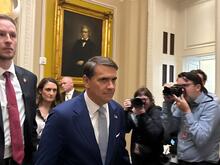
Acting U.S. Attorney General Todd Blanche is one step closer to confirmation after the Republican Judiciary Committee voted to advance his appointment on a party-line vote on Tuesday, and based on promises he made to faith leaders around the country last week, that means national anti-abortion actions may be one step closer as well.
In a conference call hosted by the White House Faith Office on July 30 with thousands of religious leaders around the country, Blanche said he was committed to achieving policy solutions so that the U.S. Supreme Court’s Dobbs decision “becomes permanent in every single state.”
A recording of the call was publicly available on YouTube as of Tuesday, posted by Intercessors of America, a religious group in Virginia, but was removed by late Tuesday afternoon.

The Supreme Court has sided with a coalition of anti-abortion crisis pregnancy centers in its fight against the New Jersey Attorney General’s Office, finding a subpoena that state investigators issued for donor information unconstitutionally chilled the centers’ free speech and association rights.
In a unanimous decision issued Wednesday, Justice Neil Gorsuch reversed an appellate court’s ruling that had prevented First Choice Women’s Resource Centers Inc., from airing their constitutional objections to the state’s probe and investigative practices in federal court. Gorsuch’s ruling returns the case to U.S. District Court.
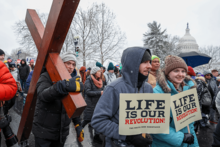
The Justice Department accused the Biden administration of unfairly prosecuting anti-abortion activists the day after it fired at least four attorneys who were involved in prosecuting those cases.
The accusations come in the first report from the Justice Department’s “Weaponization Working Group,” which has been tasked with going after law enforcement officials who have investigated President Donald Trump, including New York Attorney General Letitia James and former special counsel Jack Smith.
The report defends Trump’s mass pardoning of 23 people who were convicted under the Biden administration for violating the Freedom of Access to Clinic Entrances Act, also known as the FACE Act. The law prohibits obstructing people from entering medical centers and was passed in 1994 after a spate of violence against abortion providers, including the 1993 murder of Dr. David Gunn.
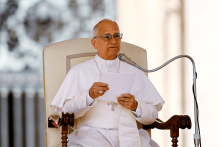
Pope Leo on Tuesday appeared to offer his strongest criticism yet of President Donald Trump’s hardline immigration policies, questioning whether they were in line with the Catholic Church’s pro-life teachings.
“Someone who says I am against abortion, but I am in agreement with the inhuman treatment of immigrants in the United States, I don’t know if that’s pro-life,” the pontiff told journalists outside his residence in Castel Gandolfo.
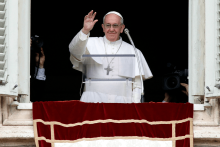
Pope Francis, born Jorge Mario Bergoglio in Buenos Aires, Argentina, was the first in a long line of 266 popes to be from South America and the first born outside of Europe since the 8th century. The pope, also the first to be a member of the Jesuit Order, was beloved by many progressive Catholics and lauded for his priorities of uplifting marginalized communities, protecting immigrants and advocating for environmental justice. According to a 2024 Pew Research Center survey, about 75% of U.S. Catholics viewed Pope Francis favorably.
But he was also a polarizing figure. He struggled to manage the ongoing sexual abuse crisis that plagued his predecessor, Pope Benedict XVI. Pope Francis met with survivors and attempted to pass reforms within the Church, but victims continue to come forward.

President-elect Trump, according to the Associated Press, has won the White House. He won the election in part by courting conservative religious communities — and appealing to their anxieties — on the campaign trail. His policy agenda will likely be shaped by these groups, influencing the White House on a range of issues from education to reproductive rights.
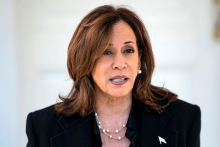
In an interview with NBC’s Hallie Jackson on Tuesday, Vice President Kamala Harris suggested she would not make concessions for religious exemptions on abortion laws, one of her strongest allusions yet to where she plans to take the abortion debate if she wins the White House in November.
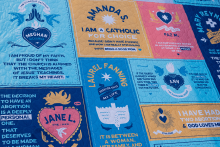
Early in the morning on Oct. 3, reproductive choice advocacy group Catholics for Choice unfurled a 50-foot long, 41-pound quilt on the road leading to St. Peter’s Square in Vatican City. Their words, written in bold, large letters across the bottom of the quilt summed up their message: “POPE FRANCIS, LISTEN.”

For several years, I pastored a small church in the Northwest Bronx. In the summer of 2022, the church leadership decided to dedicate one Sunday a month to do a service project where we engaged in direct political action. It was the summer when Roe v. Wade was overturned, and we focused our attention on reproductive justice. Instead of simply looking at reproductive justice as a pregnant person’s right to receive an abortion, we started thinking of it in broader terms: a better family welfare system in the U.S., honoring the bodily autonomy of birthing people, and taking steps toward improving the material conditions of Black and brown children in the Bronx through mutual aid, collective care, political education, and political solidarity.

While evangelical political engagement remains solidly in favor of Republicans, a group of evangelical leaders are organizing their support for Vice President Kamala Harris and Gov. Tim Walz in the upcoming presidential election.
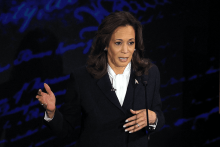
As Vice President Kamala Harris and former President Donald Trump discussed abortion policy during their first debate, Harris vigorously defended her vision for federal abortion rights. While she did, she returned to a talking point meant to appeal to religious voters.
“[Under Trump’s abortion bans] a survivor of a crime — a violation to their body — does not have the right to make a decision about what happens to their body next. That is immoral,” Harris said, before connecting morality and faith. “And one does not have to abandon their faith or deeply held beliefs to agree: The government, and Donald Trump certainly, should not be telling a woman what to do with her body.”
In the late spring of 1995, Rebekah Mitchell went into the hospital at 27 weeks pregnant with her second child. Mitchell had a kidney disease that was affecting her own health and the health of the baby. She made it to seven months, and then the baby, whom she and her husband had already named Jonathan, became entangled in the kinked umbilical cord, and died suddenly. Stunned and recovering from the cesarean section required to deliver Jonathan, she kept his body with her in the hospital room for three days.

The Supreme Court has unanimously dismissed a case that would have limited access to mifepristone, one of the two drugs used in a medication abortion. The decision leaves access to the abortion drug unchanged for now.
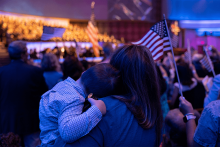
The Southern Baptist Convention, the largest Protestant denomination in the U.S., on Wednesday voted to condemn the use of in vitro fertilization, signaling the campaign by evangelicals against abortion is widening to include the popular fertility treatment.
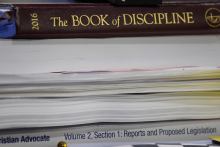
The United Methodist Church voted this week to approve a petition affirming a right to abortion and pledging “solidarity with those who seek reproductive health care.” The vote was part of the UMC’s 2020 General Conference, which was delayed until 2024 because of the COVID-19 pandemic.
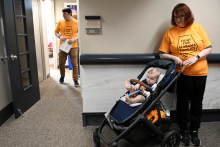
The waiting room of a fertility clinic was one of the most sacred places Elizabeth Wanczak had ever experienced. Most of the people sitting around her had weathered trauma and grief like hers — stories of repeated miscarriage, medical catastrophe, and what felt like endless longing for a baby that had not yet come. And yet, she said, the presence of these people in the waiting room signaled hope. They had not yet given up.
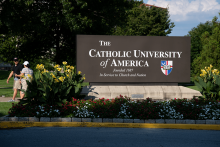
Rachel Carbonneau didn’t show up to Catholic University of America in late January planning to talk about abortion. The doula and public health advocate was visiting a class for aspiring nurses, doctors, and other public health professionals to talk about social determinants of health — the ways that economics, community structure, bias, and institutions affect health outcomes. The student-led conversation had touched on a wide range of topics from the opioid crisis, to the fact that Black birthing people in New York are five times more likely than their white counterparts to die in childbirth, to the impact of COVID-19 on placental health.
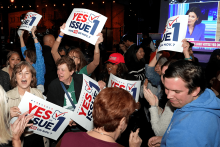
Voters approved an amendment to add abortion rights to the state constitution by a wide margin (more than 56 percent voted for the ammendment and 43 percent voted against, with 99 percent of the vote counted according to CBS News), ending a tumultuous year of uncertainty over the future of legal abortion in the state.

Lost in the conversation about abortion rights and religious liberty is the fact that many Christians are not merely politically in favor of abotion access, but theologically in favor as well. These attempts to restrict abortion care and reproductive rights — even to the point where it puts the lives of pregnant people at dire risk — go against our Christian faith.
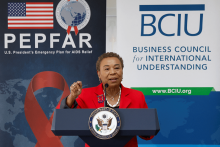
Over the past two decades, the United States has saved millions of lives by investing $110 billion in the U.S. President’s Emergency Plan for AIDS Relief, which aims to end the AIDS crisis by 2030. More than 25 million lives have been saved since PEPFAR launched in 2003, and 5.5 million babies who would have been born with HIV were born virus-free.