Homelessness
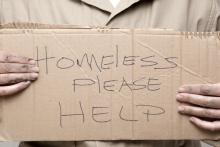
My students had questions about the central character in the story Fly Away Home written by Eve Bunting and illustrated by Ronald Himler. And even as 2nd graders, they knew something about the problem.
"Homelessness is mean," said James.
"I pass the Salvation Army on my bus on the way to school every day. I know homeless people sleep there," Billy added.
Fly Away Home tells the story of a boy who lives in an airport with his dad because they have lost their home. They move through the terminals to avoid being noticed by passengers. The story places you in the boy’s shoes and helps you see the world through his eyes. You feel the pain of the dad who can no longer provide a home for his family. You experience what it’s like to have all of your possessions in two blue bags. This is just the right book to help students and teachers think about how we view people who are homeless.
After reading the story to my students, I asked a few questions about homelessness.
From WOAI-TV in San Antonio, Texas:
She's been living on the streets to bring attention to homelessness, but Sunday night a local pastor stayed behind bars.
The Rev. Lorenza Andrade Smith had a warrant out for her arrest, because she was cited for sleeping on a park bench, which she says proves her point, that the homeless have few places to lay their heads. Along her journey the pastor has discovered what she calls an unjust judicial system for the poor.
She said, “This will be the second time I’m in jail for that same ticket and I’m just trying to survive out in the streets like hundreds of others here in San Antonio.”

By now, you have probably read about the Wild Goose Festival. You have heard about the big name speakers, you were told about beer and hymns, you know about the dunk tank and the killer music and the ticks and the scorching Carolina heat.
But, awesome as all that was, it all pales in comparison to my memory of a late night conversation at the Goose with my friend Mike.
You see, Mike is one of about 1,200 people in Wake County, N.C., who are currently without housing. Some nights he lives at the shelter, other nights he couch surfs with various friends, and some nights he sleeps in the dumpster of that downtown church with the $2 million pipe organ.
Mike is one of our volunteers at Love Wins Ministries, our little ministry of pastoral care and presence to the homeless community in Raleigh, N.C. And yes, he is currently homeless. But Mike still volunteers with us, because where you live does not decide your value or define your ability to contribute.
So, when I mentioned to Mike that we were running a booth at the Wild Goose Festival and I wanted him to come as our guest and help us run it, he was skeptical.
"These are church folks, right?" Mike said. "I don't do church folks well. You know that."
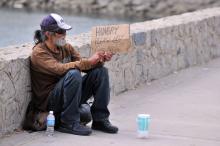
A growing number of cities across the United States are making it harder to be homeless.
Philadelphia recently banned outdoor feeding of people in city parks. Denver has begun enforcing a ban on eating and sleeping on property without permission. And this month, lawmakers in Ashland, Ore., will consider strengthening the town's ban on camping and making noise in public.
And the list goes on: Atlanta, Phoenix, San Diego, Los Angeles, Miami, Oklahoma City and more than 50 other cities have previously adopted some kind of anti-camping or anti-food-sharing laws, according to the National Law Center on Homelessness & Poverty.
During the first-ever all-virtual interview conducted by Americans via Google+'s "hangout" group video chat feature, a young, homeless veteran in Boston asked President Obama why the United States still gives money to countries such as Pakistan, that are known to fund terrorism — especially when there are so many veterans living on the streets after returning from the war. The session was broadcast live via YouTube.
Watch the video of their conversation inside the blog...
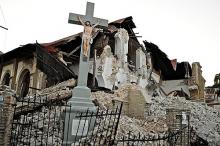
How does one dig out from under such tragedy? How does one have hope for a better life, for a new Haiti?
In a meditation titled "The Gates of Hope," Minister Victoria Safford writes:
"Our mission is to plant ourselves at the gates of hope -- not the prudent gates of Optimism, which are somewhat narrower; nor the stalwart, boring gates of Common Sense; nor the strident gates of self-righteousness ... nor the cheerful, flimsy garden gate of 'Everything is gonna be all right,' but a very different, sometimes very lonely place, the place of truth-telling, about your own soul first of all and its condition, the place of resistance and defiance, the piece of ground from which you see the world both as it is and as it could be, as it might be, as it will be; the place from which you glimpse not only struggle, but joy in the struggle — and we stand there, beckoning and calling, telling people what we are seeing, asking people what they see."
Indeed, we need to plant ourselves at the gates of hope and work toward a just peace, on Earth as it is in heaven.

Why Are American Politicians Always Switching Religions?; What It Means To Be A Liberal Person Of Faith; Home From Iraq, Veterans Seen as Perfect Candidates for Green Jobs; Bush Aide Finds Forgiveness And A Second Career; Canada Pulls Out Of Kyoto Protocol; Child Homelessness Reportedly Climbed 33 Percent In Past 3 Years.
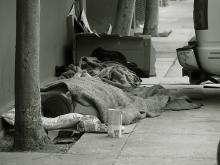
This weekend, 60 Minutes aired a piece that has been commended by many as a shocking but must-see insight into poverty in the United States today.
Sixteen million children now live in poverty, and for many, they don’t even have a proper place to call home. These situations are even more frequent in areas of the country where traditional industries have collapsed in the wake of the financial crisis – such as the construction industry in central Florida.
Christians are called to be peacemakers and healers. Disagreement on policy does not excuse us from a responsibility to help those who come home broken and in need of help.
You might call yourself a pacifist, a just-war theorist, a pragmatist, a dove or a hawk but today (and every day), you should be a good neighbor to a veteran.
The Housing First approach to homelessness is more humane -- and cheaper -- than older models.
Why Homelessness Is Becoming An Occupy Wall Street Issue; U.S. Pulls Out Ambassador From Syria: Diplomats; Hispanic Alabama Schoolchildren Face Bullying In The Wake Of Anti-Immigrant Law; Vatican Calls For Economic Equality, Sweeping Reform Of Global Financial System; We Pay More To Drive Than We Spend On Taxes; New Obama Foreclosure Plan Helps Banks At Taxpayers' Expense
As the evangelical community in Portland rediscovered the calling of showing, in addition to sharing their faith, everything has changed. And it's only the beginning of what God is doing in our city. We're in it for the long-haul.
Not only have many great needs been met, but churches are working together in relationship as never before. The impact of one church humbly serving is profound. But the impact of a united Church serving in concert, actually has the power to change how the world views the Gospel.
[Editors' note: This post is part of a series over the last few weeks on youth homelessness. In the September/October issue of Sojourners magazine, the Ali Forney Center and the Gay and Lesbian Alliance Against Defamation (GLAAD) ran an ad to raise awareness of the serious problem of LGBT youth homelessness.]
Fact 1) About 40 percent of the homeless youth in the United States identify as lesbian, gay, bisexual, or transgender.
Fact 2) One in four teens rejected by their families becomes homeless.
Fact 3) Parents who identify as strongly religious are three times more likely to reject their children.
Yet for Carl Siciliano, founder and president of the Ali Forney Center, these aren't just facts -- they are his daily life.
When it comes to homeless youth the facts are simple, services in the City of Chicago are falling far behind the need. A survey of Chicago public school students from 2009/10 revealed 3,682 children who identified as being homeless and in need of shelter. In contrast there are approximately 189 beds for homeless youth (ages 18-25) funded by the City of Chicago. In 2010, 4,775 homeless youth were turned away from youth shelters for lack of room. To be clear, that was 4,775 instances where homeless youth sought shelter and were unable to find it. To date there are only 10 percent of the beds needed to provide safe shelter and supportive programs for the estimated number of Chicago's homeless youth.
The first few nights weren't so bad. It was on the fourth night, the night it rained, that it got to me. I had just spent the past week sleeping on the sidewalk in front of the Illinois state Capitol building in Springfield. Throughout the week, young people of faith, college students, as well as homeless and formerly homeless youth traveled from Chicago to Springfield. Some slept on the sidewalks at night, and others came solely to lobby their legislators. We were all there for the same reason -- because each year nearly 25,000 youth experience homelessness in the state of Illinois. Not only were there not the resources to help these youth, but most legislators and most of the general public didn't even realize the problem existed.
In the past few weeks, I've written about a lot of full-page ads. This full-page ad is different. Too often, homeless youth have been invisible. The Ali Forney Center, a service provider for LGBT homeless youth, has a full-page ad in this month's issue of Sojourners magazine. GLAAD, the Gay and Lesbian Association Against Defamation, connected the Ali Forney Center to Sojourners, as a part of an advertising campaign the Ali Forney Center is running. The ad highlights that up to 40 percent of homeless youth identify as lesbian, gay, bisexual, or transgender. I have talked with many teens who became homeless because they were kicked out of their homes or ran away from abuse by their parents because of their sexual identity. After their homes became dangerous, they went to the streets, where many were attacked and some were trafficked or forced into prostitution.

When Kevin Barbieux became homeless in 1982, he was new to Nashville. At first, he relates in an e-mail interview, he spent his days hovering around a rescue mission. Then, as he met other homeless people who introduced him to the city’s attractions, he began to explore. He took long walks by the Cumberland River, visited the Tennessee State Museum—and found himself browsing the stacks of the downtown library.