Immigration

Adam Ramirez 2-21-2014
Brandon Hook/Sojourners
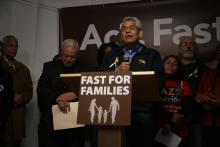
Eliseo Madina speaks at the Fast4Families tent to kick off their fast last November. Brandon Hook/Sojourners

You probably haven’t heard of Sioux County, Iowa — but if you’re ever on a flight from Boston to Los Angeles, you’ll fly right over us and know you’re at the midpoint of your trip. We’re just about exactly in the middle of the country.

But aside from U.S. geography, Sioux County isn’t often known for being in the middle. We’re found in the 4th congressional district of the state — the constituency represented by Steve King, where close to 80% of our electorate is Republican.

Recently, Sioux County, Iowa was blessed with the visit of Eliseo Medina, a hero in immigrants’ rights movements for over 40 years. Eliseo was a key part of the farmworkers movement and went on strike with Cesar Chavez. He served as a board member of United Farm Workers from 1973 to 1978.

At the Sioux Center Library, approximately 130 people gathered, overflowing the room. College students and professors, church members, and Latino workers congregated to listen to a prophetic voice calling in the wilderness for God’s justice to the powerless and voiceless in our midst. Congressman King was invited but did not attend.

2-20-2014
Do conservatives have any compassion left? As House Republicans wrestle with whether to reform our nation’s immigration laws, that is the question evangelical leaders like myself are asking.
2-20-2014
The moral case for reform as an alternative to an unacceptable status quo — a humanitarian crisis that is hurting untold numbers of people — has motivated many evangelicals to get involved in the push to fix the immigration system. And today, evangelical writer Jim Wallis makes that moral case by painting a vivid picture of the dilemma the country currently faces:
2-20-2014
And today, evangelical writer Jim Wallis makes that moral case by painting a vivid picture of the dilemma the country currently faces.
2-20-2014
And today, evangelical writer Jim Wallis makes that moral case by painting a vivid picture of the dilemma the country currently faces.
2-19-2014
“You’re not going to see the president talking critically or negatively about Republicans on an issue like this when he wants to see this happen,” said Jim Wallis, president of the Christian social-justice organization Sojourners. “They’re not looking for conflict here, they are looking for cooperation and collaboration.”
2-18-2014
“You’re not going to see the president talking critically or negatively about Republicans on an issue like this when he wants to see this happen,” said Jim Wallis, president of the Christian social-justice organization Sojourners. “They’re not looking for conflict here, they are looking for cooperation and collaboration.”
Kara Lofton 2-18-2014
Bishop Minerva G. Carcaño of the United Methodist Church in front of the White House Monday. Photo: Kara Lofton

This President’s Day, about 20 church leaders, sympathizers, and undocumented immigrants were arrested in front of the White House as part of an act of civil disobedience to protest the nearly 2 million people who have been deported under President Obama.

The core group and about 40 supporters gathered around 1 p.m. on Monday afternoon in Lafayette Park in front of the White House. They held signs that said, “Praying for Relief” and “#Not1moredeportation,” and sang hymns in between short megaphoned speeches that told personal stories. They called for immigration reform. “Not one more, not one more,” they chanted together in both English and Spanish.

The event was organized by Bishop Minerva G. Carcaño of the United Methodist Church, who was the first Hispanic woman to be elected to her position.

Carmille Akande 2-12-2014
spirit of america/Shutterstock
Immigration is an issue that affects the lives of real people. spirit of america/Shutterstock

Imagine a young girl growing up in a small town going off to college then law school. She then takes the bar examination and becomes a licensed attorney. She has accomplished what most people would call the American Dream.

However, one thing is missing — her father. You see, her father was deported when she was three years old and they have been separated ever since. She has lived 30 years without him.

Her father came to this country from Nigeria. He saw America as the land of opportunity. Her mother tells her that before coming to America he believed the streets were paved with gold. I’m not sure if his statement was figurative or literal, but I do know that he saw it as a wonderful opportunity.

Her father came to this country as a student on a student visa. He was able to obtain a bachelor’s and a master’s degree. He worked hard in school and earned both degrees. He longed to begin his career as an architect in America. He desperately wanted his piece of the American Dream.

2-07-2014
“I get the sense that there’s a mood that is at least open to options,” said Sen. John McCain (R-Ariz.), whose former chief of staff, Becky Tallent, is now Boehner’s top immigration aide. “Part of it is the business community, part of it is the evangelicals, part of it’s organized labor. It’s the largest coalition ever behind any piece of legislation.”
Adam Ericksen 2-06-2014
Coca-Cola Super Bowl commercial screenshot

The highlight of the Super Bowl for me was Coca-Cola’s "America is Beautiful" commercial. The images of the American landscape are amazing and the song was beautiful. At first I was a bit confused by the different languages singing "America the Beautiful" (I’m slow…), but I caught on about halfway through. When the commercial ended, I looked over at my wife and said, “Wow. That was beautiful … Not worth four million dollars, but that was good.”

For the moment, let’s deal with any cynicism that the Coca-Cola Company is simply trying to sell us their product. Of course they’re trying to sell us their product; that’s why they spent millions on their ad, but along the way, Coke pointed to the reason that I love the United States. I love my country because it is a nation that welcomes the “Other.” Indeed, we haven’t always been good at this, and we still struggle with it, but the United States is a nation of immigrants. Even Native Americans, who have tragically been excluded from the land they’ve lived on for thousands of years, were originally immigrants who were welcomed by this land. This land has a long history of welcoming people into it, and so any act of excluding immigrants goes against its ideal of welcoming the “Other.”

2-05-2014
Dae Joong Yoon, executive director of the National Korean American Education Consortium was one of the three core fasters. The Fast for Families tent was on the mall for one month, from November to December. Yoon, as well as advocates Eliseo Medina, Christian Avila and Lisa Sharon Harper, participated in a water-only fast for 22 days.
Aaron Klinefelter 1-30-2014
Photo via NAKASEC / Flickr.com http://www.flickr.com/photos/nakasec/

I completed my fast. I fasted for seven days as a participant in the Fast for Families: A Call for Immigration Reform & Citizenship. I fasted because Jesus cared about the "least of these" in his society, and as a follower of Jesus, I'm called to do the same. More specifically, I undertook this fast to raise awareness of these particular "least of these" in our society.

I was quite certain that some within my community of influence would disagree with me on this particular spiritual practice, whether theologically, politically, or socially. The pushback I did receive turned out to be more theological than anything. Perhaps that is just because of the circles I am in, but it went something like this, “I’m all for fasting as a personal spiritual thing, but associating it with a political cause is just wrong. Jesus came to save us from our sins and keep us individually out of hell.” The assumption is that Christianity has nothing to do with Public Square.


I'm still processing the political and governmental, not to mention partisan, implications of immigration reform. I'm certainly not under the impression that one simple bill at a federal level will "fix" immigration any more than the Civil Rights Act of 1968 fixed discrimination. Which of course is not to say that either is unimportant.
 

Still from 'Usoni.' Via the series' Facebook page.

CNN reports on Usoni , a futuristic television drama produced in Kenya that is about reversed immigration. The show depicts Europe in 2063, where life has turned unlivable after a deadly series of natural and economic disasters.

Europeans are desperately seeking a way to get to a livable continent south of them: Africa. The hardships in making the trip are unfathomable, and once the immigrants arrive, they are unwelcome, harassed, and rejected. The story follows a young couple, Ophelia and Ulysse, who are seeking to make their way with their unborn child to the land of promise.

Yes, the comparisons today to those seeking to immigrate to Europe (with obvious parallels to America) are intentional. Marc Rigaudis, the Kenya-based French filmmaker who created the program, is making a point to help us walk in the shoes of those whom we know the Bible calls “aliens and strangers.”

The chilling trailer depicting people like me being treated as illegal immigrants is enough to make one’s hair stand on end.

Ryan M. Eller 1-23-2014
 Immigration reform rally, spirit of america / Shutterstock.com
Immigration reform rally, spirit of america / Shutterstock.com

I’m a white southerner, ordained Baptist, and have built a career over the past decade working on a broad spectrum of projects in the civic sector. In that time I’ve been blessed to lead and work on some of the most prominent issues of social change throughout the globe. Whether it was working on funding for our veterans, organs for kids who need transplants, better schools and public transit, justice for Trayvon Martin, freedom for the Wilmington 10, or on political campaigns — I’ve had the opportunity to help grow and lead some of our nation’s largest and most vital organizations. Now, inspired by those in our generation who choose to dream instead of choosing despair, I’ve stepped out on faith to join the immigration reform movement. I hope you’ll pledge to join it as well.

Courtesy Jacob Lupfer
With Rev. Jim Wallis and our Georgetown students outside the #fast4families tent on the National Mall. Courtesy Jacob Lupfer

One of the most meaningful things I get to do in my work as a Ph.D. student in political science is assist Jim Wallis with a course he teaches at Georgetown every fall titled "Faith, Social Justice, and Public Life." Jim is well known as the founder and leader of Sojourners and as a lifelong advocate for social justice. Through lectures, discussions, and guest speakers, our students learn about how and why clergy and lay people of various religious backgrounds advocate for public policies as expressions of their faith commitments. This fall, the push for comprehensive immigration reform was one of the case studies we examined with our students.

I'm no expert in immigration policy. But, as a political scientist, I can offer an informed assessment about when, why, and how the House of Representatives will pass the reform in 2014. This will be the subject of a future post. For now, though, I want to highlight some distinctive features of the debate that I have noticed as an observer of religion in American politics. I do have a layman's interest in the theological justifications being offered in support of (and, perhaps surprisingly, against) comprehensive immigration reform. But for now, I will focus mostly on the politics.

Elaina Ramsey 1-16-2014

People go to great lengths for those they love, especially when it comes to immigration reform.

Ivone Guillen 1-15-2014
Ryan Rodrick Beiler/Shutterstock
One of the solutions would penalize U.S.-citizen children. Ryan Rodrick Beiler/Shutterstock

In only its second week in session, Congress is already confronted with difficult decisions that impact the lives of millions of people — some of whom are the most vulnerable in our society.

The Senate is faced with finding a solution that would extend the unemployment insurance to help a struggling workforce. One of the solutions, proposed by Senator Ayotte (R-NH), would penalize U.S. citizen children who are part of already struggling immigrant households living in poverty. While it’s important that Congress finds a resolution to the unemployment insurance conundrum, they should not do so by shifting the harm from one group to the next.     

Lisa Sharon Harper 1-05-2014
Miriam Perlacio assembles a prayer quilt in the Fast for Families tent on the National Mall. Photo by Tom Williams/CQ Roll Call

IT WAS LIKE the end of the movie Lincoln. In an instant, one whole side of the House of Representatives turned, looked up at the five core fasters from the Fast for Families and erupted in overwhelmingly spirited applause. The applause reverberated throughout the chamber for what seemed like an eternity, though it was really only minutes. Ah, but what grand minutes. I wept. My body, standing there in the gallery, could not contain it.

The Fast for Families: A Call for Immigration Reform and Citizenship was launched on Nov. 12 with core fasters abstaining from all food and drinking only water. Based in a tent on the National Mall, only a few hundred yards from the Capitol building, the fast was sponsored by nearly 40 church and labor organizations and garnered support from more than 4,000 solidarity fasters across the U.S. and around the world. Our goal: To move the hearts and compassion of members of Congress to pass immigration reform with a path to citizenship.

In the Capitol building on Dec. 2, during the hour before the startling ovation, Eliseo Medina (the leader of the fast, which had reached the end of its 21st day on that Monday evening), D.J. Yoon (executive director of NAKASEC, a Korean-American advocacy agency), Cristian Avila (from Mi Familia Vota), and I received House member after member who’d come to visit us in the gallery to say “thank you for your sacrifice.” All the faces and names you usually see flashed across the screen commenting on the events of the day on cable television shows—they came to us, standing in the flesh, shaking our hands, grateful and concerned for our health.

Christian Piatt 1-02-2014
Lev Radin/Shutterstock
One day, the “us vs. we” immigration debate will seem anachronistic. Lev Radin/Shutterstock

I’m a big fan of the TV show Mad Men, which takes place in the midst of the Madison Avenue advertising agencies back in the ’60s and ’70s. Sure, I enjoy the drama and the “cool factor” of Don Draper and his cavalier ad team. But for me, the most fascinating part is all of the cultural norms of the time that seem fairly shocking now, only a few decades later.

Of course, there’s all the drinking and smoking in the office, but beyond that, the way that non-Anglo employees and the women in the workplace are treated would today be grounds for a lawsuit, if not public shaming for such brazen chauvinism. The thing that’s hard to remember is that, although we see such behavior as morally offensive today, it was simply normal back then.