“There’s no opening yourself up to the full depth of joy without also allowing yourself the possibility of destruction.”
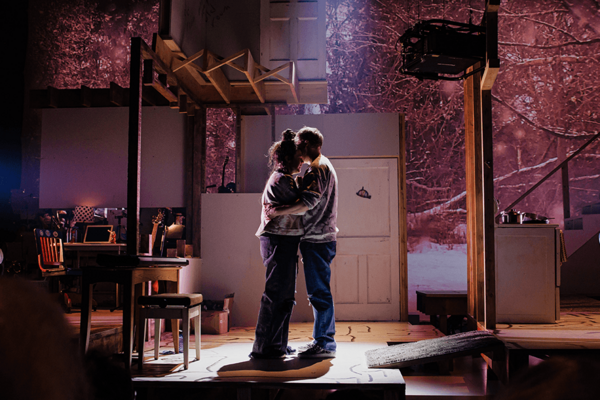
I’m talking to folk-punk musician and performer Shaun Bengson on Zoom when he says this. He and his wife Abigail have been performing their latest musical memoir in New York. Entitled My Joy Is Heavy!, the show recalls their experience getting pregnant and then enduring a miscarriage during the COVID-19 pandemic lockdown, all while caring for their young son.
By turns ferociously honest and buoyantly playful, Abigail and Shaun are not your typical performers. And in its exploration of the strange wellspring of life they found amid devastating loss, their show offers a way of thinking about joy that is unique and revelatory.
By turns ferociously honest and buoyantly playful, Abigail and Shaun are not your typical performers.
At the start of My Joy Is Heavy!, the Bengsons walk onto the stage holding two potted plants. One, they explain, remembers all those who died during the pandemic. The other represents all those yet to be born. They entrust the two plants to audience members on either end of the first row of the house for the duration of the performance, asking them to see themselves as taking care of those who are being remembered.
“We wanted to acknowledge and remember the wild loss of that time,” Shaun explained to me. Yet, knowing how daunting it might be for some to consider returning to the pain and madness of lockdown, they also saw the plants as perhaps helping people reenter that time. “We were trying to think of a place to begin that hopefully had some generosity and also softness, gentleness.”
The story that follows consists of Shaun and Abigail singing and speaking directly to the audience on a largely open set meant to recall the home they were living in during the pandemic. There’s a futon on one end, and a dining area on the other. On the refrigerator, magnets pin up pictures drawn by their son. They walk us through the music they were trying to write in lockdown, the videos they created as part of a grant, the mental and physical challenges of lockdown.
But the beating heart of their story is their desire to try to have a second child. The early going is marked by the frustration of failure and the violation of various medical professionals’ cold words and intrusive techniques.
Eventually, they do get pregnant. But that success creates shadows of its own. They had suffered a miscarriage in the past. Initially, the fear that they might be forced to endure such a tragedy again infects everything. “Early on we had this feeling like if we could just protect ourselves enough, that it would make the loss less of an impact if that’s what would happen,” Shaun said.
Seeing what their fears were doing to them, they decided to try to live out of what was rather than what might be. “We made this conscious attempt to just live in joy with this pregnancy rather than in fear,” he said. “We really did attempt to just live in happiness and joy of that little being.”
The Bengsons’ work frequently involves phrases or sounds repeated over and over. Like the melodies of Taizé, the repetition creates a sense of ongoing exploration, transforming the meaning of the words and drawing us deeper. Shaun, who “come[s] from pastors,” noted that mantras have often played a Psalm-like role in their lives. “The Christian writer [Walter] Brueggemann talks about how different Psalms will resonate with him in different chapters of his life,” he said. “One Psalm sings to him and he goes through it and goes through it and goes through it. And then eventually it loses its power, and another one emerges.”
READ: The Radical Faith of Walter Brueggemann in 10 Unforgettable Quotes
Similarly, for he and Abigail, mantras are sometimes “like a home base that you come back to,” he said. “Then you sort of spiral off, and it’s the thing that helps you get back to center. And there is the potential for new layers of meaning with each return.”
“I’d like to be happy,” they sing over and over as they think through a different, less fearful way forward. “I don’t want to wait.” As they repeat the words, the music blossoms around them into an almost childlike sense of celebration. And somehow, in the horrifying moment later, in which they realize they have actually lost their baby, they discover that alongside their grief, that joy somehow remains.
“I think it’s a really courageous thing to open yourself to love and to open yourself to joy,” Shaun said, “because the cost of it is also no joke. But the things that we were thinking about were how grief and joy are like two sides of a coin, or the same thing over a spectrum of time. The depth of the grief shows the depth of the love. You don’t have the one without the other.”
The show ends in an extraordinary New Orleans second line parade through the theater, during which Abigail describes the “heavy joy” they have found that comes “at the very beginning” and also “the very end of a life.”
“I am not trying / No I’m long past trying / To mend to mend this broken heart,” Abigail sings, dancing through the theater with her husband and their band. “I am just trying to hold all the pieces / And honor and honor every part.”
During a recent appearance on The Tonight Show, the Bengsons performed this closing number.
In the Easter season, Christians return to the idea of “Easter joy.” But rarely do we interrogate what that could possibly mean. Yes, Jesus is risen from the dead. But he was also brutally murdered, and he still has the wounds from those events. In fact, they’re not even healed over. A Christian vision of joy somehow has to account for all of that as well.
The afternoon I saw My Joy Is Heavy! I was asked to hold the plant meant to remember all those who had died during the pandemic. As the show went on, the simple physicality of holding this pot kept drawing me back to all those people we lost. They were so present to me while the pandemic was going on, and yet once it was over, I largely left my thoughts for them behind.
As the performance went on, I noticed the planter feeling heavier. Perhaps it was a reflection of the feelings the pandemic and the show brought up. Or maybe when you continue to hold something for a long while, it simply gets harder. And yet, looking at the gorgeous living plant in my hands, I found myself less sad than grateful to have been asked to be present and care for the dead in this way.
“From birth into death we have this little moment where we get to be alive together,” Shaun told me. Maybe Easter joy is what happens when you allow yourself the freedom to move beyond mending and simply hold all the shattered pieces our little moments contain.
My Joy Is Heavy! completed its opening run at The New York Theatre Workshop on April 12. The EP of the show’s soundtrack is available on music streaming platforms.

Jim McDermott is a freelance screen and magazine writer in New York. He writes a Substack on pop culture and spirituality at Pop Culture Spirit Wow.
Did this article have an impact on you? Tell us how! Whether you’re moved to take action, have a question, or want to share a comment (good or bad), we value your feedback!