This piece contains spoilers for The Drama.
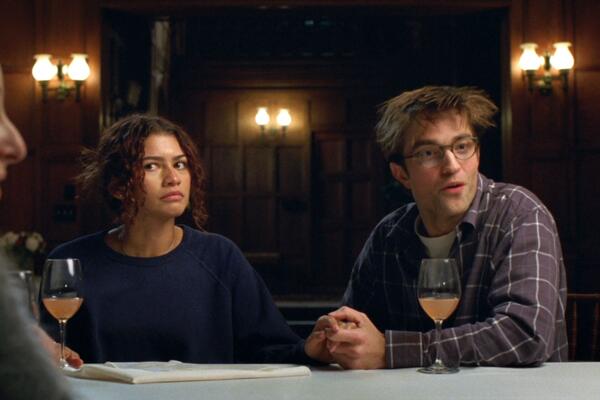
There’s a moment in The Drama that has stuck with me. In the midst of an existential spiral about his fiancée Emma’s (Zendaya) past, Charlie (Robert Pattinson) talks with some less-than-understanding friends and tries to somehow contextualize and produce empathy for her actions. He latches onto something he heard in passing about Emma’s childhood: that she had a neighbor who died in a car accident. The way that he retells the story, though, makes it sound as though this event was a traumatic origin story that totally reshaped her young psyche—even enough to explain her turn toward fantasies of violence later in childhood.
As Charlie retells the story, images flash on the screen imagining different versions of the event; the car crashing into a tree in a neighborhood; young Emma watching the crash firsthand; Emma grieving alone with no one to help her process it.
It’s an appealing narrative. And there’s truth in it; Emma did have a neighbor who died, and these things can impact children. But to claim that Emma’s plan, years later, to commit a mass shooting at her high school was the simple cause-and-effect result of this particular trauma is a convenient and romantic oversimplification.
We all search for easy and certain explanations for the unpalatable pieces of human experience we find incomprehensible. What The Drama posits, however, is that sometimes it’s better to sit in the unease and find room for grace in its midst.
The Drama has provoked much passionate conversation since its April 3rd release date. Some have argued that the way the film employs the subject of mass shootings as a “twist” not referenced in the trailers is insensitive to the gravity of the topic and the need for trigger-warnings. That’s a perspective I can understand; I think the film would have remained effective and sobering even if that detail were made more explicit before its release.
That said, I have some respect for the way director Kristoffer Borgli catches his audience off guard; viewers enter the film expecting a satirical rom-com starring two of our hottest young actors and leave with sobering questions about the human condition. What is the worst thing you’ve ever done? Who is beyond the reach of forgiveness and grace? Is it possible to truly know a person? How can we remain in relationship in the face of our gravest sins?
READ: How Long Can a Marriage Ignore the Wound?
These questions cut straight to the core of who we are. The way the film confronts our cultural norms makes it feel not unlike one of the parables told by Jesus—complete with wedding imagery bathed in spiritual subtext.
Weddings, after all, are a poetic picture of the unification of two disparate things—namely, unique human beings, who despite their nature must be different and yet also become one. Heaven and earth, the sacred and the profane, the lion and the lamb. The tale of God’s redemption of all things is a story of a cosmic wedding feast where the seemingly irreconcilable is brought together in unity and celebration and paradoxical grace.
The tale of God’s redemption of all things is a story of a cosmic wedding feast where the seemingly irreconcilable is brought together in unity and celebration and paradoxical grace.
In order to make sense of our differences, though, we must allow ourselves to be truly known. Emma is brutally confronted by this reality when her darkest secret—that she once planned a mass shooting in high school—spills out in front of her fiancé mere days before their wedding. Charlie is left reeling, trying to make sense of it all. In his confusion, he at first toggles between vast oversimplifications, wondering if Emma has an inherently psychopathic personality or if she was completely influenced by external traumatic events.
The topic of gun violence in the U.S. is one plagued with similar oversimplifications. In an attempt to deflect blame from the way they’ve enabled the gun-worshipping culture in this country, conservative politicians often redirect the cause of mass shootings to amorphous issues like mental health or hyperviolent videogames—all while doing virtually nothing to actually address these social problems.
Make no mistake, those are issues in the U.S.—and they aren’t completely irrelevant. Just as it is perfectly conceivable that Emma’s tragic loss of a neighbor in childhood could have somehow influenced her spiral into violent urges years later, it is perfectly conceivable that violent videogames could prime a young and lonely man toward gun violence himself. But anyone who truly believes these factors are sufficient or comprehensive explanations for what has occurred is kidding themselves. The reality is messier and murkier, and it often features culprits that the storyteller would rather avoid addressing: the easy access of guns in this country.
People on the political Right and political Left often fall into two separate tendencies when it comes to addressing issues of moral culpability. Those on the Right tend to exclusively blame individuals for the sins they have committed while conveniently ignoring the systemic factors (such as poverty, gun access, lack of health care, or otherwise) that exist around them. Those on the Left tend to highlight systemic and legislative factors in a way that, at least sometimes, obfuscates the reality that even in a perfect system, humans will sin.
Reality, and grace, are just messier than all of that.
In The Drama, Emma never tries to frame her past with easy answers. She was mistaken, perhaps, for burying the dark truth for so long, and for believing she would be able to exist in an intimate relationship with another person pretending that it never happened. But once the truth comes to light, there is no point in the film where Emma reduces or waves away her 15-year-old self’s thoughts or actions as a mere byproduct of deterministic forces around her, or straightforward victimization. Emma sits, instead, in the confusing and distressing reality that she really wanted to do what she wanted to do—that she thought it was cool—even when this makes her feel borderline alien to the others around her. She is earnestly repentant, but she does not assume this repentance makes her good or noble or heroic. If anything, she holds the opportunity she was given to change course as an undeserved gift.
Human beings and the world around us are complex, mysterious, and full of paradoxes. Theologian Francis Schaeffer once said we are glorious ruins, embodying both the holy image of God and the brokenness of sin. It can be tempting to try to tell a simpler story—but that is not, truly, the way to lasting peace. There is a mysterious and discomforting reality that some things just are; the broken systems are real, and the individual choices within them are real, and the human heart is full of profound innocence and profound treachery—but sorting it all out requires divine humility and grace.
Grace, then, is not just an overly charitable explaining away of sin, an easy piece of context that softens the blow of our choices. Grace also isn’t a rigid insistence on individual blame coupled with an offer of forgiveness in spite of it. Instead, grace is often a humble acknowledgement of the painful mystery of the human experience. The ways we bear the inflicted scars of living in a broken world and the fact that we willingly participate in perpetuating that brokenness nonetheless. The acknowledgement that none of these things can be untangled from each other, and the recognition of that complexity. The belief that thorny people with repentant and humble and messy hearts are better than easy explanations and certain answers.
Each of us is, after all, like Emma: a bride with dark secrets and grave sins staining our white gown. We all have need for a clear-eyed bridegroom who will sit at the table with the unclean and wash away every stain, even when the mud and blood and muck themselves are beyond our own understanding.

Georgia Coley is a documentary filmmaker and culture writer living in Nashville. She writes about the intersection of trans experience and theology at her Substack, Georgia In Her Mind.
Did this article have an impact on you? Tell us how! Whether you’re moved to take action, have a question, or want to share a comment (good or bad), we value your feedback!