From Texas to Iowa, numerous Christian candidates have campaigned with their commitments to faith and social justice front and center.
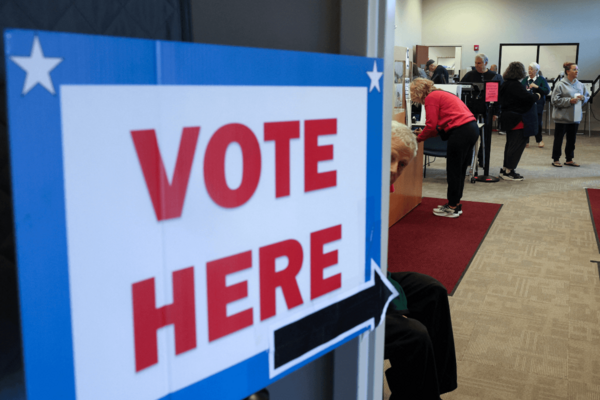
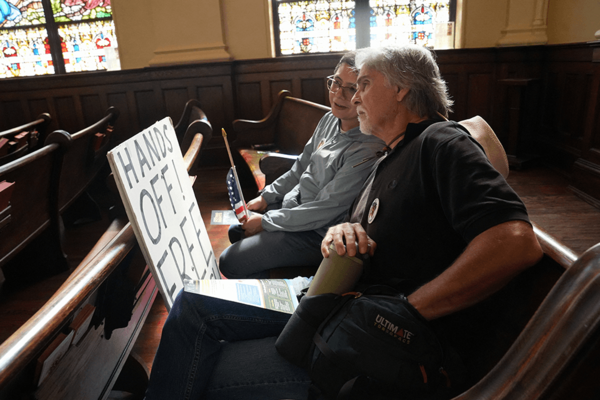
It’s not unusual to see pastors and faith leaders serving as poll chaplains, leading voter drives, or working alongside election officials to ensure a safe election. And while decades of Republican politics have leaned on Christian language in their campaigns, this year, a surge of progressive Christians have utilized the language of faith and morality to pitch voters on their candidacy.
As results roll in, Sojourners will be tracking how these candidates fare and their reaction to the results.
This is a live article and will be updated. Last updated on Nov. 4,10 a.m., Eastern time.
James Talarico: WON
Democratic candidate for U.S. Senate from Texas
James Talarico is a Presbyterian seminarian whose faith was been a centerpiece of his campaign, which focused on economic inequality and its corrosive effect in politics.He defeated his opponent Ken Paxton, flipping a Texas senate seat that had not been held by a Democrat for nearly 40 years. “Every single person bears the image of the sacred; every single person is holy — not just the neighbors who look like me or pray like me or vote like me,” he said on his campaign website. “Those billionaires want to keep us from seeing all that we have in common.”
Growing up in St. Andrew’s Presbyterian Church, a Presbyterian Church (U.S.A.) congregation in Austin, Talarico highlighted his pastor Jim Rigby’s decision to ordain gay and lesbian elders and bless same-sex unions in the early 2000s as formative for him. Speaking to Ezra Klein at The New York Times, Talarico said, “The genius of Christianity — the miracle of Christianity — is not the claim that Jesus is God. It’s that God is Jesus, meaning that Jesus helps us understand the mystery.”
Talarico’s campaign raised more than $134 million , including $64 million in the third quarter, breaking records for a senate candidate. The large sum is still less than the $200 million spent on behalf of Paxton, nearly all of which came from Elon Musk, according to The Texas Tribune.
In his victory speech on Election Night, Talrico likened his win to the Bible story of David and Goliath, and drew attention to Musk’s fundraising and President Donald Trump’s support for his opponent: “In this race, we went up against our own Goliaths, the richest man in the world, the most powerful man in the world, and the entire Washington, D.C. establishment,” he said.
Rev. Sarah Trone Garriott: WON
Democratic candidate for U.S. House of Representatives from Iowa’s 3rd District
Sarah Trone Garriott is a minister in the Evangelical Lutheran Church in America denomination, whose campaign focused especially on affordability for Iowa families and holding politicians to a higher ethical standard. On election night, she defeated incumbent Zach Nunn.
“The challenges ahead are significant, but the hope we have is stronger.,” she said in her victory speech. “The love we have for our neighbors is so much more powerful, and we know the truth. The truth that when people come together on our common ground, we will do powerful things.”
On her campaign website, she highlighted her time working at a women’s shelter and a nonprofit for youth while at Harvard Divinity School as formative for her faith. She is a state senator and has spoken against Christian nationalism from her perspective as both a minister and public servant.
Speaking during the campaign of the flux of openly religious candidates on the Left, she toldThe 19th’s Mariel Padilla that “people are realizing that there’s been a vacuum that was created by well-intentioned people not talking about how faith and politics intersect, and the vacuum was filled by the religious right.”
Rev. Lindsay James: WON
Democratic candidate for U.S. House of Representatives from Iowa’s 2nd District
In another Iowa district, Presbyterian Church (U.S.A.) minister Lindsay James ran on a platform that included bringing down the cost of living and policies meant to end political corruption in Washington, D.C. She will succeed Republican Rep. Ashley Hinson, defeating her GOP opponent, housing developer Joe Mitchell.
She has served as a state representative since 2018 and previously worked as a college chaplain; her first televised advertisement this election cycle connected that ministry work to her campaign. “I became a chaplain to serve people in their hardest moments … And I’m a fighter,” James said.
Speaking to Motherly, James said she hopes her children’s takeaway from the campaign is “the importance of stepping up for your deeply held moral beliefs. We can make the world a better place and give them the life they deserve, but it will take sacrifice to achieve.”
Rev. Frederick Haynes III: WON
Democratic candidate for U.S. House of Representatives from Texas’s 30th District
Frederick Haynes III is senior pastor of Friendship-West Baptist Church in Dallas and has made his four-decades career as its pastor a major part of his campaign. He’s also served as a trustee for the Samuel Dewitt Proctor Conference and as a member of the board of directors for the Conference of National Black Churches. He defeated his GOP opponent Everett Jackson.
His campaign highlighted his commitment to representing the diversity and values of his community, his perspective as an “outsider” to politics, and his commitment to the underserved. “[O]ur diversity should never be just a statistic; it should translate into power, opportunity, and equitable policy outcomes,” he wrote on his campaign website.
Haynes plans to remain in leadership at his church, following in the footsteps of several other Black pastors who also served in elected positions. Speaking to Adelle M. Banks at Religion News Service, he acknowledged that he receives pushback for his approach to faith and politics.
“I’m in one of the capital states for white Christian nationalism and, as a consequence, our approach is in the minority, a decided minority,” he said. “But I also believe that there is a real surge among those who are looking at the policies that go with white Christian nationalism, and they’re saying there’s something about that that’s not right.”
Pastor Robb Ryerse: LOST
Democratic candidate for U.S. House of Representatives from Arkansas’s 3rd District
Robb Ryerse and his wife Vanessa are the founding pastors of Vintage Fellowship, a nondenominational progressive church in Fayetteville, Ark. Ryerse is also the political organizer for Vote Common Good, a political nonprofit headed by Doug Pagitt that trains progressive candidates. Ryerse previously ran for Congress as a Republican in 2018, losing the primary by almost 70 percentage points to incumbent Rep. Steve Womack. He fared significantly better on Tuesday, losing by about 13 points.
This year, he criticized Womack, saying in debates he had “bent the knee to the military industrial complex,” according to reporting from Antoinette Grajeda at the Arkansas Advocate. His campaign focused on how his faith compels him to protect democracy and his desire to deepen honesty in politics.
“Faith means telling the truth about each other,” a campaign webpage reads. “We are not enemies. We are neighbors. And we’re responsible for what we build together.”
He has said he grew up in evangelical and Christian nationalist expressions of religion, but that his interpretation of scripture changed rapidly, and he saw there was a “different way to integrate faith and politics.”
“I’m not running to take America back for democratic Jesus,” he said. “It’s not like a progressive version of Christian nationalism. I’m running because my faith motivates me personally, but the Bible’s not the basis for laws.”
Chris Jones: TOO CLOSE TO CALL
Democratic candidate for U.S. House of Representatives from Arkansas’s 2nd District
Chris Jones is an ordained minister and a rocket scientist. He ran an unsuccessful campaign for governor in 2022, but this year’s candidacy has garnered national attention and support from figures like Kamala Harris and Pete Buttigieg. His campaign focused on affordability, accountability, and increasing economic opportunities for all.
Jones told Capital B’s Brandon Tensley that the country needs elected officials who understand both faith and math.
“Part of what I learned from my faith is that we are all created in a special way to do a special thing. No one is better than the other, and we need one other to survive — we need one another to thrive,” he said. “My faith teaches me: Love your neighbor as yourself. Period. Not: Love your neighbor as yourself if they also have a Ph.D. or if they’re also Black or if they also have nine zeros in their bank account behind the first digit.”
Rev. Adam Hamilton: WON
Democratic candidate for U.S. Senate from Kansas
Adam Hamilton is the pastor of Resurrection, a United Methodist megachurch with locations throughout the Kansas City metropolitan area known for its moderate political approach. Hamilton’s campaign focused on issues related to rising costs for consumers, affordable healthcare, and restoring “government ethics and real accountability” in Washington, D.C. He defeated incumbent Republican Sen. Roger Marshall, the first Democrat to win a Senate race in Kansas since 1932.
A self-identified evangelical, Hamilton has directly attributed his decision to run to the Holy Spirit. He described his evangelicalism to Jack Jenkins of Religion News Service as “that evangelical gospel of wanting people to know Christ, to surrender their lives to God, to invite the Holy Spirit to work in and through them‚ and then to go out and to work for justice and compassion in the world.”
Running in a state that President Donald Trump won by 16 percentage points, Hamilton has called his pocket New Testament the “defining story of my life,” and said that, though it’s not his place to judge the president, “based upon his politics and his rhetoric, there are times I think this does not look like Jesus in the gospels.”
“What it looks like to be a Christian is I get up every morning. I get down on my knees, as I did this morning. I lift up my hands next to my bed, and I just say Lord, I’m yours,” he told Politico’s Dasha Burns. “I belong to you. Do with me whatever you want. I pray for the Holy Spirit to fill me, form me, and lead me. I read the scripture every morning when I start the day, and I say help me to live this.”
Rev. Emanuel Cleaver II: WON
Democratic candidate for U.S. House of Representatives from Missouri’s 5th District
Emanuel Cleaver is a longtime civil servant, serving in the House since 2005 after a career in city politics, including as mayor of Kansas City, Mo. His campaign emphasized his record on Capitol Hill pushing back on Trump’s policies and his commitment to affordable housing. Starting in 2025, a Trump-backed redistricting plan attempted to divide Cleaver’s district, but was ultimately blocked by the U.S. Supreme Court and sent to voters as a ballot measure. On Tuesday, Cleaver defeated his Republican challenger Rick Brattin.
He’s also a United Methodist pastor and served as pastor of St. James Church in Kansas City from 1972 until 2009 when his son became senior pastor. While serving as pastor and representative, Cleaver used to write sermons on flights between Washington, D.C., and Missouri, according to CQ Roll Call. As a politician, he said he’s been careful not to impose his religious views on others—whether constituents or colleagues. When asked by CQ Roll Call about fellow member of Congress Rep. Mike Johnson, he said he doesn’t use scripture to try and convince others.
“But internally, I would say, ‘Defend the meek and the fatherless and the poor and the oppressed,’ which comes from the 82nd Psalm,” he said. “I’m not using a religious billy club on others. … I impose my faith on me.”
Anna Golladay: LOST
Democratic candidate for U.S. House of Representatives from Tennessee’s 3rd District
Anna Golladay is a progressive faith leader who has long advocated for inclusive faith. She lost her race against incumbent Chuck Fleischmann.
A United Methodist, she’s been a speaker at the Wild Goose Festival and works in communications for the Convergence, a theologically progressive nonprofit that does strategic planning for congregations. In 2018, Golladay was fired as a pastor from her Chattanooga, Tenn., church for officiating a same-sex wedding.
As a candidate, she emphasized her commitment to lowering the cost of living; support for rural communities, especially healthcare; pro-democracy efforts; and “honoring the sacred worth of every single person — without exception.” She told Ben Sessoms of the Tennessee Lookout that the year’s early protests against federal immigration enforcement inspired her to run.
“I watched Alex Pretti and Renee Good be murdered in the streets of Minneapolis, and it all changed for me,” she said. “We have a representative that is consenting to this kind of terror and is not speaking out against it.”
Speaking in 2015 about a tattoo she has, Golladay pointed to Jesus as the “anchor” for her faith: “[M]y faith is anchored in love, and I know the depth of that love through the sacrifice of Jesus.”

Did this article have an impact on you? Tell us how! Whether you’re moved to take action, have a question, or want to share a comment (good or bad), we value your feedback!