Across Latin America, faith-based organizations have a long history of accompanying and serving migrants traveling northward. But as the U.S. grows increasingly aggressive in its immigration enforcement, these ministries find themselves serving migrants flowing south, away from the U.S.
Yuni Ortiz Alvarez is the general coordinator of Casa Esperanza, an organization that provides meals and shelter to migrants traveling through the border town of Los Chiles in northern Costa Rica. She has been working in Los Chiles since January 2025 and has seen dramatic changes in migration flows since then.
“Until January 2025, people were going north,” Ortiz Alvarez told Sojourners. “Since February 2025, because of the Trump policies, people are returning instead.”
Ortiz Alvarez spoke to Sojourners twice, in November 2025 and March 2026. She said migrating south is harder, mostly because migrants no longer have the clear goal of a future in the U.S.
“Before, at least they were going with hope for a better future. Now, they’re coming back with an empty bag, no dreams, and some with the fear of not being able to return to their countries,” she said. “It’s a very demoralizing situation.”
Turbulent immigration enforcement
After turbulent immigration enforcement operations, with the Department of Homeland Security deploying thousands of agents across U.S. cities over the past year, recently appointed DHS Secretary Markwayne Mullin is emphasizing new strategies. DHS is still pushing an ambitious deportation agenda, but in ways less visible to the American public.
“Home is just a few clicks away!” DHS officials wrote on social media in March, in a post advertising a $2,600 “exit bonus” for immigrants who leave the U.S. voluntarily. Calls for “reverse migration” have become a cornerstone of the administration’s agenda. According to CNN reporting, the concept of “reverse migration” or “remigration” has a history going back to at least the 1930s, in the form of a Nazi plan to forcibly move Europe’s Jews to Madagascar. In recent years, the idea has gained a new following on the far right in Europe and the U.S.
In Costa Rica, Casa Esperanza is set up to provide two main services: free meals during the day, and a dormitory where migrants can sleep safely overnight. Between March and October 2025, Casa Esperanza served more than 26,000 meals and offered 7,153 nights of sleep in its shelter to more than 2,000 people. In previous years, Casa Esperanza, like other ministries, was supported by foreign aid grants from the U.S. government. That work has a new level of financial uncertainty, as funding support from the U.S. has dried up.
Casa Esperanza’s dormitory was funded mainly through UNICEF, whose $142 million in US funding was taken back by Congress as part of its July 2025 rescissions package. The dormitory closed in October 2025 after having been open intermittently for about six months that year, Ortiz Alvarez said.
“Thanks to some small donors and the work of some of the people who support the dining hall … we operated at almost 20 percent.” The meal services, meanwhile, were able to continue until April 2026 thanks to European contributions to the World Food Programme, Ortiz Alvarez said. She told Sojourners that Casa Esperanza had secured funding for the dormitory from UNICEF for the next four months.
READ MORE: What Advocates Want Churches to Know About Defending Migrants
Sister Adriana Calzada, working on the other end of Costa Rica in Paso Canoas, mentioned similar funding challenges. Calzada is affiliated with the Sisters of Charity of the Incarnate Word. On a typical day, the sisters work to purchase and distribute food to migrants passing through from a canteen they operate out of the local Catholic church. Calzada told Sojourners that since January 2025, roughly 98% of the people passing through Paso Canoas are on their way south.
The sisters don’t receive government funding for their migrant support work, but they’ve had to deal with the ripple effects of Trump administration decisions to cut humanitarian aid. Calzada emphasized that even while the Sisters of Charity of the Incarnate Word have been able to keep working, many other organizations have been forced to pause or seriously limit their operations. When former partner organizations close their doors, Calzada said her work in Paso Canoas has increased, and life for migrants has become more difficult.
Additionally, not all organizations are equipped to provide the same services. “We can’t offer people medical attention,” Calzada said of the gap in care that she and her colleagues can’t fill. “The other concern is the legal focus, especially those who work connected with government authorities.”
Many of the people passing through Paso Canoas heading south are Venezuelans who had been waiting in Mexico for their asylum applications to be processed by the U.S. Those with credible claims of threats against them in Venezuela, Calzada said, “were still hoping for a possibility to enter the United States. Now that this chance is no longer real, even these people are starting to come back.”
WhatsApp Image 2025-11-20 at 13.12.13 (1).jpeg
‘They decided to leave the U.S. because they know when they’re not wanted’
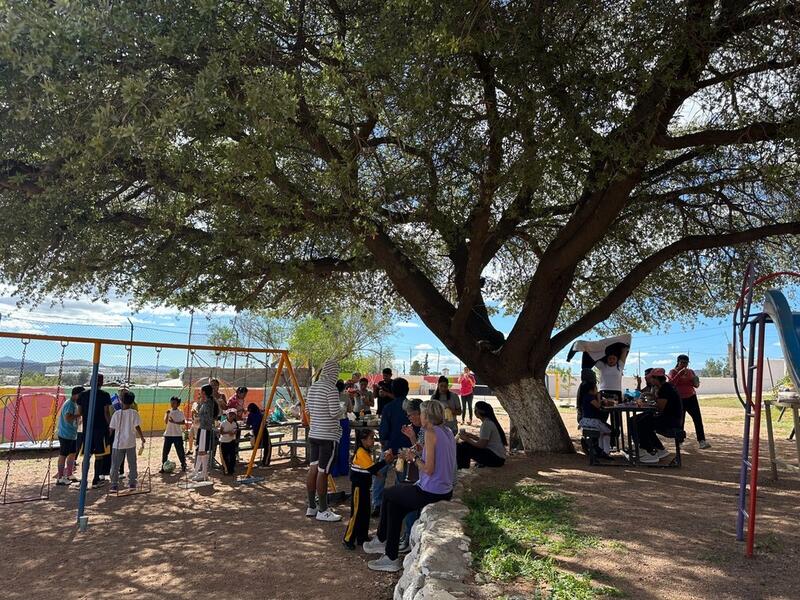
One haven for asylum seekers is Casa de la Misericordia, on the Mexican side of the border in the city of Nogales, directly across the border from Arizona. Alma Angélica Macías Mejía started the ministry just before the COVID-19 pandemic. Macías Mejía is better known as Sister Lika in Nogales, and her team works to provide a resting space for migrants waiting near the border.
“I believe that when people migrate, they do so as whole people: physically, psychologically, socially, and transcendentally,” Sister Lika said. “Our goal is to save lives and to bring people to a point of health, wholeness, and strength.”
Casa de la Misericordia has been stretched thin over the past few months, after foreign aid cuts from the U.S. forced several of its partner organizations, including HIAS and the U.N. High Commission for Refugees, to stop operating in Nogales. Sister Lika told Sojourners it’s difficult to keep operating their school without volunteer help. However, they have found a renewed sense of purpose as the situation for migrants gets more difficult, whether they’re going north or south.
“People show up here, and they’re confused, scared because of what they had to live through,” Sister Lika said. “Sometimes, they walked here on their own feet, they decided to leave the U.S. because they know when they’re not wanted. Others, they say they got a deportation letter and so here they are.”
Sister Lika is proud that Casa de la Misericordia has been a safe place for people leaving the U.S.
“First, people tried to ask for asylum in the United States,” Sister Lika told Sojourners, “And now that the United States isn’t in condition to give asylum, we’re becoming the ones who welcome the displaced, those who have no place to go, those who want a better life and a stable existence.”
‘This story has been happening for a long time’
After seeing how pressure from the first Trump administration hardened the Mexican government’s treatment of migrants within Mexico, Natalia Serna started a community home where migrants could wait safely while planning their next steps. Serna says this was often formal refugee status in Mexico before getting the same designation in the U.S.
Serna said friends of hers who run a shelter in the city of Chihuahua that can at times host hundreds of migrants have also shifted their work to focus on supporting indigenous people in Mexico.
“I can’t say it’s like that everywhere in Mexico, but I think in many of these places, you know, there’s less migration, there’s less people trying to come north,” Serna said. “Those that are coming north aren’t using the shelter systems and because the enforcement is so aggressive people are really taking routes where they’re moving in a way that’s more invisible.”
READ MORE: ‘We Are Full of Fear, but We Are Not Helpless’
Serna emphasized that a harsh anti-immigrant stance has long been the U.S. policy.
“This story has been happening for a long time, and I think for folks that have been on the south side of the border receiving deportees, honestly, some of the cruelest years were at the beginning of the Obama administration.”
The early years of Obama’s second term saw record numbers of deportations, according to statistics from DHS. The Trump administration claims to have deported a new record of more than 500,000 people in 2025, but evidence shows those claims are false.
“What’s new is how outspoken and hateful this administration has been,” Serna said. “Which in some ways honestly I’m thankful that they’re doing this in the light of day, because that way people can really see what’s happening and can make a choice to do something about it.”
Back in Costa Rica, migrant advocacy groups are still reckoning with all the consequences of the new reality for migration. Starting in February 2025, Costa Rica accepted 200 third-country nationals who were deported from the U.S. as part of a government-to-government agreement.
Isela Loría, head of operations for the Jesuit Migrant Service in Costa Rica, told Sojourners that working to provide care for migrants deported to Costa Rica has been an unexpected challenge that came from the change in U.S. policies.
“It’s really been a change in the people we’re serving,” Loría said. “They’re coming from conditions that re-victimize them more than ever before, and the profile of the average migrant now isn’t who we’ve been used to working with in the past.”
Christopher Pérez, a project manager for the Jesuit Migrant Service, said that a “message of hospitality, reconciliation, solidarity, and peaceful coexistence” is more important now than ever. Pérez is hopeful that the Jesuit Migrant Service will be able to chart a path forward by deepening partnerships with other religious organizations working to support migrants.
Despite the uncertainty of what’s next for migrant support services in Costa Rica, Ortiz Alvarez told Sojourners that faith keeps her motivated to serve.
“I think if Jesus were here, he would put on a t-shirt and come down here and he would make food and support all these people who are unprotected,” she said.
“I think if Jesus were here, he would put on a t-shirt and come down here and he would make food and support all these people who are unprotected.” —Yuni Ortiz Alvarez

Did this article have an impact on you? Tell us how! Whether you’re moved to take action, have a question, or want to share a comment (good or bad), we value your feedback!