Tate Young is a reporter in Washington state. They were a reporter for the 2025 Sojourners Journalism Cohort.
Tate is an unashamed news junkie and overthinker looking to share stories concerning environmental justice and politics.
Coming from a background in anthropology and multimedia journalism, they deeply enjoy digging into people’s relationships with their environment, and how those relationships might be driving change or being changed by outside factors. Breaking down environmental and sociological concepts in an accessible way is a passion and goal for them. On the political side, Tate is especially interested in topics that relate to the public’s access to fair information and human rights. They believe that the path to a less afflicted society means getting serious about the fact that the basic necessities of life should be considered a default for everyone, not a privilege.
Honesty, precision, and ethical journalism are of the utmost importance to them in their work. Outside of work, Tate enjoys wilderness backpacking, drawing in their sketchbook, and capturing the moments around them on camera. They get sidetracked down information rabbit holes frequently, and anyone looking to speak with them should have a blanket warning that they may trap you in conversation about their latest focus.
Posts By This Author
Why Your Church Should Start Visiting People in Prison
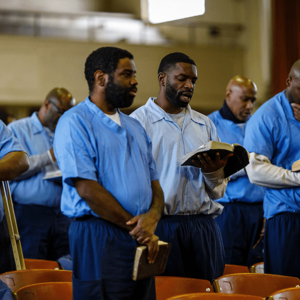
While each of the nearly 2 million incarcerated people in the U.S. has their own story, they all share one experience: losing access to their neighbors on the outside.
The majority will be released after their sentences are served, but an atrophied social life and the stigma of incarceration mean they face a long uphill battle to take care of themselves, much less fully rejoin society. Christians have long stepped into this gap, many seeking to live out Jesus’ parable in Matthew 25 and visit those in prison. In the era of mass incarceration, religious volunteers visit incarcerated people to bridge the gap between them and life outside.
In March, Families Against Mandatory Minimums, a nonprofit devoted to fighting unjust prison policies, launched its “Visit a Prison” campaign, urging lawmakers and faith groups to visit their local prisons, including a guide for people interested in getting involved with incarceration ministry.
Israel Is Blocking Palestinians from Easter at Church Where Jesus Resurrected
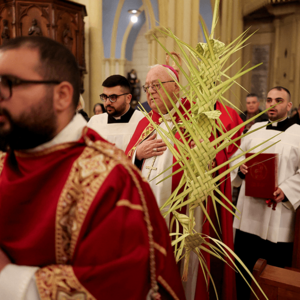
As Christians across the globe remember Jesus’ journey through Holy Week, Israel is taking the unprecedented steps of restricting access to holy sites in Jerusalem.
Israel is blocking access to the Church of the Holy Sepulchre, as well as the Western Wall, and the Al-Aqsa Mosque complex indefinitely after the outset of the U.S.-Israeli war with Iran, impacting typical observance of the Christian Holy Week, Ramadan, and Passover and restricting travel into East Jerusalem.
For Palestinian Christians, it would mark the first time that access to the church—which is known as the site of Jesus’ crucifixion, burial, and resurrection—is blocked over Easter. Historically, thousands of Christians around Jerusalem have traveled to the city and church as part of their Easter celebration.
Here AI Am to Worship?

As artificial intelligence-generated songs and musicians multiply across streaming platforms, Contemporary Christian music audiences and creators are reckoning with the technology’s meaning for the booming genre, the opaque industry, and the very heart of Christian music.
In November 2025, Christianity Today reported on Solomon Ray—an AI-generated artist who boasts 499,000 listeners on Spotify. But Ray is not the only CCM AI artist garnering thousands of listeners. Minimal artist descriptions, quick release schedules, no contact methods, no website, and no tours or physical appearances are all indicators of potential AI-generated artists, and CCM has no shortage. Smaller accounts still have thousands of monthly listeners, including the likes of Jaxon Maverick Phoenix at over 39,000, The River Sons 59,000, and Glory in the Ruins 68,000.
Their music is nothing elaborate and draws firmly from the CCM tradition: “I’ve read the words, I know they’re true but some days they feel far from view / I’m still holding on to what you said, even when the lies scream loud instead,” are some lyrics to “Faith Over Fear,” by The River Sons. The band’s page description is equally vague.
Chicago Clergy Win Court Order Against ICE. Will ICE Comply?
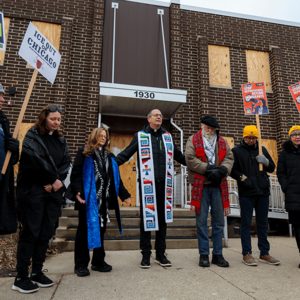
A federal district judge ruled that government authorities must allow clergy to minister to Broadview Processing Center detainees on Ash Wednesday this Feb. 18. The order, if followed, fulfills a year of organizing by Chicago area clergy to minister to detainees of Immigration and Customs Enforcement within the oft-protested facility.
The government and its officials substantially burdened the exercise of religion by the clergy group who brought the lawsuit and made no argument that the burden was “in furtherance of a compelling governmental interest, and that it is the least restrictive means of furthering that compelling governmental interest,” according to the injunction, written by Judge Robert W. Gettleman.
Chicago Faith Communities Say ‘Joy’ Is Key to Resisting the Feds
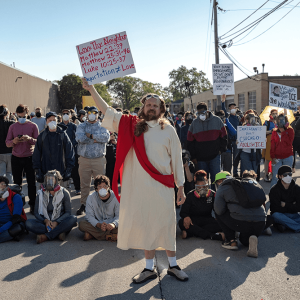
In response to ongoing federal threats from President Donald Trump, Chicago faith leaders organized a surge of solidarity to protect the most vulnerable. Alongside a deep pride for their city, some of the organized actions share a critical motif: joy.
Community leaders in Chicago were already alert to the threat that Trump posed to immigrant communities in Chicago when the president began hinting at sending the National Guard into the city to support Immigration and Customs Enforcement agents and cut the crime rate of what he falsely claimed to be the most dangerous city in the world. For some of the faith leaders, it was important that they protest not just the dangerous influx of troops, but also the false narrative surrounding their city.
“We’re called to be constantly rejoicing,” Rev. Juan Pablo Herrera told Sojourners. “It’s a spiritual strength that we can have in times of negativity coming against us, that we can choose to live with joy as a way of defying the forces of principality.”
Arkansas Faith Leaders Call for Systemic Solutions, Not More Executions
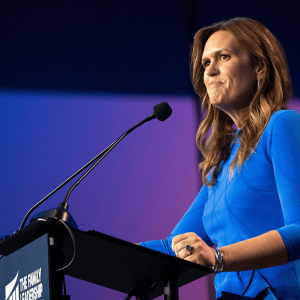
Faith leaders are speaking out against Arkansas’ efforts to expand its options for carrying out the death penalty, calling for the state to address the root causes of violence rather than doubling down on punishment.
“Some will say, if you really do the research, you’ll find a more humane way for us to kill each other. I say, if you really do the research, you’ll find the laws that won’t put us in that position to begin with,” said Rev. Paul Beedle of the Unitarian Universalist Church of Little Rock.
Beedle joined more than 40 faith leaders signing onto a letter urging Republican Gov. Sarah Huckabee Sanders to refrain from authorizing nitrogen gas as an execution method. Seven leaders gathered and spoke at the state’s capitol in Little Rock on Aug. 21, then delivered the letter to the governor’s office themselves.