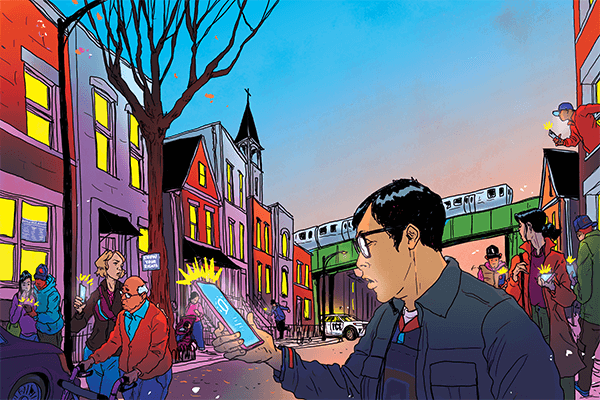
AS ORGANIZERS IN her city began preparing for the No Kings protest in October 2025, Erin Groble thought seriously about whether she should attend. On the one hand, she felt the need to do something. She was raised Lutheran and attended the Jesuit Loyola University in Chicago, and the increased presence of federal agents in Chicago challenged her to figure out what it meant to love her neighbor. On the other, she was genuinely scared at the possibility of being physically harmed or getting into conflict with authorities.
“I realized it just wasn’t really authentic to who I was. It just didn’t feel like the right thing for me to do,” Groble told Sojourners. “But then I started thinking, ‘OK, well, what is the right thing for me to do?’”
Groble was already part of a group chat organized by Brendan Curran, a Catholic priest and community organizer with The Resurrection Project. Curran had brought her block about 50 yard signs advertising “Know Your Rights” information via QR codes. Groble and her neighbors had planted a few of the signs, but there were plenty sitting in her neighbor’s home. “Yard signs are kind of hard to put up—especially in the city!” Groble said. “You have to find a place to put them; there’s a lot of concrete here and a lot of the soil is compacted. So, you need a lot of determination. I just went on my normal walking route, and in front of schools, by parks, by bus stops, I put them all up.”
The foremost goal of the signs is to share information. Her neighbors need to know their right to remain silent, refuse searches and entry, and to speak with a lawyer. But secondly, she hopes the signs send a message: “We have a lot of Ukrainian neighbors; we have a lot of Latino neighbors who have lived in this neighborhood for a long time or who come to work in this neighborhood,” she said. “It’s important to me that if there are people who feel scared right now, they at least know that their neighbors support them.”
Groble is one of many examples of people living in communities such as Chicago, Washington, D.C., Portland, Ore., and Charlotte, N.C., where the Trump administration has increased deportation efforts. Where the targeting of migrants has ramped up, so has the organizing to resist.
In Chicagoland, images of protests at the Immigration and Customs Enforcement facility in the suburb of Broadview have taken center stage: State and federal agents have dragged, sprayed at point-blank with chemical irritants, shot with pepper balls, and blocked clergy trying to bring communion to those detained. But solidarity is not just expressed in direct protests, it’s also creative companionship in the day-to-day. Neighborliness is trying to meet a moment where many are no longer safe to participate in tasks such as grocery shopping, taking the bus to work, or picking kids up from school. It’s work that organizers say is critical: Not everyone can risk getting tear-gassed by U.S. Customs and Border Protection agents or go toe-to-toe with ICE, but everyone can do something.
Not everyone can risk going toe-to-toe with ICE, but everyone can do something.
janfebatenciofeatureB (1).png
Networks of support
THE FIRST STEP to many volunteer networks is communication. Email listservs and group chats serve as the starting ground for organizing smaller communities such as neighborhood blocks or churches. In recent months, many activists have moved to using WhatsApp or Signal—messaging platforms that feature end-to-end encryption, which offers more security for sensitive information.
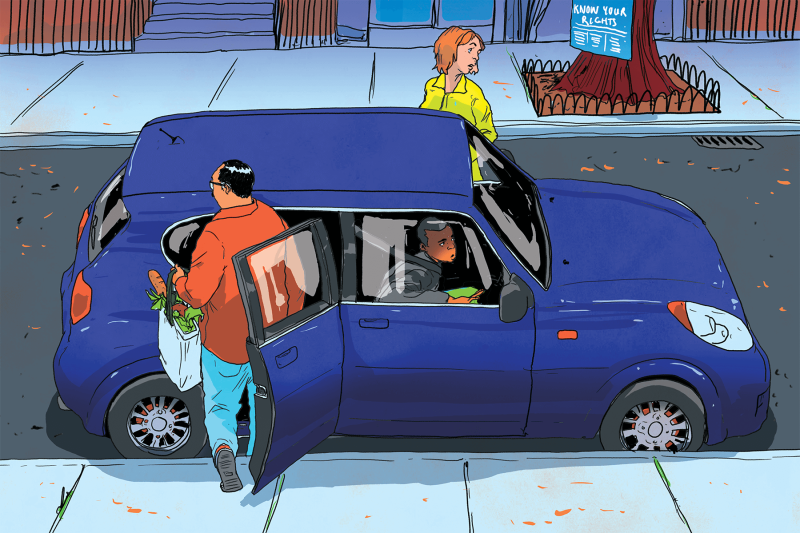
From there, a group can message any time there’s a tangible need. Kristen, whose last name Sojourners is withholding to protect the people she supports, found her way to serve through one of these groups. She moved to Chicago more than a decade ago for school. After graduation she ended up in a suburb of the city, but she liked her United Methodist congregation so much that she kept commuting.
A predominantly white church, her congregation had been a site of relief during the 2020 racial justice uprising—a place people could stop in for hospitality or care in the middle of a protest. Her church has a sister congregation that is primarily Latino, and her pastor operates a Signal chat for opportunities to serve. One day, two opportunities came in to offer rides to people connected to the Latino congregation who no longer felt safe taking public transit. At first, “It wasn’t necessarily a recurring thing,” Kristen said. “It was just ‘This person needs a ride tomorrow, who can do it?’” But when the second request came in, she asked to see the person’s full schedule. She’s been giving him one or two rides a week since then. “I mean, I definitely was planning to drive this man once, and after that I was like, well, he needs to get to work,” she said. “You feel connected and responsible ... even though I don’t know him very well at all, it’s not a ‘good deed’ so much as it’s this person that I know needs a ride.”
Kristen pointed to her pastor as the hub for organizing the people in her church community. And Groble was quick to give credit to Curran, the Dominican priest who passed her the signs, for spurring her involvement. For both, having tangible tasks made it easy to begin volunteering. And they both looked for ways that they could use their natural resources and life rhythms to serve.
Many of the folks who are beneficiaries of these efforts declined to talk to Sojourners—even when offered total anonymity—in fear for their safety. The Trump administration has shown a willingness to target even legal noncitizens—such as Mahmoud Khalil or Rümeysa Öztürk—for their speech, making many wary of anything that may draw attention. Undocumented immigrants feel even more at risk. Because of this, it’s become a norm for church leaders with social capital to serve as public spokespersons—a somewhat uneasy norm for activists (and some journalists) who would prefer to center the vulnerable. Close relationships and well-earned respect help: Curran has been active in his community for decades.
“For nearly 20 years, we have gathered peacefully at Broadview Detention Center every Friday to pray for detained immigrants, their families, and those who work there,” Curran said in a statement through The Resurrection Project. His statement came after providing witness testimony on Nov. 5 before U.S. District Judge Sara Ellis. “The violent actions and intimidation by ICE agents have fundamentally altered our ability to gather in prayer. What was once a peaceful expression of faith and solidarity has now become an act fraught with fear, as we face the threat of tear gas, rubber bullets, and arrest simply for practicing our beliefs.”
Before Kristen agreed to speak to Sojourners, her pastor coordinated with the Latino congregation’s pastor to check comfort levels and what would be OK to reveal to the press. Sojourners agreed to describe the churches generally, withholding their names, specific neighborhoods, and Kristen’s last name.
Rev. David Swanson, who pastors an Evangelical Covenant Church on Chicago’s South Side, said connections between congregations have been vital to helping his church navigate the stress of this moment. “We are so fortunate as a church to be connected with other local congregations in our community,” Swanson said, “and these are all Black churches and led and served by Black clergy, who all have a very long memory of doing church and pastoral care under very challenging adverse circumstances.”
Swanson said that other pastors he knows have seen their church attendance drop precipitously, as congregants stay home out of fear of deportation. In his own church, at least one member has done the same. “As I engage our church with this, to be talking not theoretically or from the news, but from lived experience and relationship with other members of the body of Christ is really important right now,” Swanson said. “These are our sisters and brothers who are suffering or going through this. We’re connected with them. We have obligations to them.”
Whistles and watches
FATHER CURRAN HAS spent most of his 24 years as clergy working on immigration support efforts in Chicago. He told Sojourners that he quickly realized increased federal enforcement in the city would make immigrant support tangibly different than in years past. On the final day of school last summer, he said someone shared in his group chat that ICE agents were gathering in the parking lot adjacent to a neighborhood school.
“Myself and others showed up at the scene and observed that these five vehicles were indeed ICE agents,” Curran said. “So, folks peacefully gathered around the parking lot, not blocking the parking lot, and we made ourselves obvious—cell phones out—reminding the agents that whatever they were going to do, we were going to make sure the world knew.” Before school dismissal, the ICE agents left the parking lot, and Curran thought to himself: “That’s why you have a rapid response group ... to diminish the tension in a peaceful way. To help remind ICE agents: If you don’t have a warrant, if you’re really not looking for specific people, [showing up at] dismissal at the end of an academic school year is an act of aggression.”
School watches, where volunteers go to adjacent parks or parking lots and try to monitor for ICE, have been a way that grass-roots organizers are trying to keep their neighbors safer. Groble works from home, and that flexibility has allowed her to stand watch during school pick-up and to spend weekends passing “Know Your Rights” flyers to local businesses.
janfebatenciofeatureC (1).png
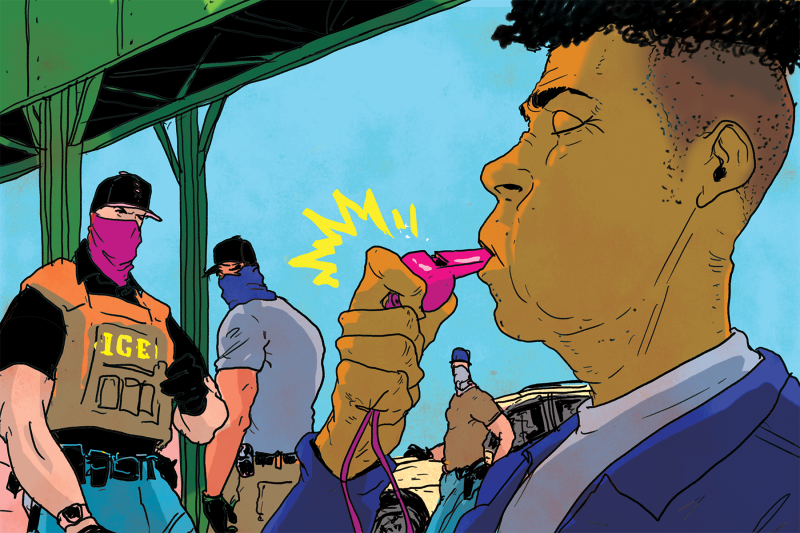
Other tools include whistles, distributed in neighborhoods, to quickly alert people to the presence of federal agents. According to Alex V. Hernandez’s reporting for Block Club Chicago, the idea came from consulting between Chicago community leaders and activists in Los Angeles. “We had the idea of coming out with a whistle so people could hear that noise, and if they don’t have legal status, go the other way—run as quickly as possible to safety and to make sure they don’t open their doors,” Baltazar Enriquez, president of the Little Village Community Council, told Block Club. Another organizer, Lisa Rogers, chair of Advocacy Partners of the Northern Illinois Conference of the United Methodist Church, said she organized a similar group to stand watch outside her church’s clothing center, which serves a majority immigrant population.
Multiple pastors said they knew of groups organizing grocery store runs, where individuals who felt unsafe leaving their house could be connected with people willing to pick up groceries for them. “Volunteers have operated just like [during] COVID, where they’re back connecting to different food sources of food distribution pantries in the area,” Curran said.
Other churches have volunteered members to stand guard at the door of predominantly Latino or immigrant populations during worship.
Finding tangible ways to help others was one way to fight off “doom-scrolling despair.”
Combating despair
EVEN THOUGH IT’S an hour extra driving (an hour-and-a-half if Chicago traffic is bad, as it often is), Kristen said it wasn’t a “big deal” to offer rides. Still, finding tangible ways to help others was one way to fight off the “doom-scrolling despair” that she had first felt when realizing the Trump administration would be targeting Chicago.
Groble said that as she put up the “Know Your Rights” signs, several folks stopped to offer encouragement. “I was putting up a sign near a bus stop that happened to be by a bar, and this tough looking guy walked out of the bar and asked me what I was doing. In that moment, I was kind of nervous” she said. After she explained the purpose of the sign, the man made a joke and offered her his encouragement. “It made me feel relieved,” Groble said. “Someone who stereotypically you may not think cared, did care.”
For Groble, who has lived in Chicago since 2010 and in her neighborhood since 2019, it felt especially important to return the love her neighbors gave when they welcomed her so warmly. “We look out for each other; we care for each other,” she said. “One of the reasons that’s possible is because there are a couple families that have lived here for 20 years. Some of those families are immigrants with [legal] status, some of those families are Latinos who were born here, some are mixed-status families. Some of the families, like ours, are newer to the neighborhood in the last five years but have really embraced the communities that live on this block.”
Through tears, Groble said those deep connections made her faith feel all the more tangible. There is a dystopian fear that comes with hearing whistles and knowing that ICE is detaining people, she said. “I don’t think there’s anyone more vulnerable in the United States than the undocumented person, the undocumented child. Especially now,” she said. “So, how do you look out for the most vulnerable of God’s children? What does it mean for us to take care of each other?
“Every person’s situation, and how they feel about it, is different. Figuring out how to show up for your neighbors, as individuals, is really important.”


Did this article have an impact on you? Tell us how! Whether you’re moved to take action, have a question, or want to share a comment (good or bad), we value your feedback!