THE STATIONS OF THE CROSS is a devotion practiced by Jesus followers since earliest memory. Based on scripture and sacred tradition, the stations invite believers to walk in the footsteps of Jesus through his final hours, from sweating blood in the garden of Gethsemane to laying his lifeless body in a temporary tomb. Even in present-day Jerusalem, believers walk the Via Dolorosa. It is one of the most sacred pilgrimages for Christians.
My earliest memories of Lent include a candle-lit church smelling of beeswax and incense, with the murmur of prayers before each image of the stations. Heartrending questions prick my conscience and point me along the way: Have I stayed awake with you, Lord? When did I see you thirsty, Lord? Have I allowed you to find me when I fall? For many years, it was my father’s voice that split the silence of the Good Friday service. He read from Anthony T. Padovano’s Dawn Without Darkness, which posed the question: “What does one see from a cross?”
The Way of the Cross presents a contradiction for many in our time because it does not offer a progressive view of history. The traditional 14 stations move from the garden to Golgotha, from solitary human agony to a political execution among rebellious slaves, followed only by a tomb full of silence. Period. These stations leave us hanging.
As German theologian Dorothee Sölle wrote, “When Christians meditate together on the cross, they are not interested in a contemplative enjoyment of all that Christ has done for us. Their purpose is participation, identification.” On this pilgrimage, the “arc of the moral universe” does not bend toward justice. We are not firmly among the saved. We cannot better the human condition through social reform and good works. Things are not getting progressively better. We who seek to emulate Jesus are simply among the cursed, as is “everyone who hangs on a tree” (Galatians 3:13, Deuteronomy 21:22-23).
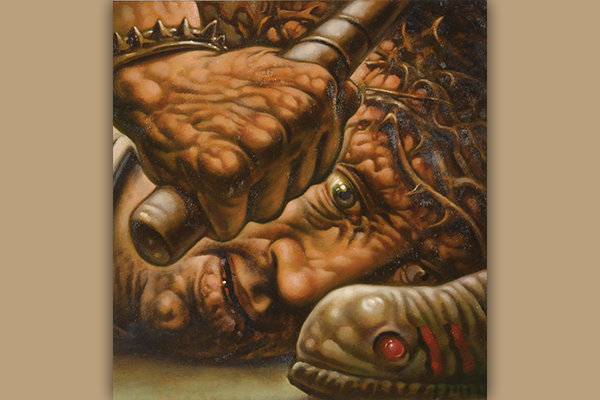
At the third station, Jesus falls the first time. His body was not strong enough or healthy enough to absorb the abuse nor the weight of a tree strapped to his back. Exhaustion. Maybe he had fallen before but gotten back up. Not this time. He’s on the ground, a mouth full of dirt. Scottish painter Peter Howson captures this moment up close in his rendition of station III. A guard’s spiked bracelet derides Christ’s crown of thorns. A soldier’s work boot fills his view, evoking a serpent with an eye of blood, the ancient enticements of sin.
Howson’s style is fleshy and masculine. Men from Glasgow’s roughest neighborhoods are his models—hard scarred bodies, tender, and sometimes vicious. But, said Howson, they are “nearer to salvation than the suburban Middle Class.”
Howson converted to Christianity as an adult. Traumatized after serving as an official British war artist in Bosnia and struggling with addiction, Howson recuperated in a residential rehab center. Amid his nightmares, physical withdrawal, and family crises, Howson heard a voice. Into his own personal wilderness, the voice spoke: “You are loved. You are cured. You will not be free from suffering, but I am with you.” The voice stayed with him for three months.
In Howson’s art, “Christ is a victim not a redeemer,” writes art historian Donald Kuspit, who compares Howson’s work to that of Hieronymus Bosch. Howson’s Christ is a scandal to most self-identified Christians. It scrubs at the facades of my faith like a wire brush.
Sölle wrote, “For us, faith means resisting cynicism in a situation that is objectively cynical.” The raw, emotive truth in Howson’s work pushes back my cynicism. Practicing the Stations of the Cross abrades my own encrusted sin, my estrangement from God. This “perception of sin,” as Sölle put it, “is contrition and conversion.” Gaining this perception is how followers of Jesus receive their sight. Conversion comes through an encounter with suffering and powerlessness.
If we let it, “Jesus Falls for the First Time” can shatter our cynicism. And that’s what redemption feels like. God wraps us in a cloak of human dignity and says, “You are loved.”

Rose Marie Berger, a Catholic peace activist and poet, is senior editor of Sojourners magazine. She is author ofBending the Arch: Poems.
Did this article have an impact on you? Tell us how! Whether you’re moved to take action, have a question, or want to share a comment (good or bad), we value your feedback!