Climate change
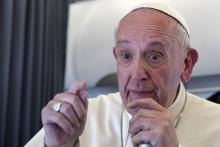
The pope's meeting with Trump could be potentially awkward given their diametrically opposed positions on immigration, refugees and climate change, which he told reporters on the plane "are well known".
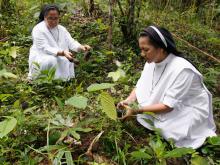
Nine Catholic organizations from around the world have announced they are divesting their savings from coal, oil, and gas companies, in a joint bid to fight climate change.
Religious orders and dioceses from the U.S. and Italy made the announcement on May 10, ahead of international negotiations due this month on implementing the Paris Agreement on climate change.
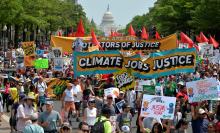
Protesters marched in Washington on a second consecutive Saturday to challenge President Donald Trump's stance on the environment and call on him to stand by policies to stop climate change championed by his predecessor. Thousands of people gathered for the afternoon march from the lawn of the U.S. Capitol to the White House, an event that coincides with the completion of Trump's first 100 days in office and the end of the traditional "honeymoon" period for a new president.

To tell a Christian story about environmental care, we must redefine Christian stewardship. For a movement to attach Christ’s name to it, it must embody the spirit of Jesus as one who gave away his power. Christian stewardship, then, is not dominating with power, but yielding with care. First, we must listen to what the natural world is telling us and respond to it accordingly, not only because we ought to be tenderhearted people, but because it ensures our mutual flourishing
1. How to Talk to Climate Change Skeptics in Your Church
This weekend, the People’s Climate March hits Washington, D.C., and sister marches are planned throughout the country. But 7 in 10 people don’t talk about climate change with friends and family. Here’s how to start.
2. Women Are Dying Because Doctors Treat Us Like Men
Marie Claire’s Kayla Webley Adler digs into the systemic reasons behind why female patients' symptoms are less likely to be taken seriously by doctors, and women are more likely to be misdiagnosed, have their symptoms go unrecognized, or be told what they're experiencing is psychosomatic.

Salvation cannot remain an individualized spiritualized concept. When the psalmists called out for salvation, they meant salvation from present suffering and danger. When the crowd shouted “Hosanna” at Jesus’ arrival in Jerusalem, they weren’t referring to the afterlife. When we talk about salvation in the context of our warming climate, we mean deliverance from the most destructive force our species has ever faced. When it comes to climate change, we have to think about community and salvation in a global sense. We must start to recognize that our communities are mutually dependent upon each other.
The resurrected Jesus is recognized not by his words but by his wounds, the wounds of his crucifixion. Herein lies a great irony. The crucifixion has left its indelible marks upon the resurrected one, such that the risen Jesus is recognizable only through them. On the one hand, resurrection has not erased his wounds. On the other hand, Jesus’ wounds no longer define him as a dead criminal, as determined by the state. Jesus doesn’t wince at Thomas’s touch. Even as his wounds remain, Jesus’ body is made whole and new.
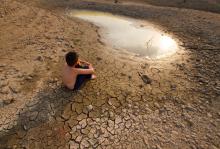
As presidential orders and administrative policies continue to scale back environmental protections, it’s important for Christians to realize that this is a vitally important spiritual issue. Many Christians ignore environmental issues because they don’t view it as an important faith-related concern — but what if environmentalism was essential to evangelism? In many ways, taking care of our environment is a direct form of evangelism, but many Christians have yet to realize — and even reject — this truth.
The power of the order is found less in its immediate consequences, and more in its trajectory-setting results. While the world is slowly backing away from a crumbling cliff, this executive order represents a shift into drive to send the global climate hurtling toward the ledge.

U.S. President Donald Trump will announce the approval of the Keystone XL oil pipeline at the White House on Friday, alongside the chief executive officer of builder TransCanada Corp, according to a senior administration official.
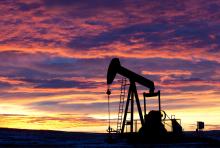
The State Department is set to approve the Keystone XL pipeline by Monday, Politico reports. The cross-border permit that will allow construction to proceed is set to be signed by Undersecretary for political affairs Tom Shannon just before the end of the 60-day timeline President Donald Trump called for in January.
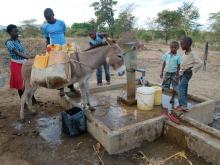
The drought in the Sahel — a region that forms a dry belt across northern Africa — has left millions without any water to drink, and is being linked to three deaths in recent days in Kenya, due to consumption of unsafe water.
“There are no drops to reduce, recycle, or reuse,” said professor Jesse Mugambi, of the University of Nairobi, who added that many in the region are spending World Water Day “praying for drops of rain to quench their thirst and that of their livestock.”

The years ahead of us will be the most challenging our species has ever faced. For many of the other species that share this planet with us — and for some of our own people — it will be too much to survive. Dressing for a funeral doesn’t begin to prepare our hearts for this kind of devastation.
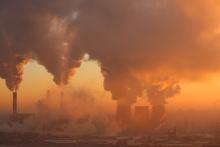
After sessions on gravitational waves, nuclear forensics, and artificial intelligence, one of the world’s largest general science conferences invited attendees to hear from an Episcopal priest.
The Rev. Fletcher Harper preached on climate change, and how to get a vast segment of the world’s population to pay better attention to what scientists know but many others doubt: that the problem is worsening and portends disaster.
“My entreaty for scientists is to be able to speak publicly about why you care,” said Harper, executive director of GreenFaith, an interfaith nonprofit that aims to galvanize religious people to safeguard the environment.

For Catholics, the key to working collaboratively with Pope Francis, on issues from mass migration to climate change to Hispanic evangelization, may be found in a controversial movement that many left for dead long ago: liberation theology.
That message reverberated, from Feb. 6 to Feb. 10, through the halls of Boston College and a nearby retreat center, as nearly 40 theologians gathered from across the Spanish-speaking world to discuss the movement’s future with its founding figures.
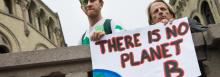
If confirmed, Pruitt should walk into the halls of the Environmental Protection Agency with the same conviction of faith with which he walks into First Baptist Church of the Broken Arrow. He should promote policies to guard clean water and clean air, to protect children from pollution, and to safeguard all of us from the impacts of a changing climate.
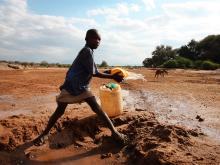
At the Thatha Roman Catholic Mission, part of the Machakos Diocese, the Rev. Gerard Matolo increasingly sees more people seeking help.
“You can’t tell them that there is nothing,” Matolo said. “As their shepherd, I have to find a way to ensure they get something to eat. Sometimes I share my own food.”

Religion is increasingly viewed as highly politicized, not least due to the way that it is frequently covered in the news. Numerous studies have shown that news stories with emotional cues tend to both gain audience attention and prolong audience engagement.
It may therefore come as no surprise that online debates about religion are packed with emotional cues that evoke strong reactions from those who participate in them. This sets the stage for passionate online debates.
I join with those who celebrate the birth of this spirit-child, even while knowing his life led to murder at the hands of a corrupt Roman regime that for years had been using power and wealth to silence and oppress people. It is said that after his murder, this same person rose from the dead, his body and bloodshed becoming a bridge from violence and trauma to wholeness and healing — showing that hope could conquer hate, and that the power of integrity, justice, and love could win over corruption, fear, and violence.

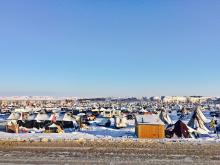
Sometime over the weekend, I noticed a few friends unexpectedly “check-in” to Standing Rock Sioux Reservation, N.D., on Facebook. Given the recent rise in tensions between police and the water protectors protesting the Dakota Access Pipeline, it made sense to me that some of my pastor-friends would go be a part of the protests.