Faith

I do most of my work by contract, which means I'm usually looking for work. When the time comes for me to put my feelers out for new opportunities, I tend to look far and wide. In doing so, sometimes I come across some unexpected prospects.
A couple of years ago, I applied for an editorial position at a magazine. Things were going well until we got down to the final rounds and they placed a statement of faith before me that I was expected to sign. There was much in the document that I didn't agree with, and in general, I balk at signing anything that tries to nail down what I believe or what I claim as a Christian.
I respectfully declined to sign the document, and within the hour, they withdrew my name from consideration for the job. I was recounting this to a friend and fellow writer last night over a beer, and he shared a number of similar experiences. He tends to "get" evangelical Christian culture a bit more than I do, however, so he has found various ways to work around the points of disagreement he finds in such statements.
In one case, at a college where he was applying for undergraduate studies, he performed a line-item edit, striking out everything with which he took issue. Surprisingly, the administrators at the school accepted the revised document and never mentioned his changes.

It was my junior year of college. I sat in the balcony of chapel listening to a message and expecting nothing more than the usual chapel routine.
My life up until that point had been all about finding control and self-worth, which centered on academics and hard work. Blame my culture or my textbook Type A work patterns, but really the core of the issue was my pride and self-reliance. I wanted (and probably in some ways still want) to control and perfect every aspect of my life. X plus Y equals Z, right?
So, I sat there completely unaware that it would be a message that I still haven’t forgotten.

I wasn’t really expecting painful things to happen to me.
I knew that pain was a part of life, but — thanks in part to a peculiar blend of “God-has-a-plan” Southern roots, a suburban “Midwestern nice” upbringing, and a higher education in New England stoicism — I managed to skate by for quite some time without having to experience it.
After a handful of traumas in the last five years, things look different now. Trauma upends everything we took for granted, including things we didn’t know we took for granted. And many of these realities I wish I’d known when I first encountered them. So, while the work of life and healing continues, here are ten things I’ve learned about trauma along the way.
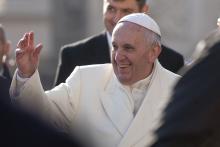
"Preach the Gospel at all times, and if necessary, use words" is a quote widely attributed to St. Francis of Assisi. It also seems to be the motto of Pope Francis. Instead of just talking about abstract doctrines, he consistently lives out his beliefs in public ways that have grabbed the world's attention. His example of humility, compassion, and authenticity resonate powerfully in Washington, where cynicism is rampant, pride remains even after the proverbial falls, and an ideology of extreme individualism has overtaken a significant faction within our politics.
The Pope's words and deeds fascinate us because they are genuine and selfless. How could a leader of global significance spend time cold calling pregnant women in distress, kissing the feet of young Muslim inmates, or embracing a disfigured man? What sorts of values motivate such behavior? These stories touched our hearts, but they appeared irrelevant to our politics.
Then the Pope started talking about our wallets, which, according to a several commentators on the far right, instantly transformed him into a threat to capitalism itself.

After 36 years of serving churches as a pastor and consultant, I came to a startling conclusion the other day.
Not startling to you, perhaps. I might be the last person to get the memo. But the conclusion drew me up short.
My conclusion: Religion shouldn’t be this hard.
These magazine articles and blog posts published by Sojourners through the years pay tribute to the great South African leader.

Cynthia Bourgeault explains how we can both seek social justice and do justice to our souls.
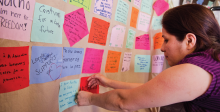
IT WAS LIKE the end of the movie Lincoln. In an instant, one whole side of the House of Representatives turned, looked up at the five core fasters from the Fast for Families and erupted in overwhelmingly spirited applause. The applause reverberated throughout the chamber for what seemed like an eternity, though it was really only minutes. Ah, but what grand minutes. I wept. My body, standing there in the gallery, could not contain it.
The Fast for Families: A Call for Immigration Reform and Citizenship was launched on Nov. 12 with core fasters abstaining from all food and drinking only water. Based in a tent on the National Mall, only a few hundred yards from the Capitol building, the fast was sponsored by nearly 40 church and labor organizations and garnered support from more than 4,000 solidarity fasters across the U.S. and around the world. Our goal: To move the hearts and compassion of members of Congress to pass immigration reform with a path to citizenship.
In the Capitol building on Dec. 2, during the hour before the startling ovation, Eliseo Medina (the leader of the fast, which had reached the end of its 21st day on that Monday evening), D.J. Yoon (executive director of NAKASEC, a Korean-American advocacy agency), Cristian Avila (from Mi Familia Vota), and I received House member after member who’d come to visit us in the gallery to say “thank you for your sacrifice.” All the faces and names you usually see flashed across the screen commenting on the events of the day on cable television shows—they came to us, standing in the flesh, shaking our hands, grateful and concerned for our health.
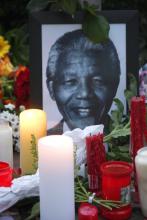
NELSON MANDELA was the most important political leader of the 20th century. While Roosevelt and Churchill helped protect the West and the world from Hitler’s Nazism, Mandela heroically exemplified the movement against the colonialism and racism that oppressed the global South, shown so dramatically in South Africa’s apartheid. And from a Christian point of view, he combined justice and reconciliation like no other political leader of his time, shaped by the spiritual formation of 27 years in prison.
Shortly after Mandela was released from prison, he came to New York to meet with a small group of Americans who had been involved in the anti-apartheid struggle, and I was blessed to join them. From the start, I felt in Mandela a moral authority I have never experienced with any political leader.
Attending Mandela’s inauguration in 1994 was a highlight of my life. We were picked up at the airport by friends, a couple who had both been in prison and tortured, but now she was about to become a member of the new South African parliament. We saw a group of the infamous South African security police. Having been interrogated by these thugs before, I immediately said, “Let’s get out of here!” To which they replied, “Don’t worry, Jim, they’re ours now.”
At the ceremony, joined by my South African friends, we watched Nelson Mandela announce his vision for a new rainbow nation. More than 100,000 people (and a billion or so more via TV) listened with tears in their eyes and great hope in their hearts.
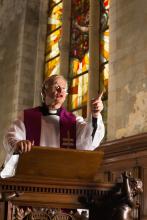
Sentiments of frustration are growing among many followers of Jesus who admire Christ but despise certain things associated with him.
They look at the New Testament and are attracted to Jesus’s selfless acts of generosity, service, and love, but don’t see the same spirit in today’s “Christian” institutions, churches, communities, and faith leaders.
Modern faith is often a complex minefield of theologies, doctrines, practices, and expectations, where individuals carefully walk on eggshells to avoid a litany of “sins” and “heresies” that will inevitably attract the wrath from religious friends, strangers, and authorities.
LONDON — Eight of the 47 countries that hold seats on the United Nations Human Rights Council imprisoned people in 2013 under laws that restrict religious freedom, according to a new report from Human Rights Without Frontiers International, a nonprofit advocacy organization based in Belgium.
The eight UNHRC member states on the group’s second annual World Freedom of Religion or Belief Prisoners List, released Monday, are Morocco, China, and Saudi Arabia (whose new three-year terms begin Wednesday), and current members India, Indonesia, Kazakhstan, Libya, and South Korea.
Hundreds of believers and atheists were imprisoned in these and 16 other countries for exercising religious freedom or freedom of expression rights related to religious issues, according to the report. These rights include the freedom to change religions, share beliefs, object to military service on conscientious grounds, worship, assemble, and associate freely. Violations related to religious defamation and blasphemy are also included in the report.

O gracious God, we thank you for getting us through 2013 — cantankerous, contentious bickering mess that it was on many public and political fronts — and we pray that you will help us to look back on it as the low-water mark from which American society emerged more civil and united.
For us to see an answer to that prayer, we must resolve to begin 2014 by climbing into stronger, healthier relationships with other people — not waiting stubbornly for them to come around to our way of thinking but deliberately moving to a position from which we love them more, understand them better, and honor our God in a new way.
Move far enough in this way, and we will turn our fractious society upside down.
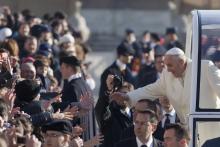
The year 2013 ushered in a number of data milestones in American public opinion. Here is a sampling reported by the Pew Research Center.
It’s the end of the year and, as always, a great time to reflect on what has happened over the past 12 months. I’ve been blessed to have so many talented and diverse writers share their voices and views alongside me on the God’s Politics blog. I want to take this opportunity to share some of my favorite posts from this past year with you, in no particular order.
Faith
We had so many great posts this year that explored the different facets of our faith. If you haven’t read them yet, make sure you look at:
What Good is a Ph.D. for reading the Bible? by Rev. Dr. Guy Nave
Five Things That Are Holding Christianity Back by Christian Piatt
10 reasons Why Men Should Not Be Ordained For Ministry by Eugene Cho
Women and Girls
Since the 1970s, Sojourners has been committed to resisting sexism in all its forms, while affirming the integrity and equality of women and men in the church and in the larger world. This year we’ve been even more intentional about looking at these topics through our blog and magazine.

As you make your winter reading list or shop for gifts, consider these 2013 books from Sojourners magazine staff and contributors. Or, buy yourself a gift for 2014.