Forgiveness
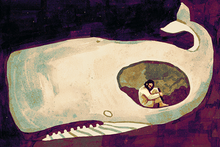
FORGIVENESS CAN BE a profoundly beautiful act. And I never talk about it without offering some critical disclaimers because I know all too often forgiveness has been misused to keep victims and survivors silent and oppressed. Forgiveness is not about allowing abuse or mistreatment to continue. It is not about excusing bad behavior or insisting that you remain in relationship with the systems or person harming you. Forgiveness is fundamentally about liberation—liberation of self, and when appropriate, liberation of the repentant party.
These passages engage the theme of forgiveness, and I encourage every preacher to handle these texts with care using a lens of liberation. Preach in such a way that you are never sending a victim back to her abuser. Preach in a way that sets the people free. Make forgiveness the thing of beauty it is capable of being, not another trap for the downtrodden. How? Perhaps by letting the texts be as complex as our actual human lives—full of nuance and heartache, consequence and hope.
Our job is not to resolve the tension but to carry it well. Yes, Joseph forgives his brothers. But he messes with them a bit first. It’s not that black and white, and neither are our lives. Yes, Jesus surrenders himself to death, and it’s brave, noble, and profound. He also rises from the dead and seems to know he would. He wasn’t surrendering to his enemies so much as entrusting himself to a God who could bring resurrection from death. That distinction matters. Forgiveness can be beautiful, but it is rarely simple.

I DON’T KNOW about you, but I’m having a tough time. I look around and so much is broken that I don’t know how to fix. To make matters worse, your personal life never gives you a break just because the world is falling apart, which hardly seems fair. It’s always something, and it’s just too much for one person to hold.
We are not the first to feel this way. I found inspiration in the characters from our lectionary texts this month. They faced great challenges, too, and surely felt the same despair and fear we do. They navigated uncertainty, conflict, and circumstances beyond their control. And yet, it turns out God didn’t need them to be perfectly faithful or unshakingly stable.
When Peter gets scared and starts to sink, Jesus pulls him back up. When Moses’ life is threatened at birth, six women participate in his rescue (and it takes all of them). Peter questions Jesus to his face because he does not understand. Jesus corrects him without kicking him off the team. The heroes of these stories and of our faith are brave and also human—just like us. God is not upset about our human limitations. God sticks it out with us. Maybe faith isn’t about holding everything together. Maybe it’s about trusting that we are being held, even when we’re not sure we can hold on.
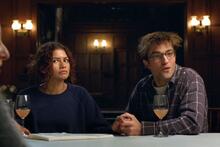
There’s a moment in The Drama that has stuck with me. In the midst of an existential spiral about his fiancée Emma’s (Zendaya) past, Charlie (Robert Pattinson) talks with some less-than-understanding friends and tries to somehow contextualize and produce empathy for her actions. He latches onto something he heard in passing about Emma’s childhood: that she had a neighbor who died in a car accident. The way that he retells the story, though, makes it sound as though this event was a traumatic origin story that totally reshaped her young psyche—even enough to explain her turn toward fantasies of violence later in childhood.
As Charlie retells the story, images flash on the screen imagining different versions of the event; the car crashing into a tree in a neighborhood; young Emma watching the crash firsthand; Emma grieving alone with no one to help her process it.
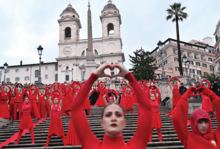
“HOLY HUSH” MEANS people of faith keep quiet about abuse, women don’t feel empowered to speak their truth, or families feel pressure to pretend everything is fine when it’s not. Part of the fear is that if we speak out, that means we’re not a forgiving community. Responding to abuse is about justice, accountability, and change, which often isn’t what those who act abusively want. They want quick forgiveness; this can be challenging to a religious leader who says, “It’s not my role to forgive. It’s God’s role. It’s the victim’s role.”
Religious women often feel they promised God to be faithful to the end. That’s where a religious leader can say, “You haven’t broken the covenant. The person who’s been abusive broke the covenant. Seventy times seven doesn’t mean someone can hit you over 400 times, say they’re sorry, and you say, ‘Let’s go back to life as it was.’”
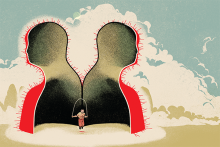
IN 2017, SYLVESTER JACKSON joined a forgiveness therapy group simply to get out of his cell in a maximum-security prison—he might not have participated otherwise.
This happenstance involvement profoundly impacted the course of his life. Now living in Milwaukee, Wis., he leads community members whose lives have been impacted by the criminal justice system through the same course.
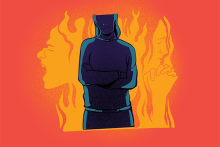
WHEN RAGE OR disappointment, petty or vast, grips me, I sometimes lower my blood pressure with Lyle Lovett’s song “God Will,” in which the narrator asks his unfaithful partner who will trust, love, and forgive them for a litany of sins. The narrator answers his own questions in the chorus:
God does, but I don’t
God will, but I won’t
I use these words in the moments when I’m unable to release anger or to feel love toward those who have caused harm — I may be steaming, but I’ll accept for now that God loves and will forgive the people who I won’t (for now). There, in that space between who I am and who I believe God to be, my fury and pain can bide their time.
I have muttered “God will, but I won’t” a lot since Election Day, about political leaders and operatives who infuriate me and those who voted them into power.
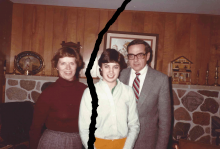
“IN THE BEGINNING was the Word and the Word was with God and the Word was God.” I had no idea what the words I recited in front of the church meant. My Mary Janes hurt my feet and my dress was so tight it left angry red welts in my armpits. Mom looked so proud; Dad, too, sitting in the front row, smiling. I didn’t want to disappoint them, especially here.
As far back as I can remember, my parents started churches in our suburban Milwaukee home. They were nondenominational, Independent, Calvinist, Fundamentalist Baptist. Initially, just a few families gathered, with Dad leading the service in our living room. Before long, our house overflowed, and the adults started raising money to construct a church. Once the building was complete, dissension began and my parents would leave, claiming the church was now too liberal. They disapproved of so many things: changes to the prayer book, Black people joining their all-white communities, homosexuality, women in ministry, the Equal Rights Amendment, anyone who questioned the literal translation of the Bible, adding rhythm to traditional hymns, accepting Catholics as fellow Christians. We were the “Chosen.” Predestined and proud of it.
My parents were also active members of The John Birch Society (JBS), the extreme right political organization, founded in 1958, which is known to be racist and antisemitic. They hosted monthly JBS chapter meetings in our living room. It was hard to know which belief system drove them more: the conservative politics of the JBS or the fundamentalist Christian fear of the rise of the Antichrist. Either way, to them the possibility of a communist invasion was a real threat.
They hired a handyman to build a hidey-hole in the back of the closet in our basement, where our whole family could hunker down if communists invaded the United States. Because we were Christians, educated, and part of the ruling class, Mom told us our family would be among the first to be imprisoned, then executed. Most of my nightmares as a child involved communists finding us in our hiding place.
I grew up listening to Mom and her friends, drinking coffee around our kitchen table while they animatedly discussed which group of people was ruining our country and if former President Dwight D. Eisenhower was really a communist agent.
I never quite understood what all the fuss was about. All I knew was that I adored listening to my Dad talk about politics and preach. I loved memorizing the verses he gave me about fleeing evil and avoiding temptation. I believed the words he spoke to be true. For me, he embodied the Heavenly Father he taught me about.
I didn’t feel the same about my mother. After every church service, whenever I’d overhear her describe someone as a person who “loved the Lord,” the hair on the back of my neck would stand straight up. If she caught me rolling my eyes as she quoted scriptures, I knew I had it coming. As soon as we got in the car, she’d slap my face.
My mother hitting me wasn’t unusual. Quite often after one of the regular beatings she gave me, she’d make me kneel in front of her, as she reverently prayed, eyes closed, “Please forgive Diana, Lord. She doesn’t know how to respect or obey me.” Never knowing when she’d strike, I was constantly on guard.
I believed in God as a child and deeply felt Jesus was my friend, responding to an altar call when I was 6. But Mom smugly told me Jesus could never love a naughty, backsliding little girl like me. Because of that, I was never sure my salvation stuck, so I made at least half a dozen more trips down the aisle. My teenage years and early 20s did little to reassure me of God’s love. I didn’t want to go to hell. It seemed like a scary place. But when I was 25, hell found me anyway.

Ted Lasso season three has been unbelievable, and not just because season two ended with the destruction of the series’ defining image: a yellow paper sign with the word “BELIEVE” scribbled across it.
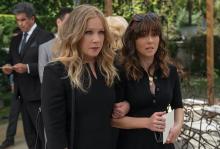
I AM CONVINCED that 20 years from now, Dead to Me will finally get the praise it’s due, ending up in some culture magazine’s ranking of the best TV comedies of all time. (I’m giving you a head start, Sojourners: Beat Rolling Stone to the punch.)
Dead to Me, a Netflix show about a woman and her children grieving her husband after he is killed in a hit-and-run, is sort of what you would get if you merged another destined TV classic from Netflix — Grace and Frankie — with the Joan Didion memoir The Year of Magical Thinking and then sprinkled in a police investigation. The show is laugh-so-hard-you-cry funny and yet is driven by situations that would probably make you weep if you paused to think.
I barely had time to do that, though, because Dead to Me is a twisty thriller centered around a hilarious opposites-attract friendship between the widowed protagonist Jen (Christina Applegate) and a jolly woman she meets at group grief therapy named Judy (Linda Cardellini). Throw in some great meditations on friendship, forgiveness, motherhood, absence, and why everything is so screwed up if the whole world is in God’s hands; a Christian youth dance troupe; and an astounding performance by the actor James Marsden, and you have one of the best TV shows ever.
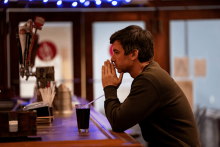
As it turns out, the person who needed The Rehearsal most was Fielder himself. His interaction with Angela in the finale reveals that the whole enterprise is actually an exploration of the inevitable pain humans cause others, even when we’re not trying to, and our need for grace and self-forgiveness.

First Presbyterian, a congregation in the Presbyterian Church (USA) denomination, is one of many across the country raising money through the nonprofit RIP Medical Debt to buy and forgive medical debts owed by people who can’t afford to pay them back. The church hopes to raise $50,000 as one of two mission components to its capital campaign — enough to forgive $5 million in medical debt.
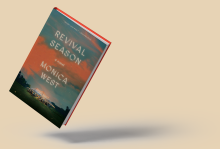
FOR 12 YEARS, the Hortons have spent their summers on the revival circuit, driving hundreds of miles from one small city to another. Samuel Horton, a Black Baptist preacher famous for his healing, is proud of the souls he has won for the Lord and prouder of the power he wields. Still, he yearns for miracles no one would question, that would wipe away any doubt in his ability. If only he could heal his younger daughter, Hannah, who has cerebral palsy. If only his wife could give him another son, especially after their second son, Isaiah, was stillborn. In his pride, Samuel blames the women around him for his own limitations, even as he relies on them to hold together the picture of faith he has carefully constructed.
Behind the scenes of Samuel’s performance is 15-year-old Miriam Horton, the narrator of Monica West’s Revival Season. When the novel opens, Miriam is in awe of her father’s position and power, despite questioning the limited roles women hold in her community. As she helps raise Hannah and supports her mother, she memorizes her father’s prayers and sermons, carefully stud-ying his process. She particularly envies her younger brother Caleb, who has the privilege of shadowing their father. Still, she prays that the scandal of the previous summer—when her father injured a pregnant girl he was meant to heal—does not follow them into the new season.
The film also gets right Rogers’ deep belief in God and Junod’s persistent doubt. Junod was raised a Catholic but fell away from the church. For a while he attended a Presbyterian church, but now does not. He is still interested in the spiritual, he says, and a lot of that stems from his relationship with Rogers. This summer, as publicity for the movie was heating up, Junod recovered 70 emails he exchanged with Rogers from an old laptop, many of them about theology.

A racial leveraging of forgiveness followed Amber Guyger’s trial in Dallas.

Do you remember where you were four years ago when you heard the news?

"AND THERE SAT a dark leather-bound Bible soaked in blood. A bullet had pierced its pages.”
The Bible belonged to Felicia Sanders, one of the five people to walk out of Mother Emanuel AME Church alive after a stranger who had been welcomed to a Bible study shot and killed Rev. Clementa Pinckney, Cynthia Hurd, Susie Jackson, Ethel Lance, Rev. DePayne Middleton-Doctor, Tywanza Sanders, Rev. Daniel L. Simmons, Rev. Sharonda Coleman-Singleton, and Myra Thompson.
The quote is from Jennifer Berry Hawes’ new book, Grace Will Lead Us Home: The Charleston Church Massacre and the Hard, Inspiring Journey to Forgiveness. With measured prose and journalistic excellence, this book rounds out the forgiveness and grace that have become synonymous with the Charleston massacre by exposing the outrage, isolation, and bumpy road of grief that followed the deaths.
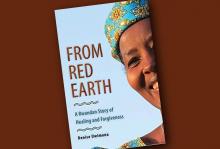
“WORKING SHOULDER to shoulder, after sharing our struggles and tears, is forging a powerful bond,” said the woman laboring at my side. “Death once swept our land, but life has its own momentum.” When the fieldwork was done, we built a stable for Theresie, who had shared her hut with a cow. The young people helped, hauling poles and erecting the walls and roof.

Christ, your words of love confound us,
even as we give you praise,
for the lessons that you teach us seem
so far from this world’s ways. How can we love those who hate us?
How can we love enemies?
What of people who abuse us?
How can we love even these?
ON A BALMY SUMMER afternoon in July, I rang the bell at Jean Vanier’s sky-blue gate in Trosly-Breuil, France. Vanier, the founder of L’Arche, an international federation of communities of people with and without developmental disabilities, is central to a new documentary film, Summer in the Forest. I was there to interview him about the film and as research for a play I’m helping to write for the 50th anniversary of L’Arche Daybreak community, near Toronto.
As the gate opened, Vanier, wearing his signature navy blue jacket, greeted me with the warmest presence I have ever felt, saying, “All the way from Daybreak you have come to visit me!” I replied sheepishly, “Yes, to finally meet the man who changed my life.”
My salutation was not hyperbole—Vanier’s gift, a vision of communities where people live in a spirit of mutual learning, dignity, and care, has touched and changed the lives of thousands of people around the globe. Though I’d come for professional reasons, it also felt like a pilgrimage to seek Vanier’s wisdom in the place where it all began. He ushered me into his small office and living room to chat.
In 1964, while Vanier was living in Trosly-Breuil, he visited a psychiatric hospital near Paris. He saw men there subjected to violence, locked up all day, and feared by the public. He was moved with a compassion that he couldn’t totally understand at the time. But as Vanier told me, “We all have, as human beings, a design that teaches us to reach out to others, and not only to serve ourselves. If we listen to this inner design, this inner voice, it will lead us always to do what is right.” With little training and no formal plan, Vanier bought a dilapidated house and took three of the men out of the institution to live with him in the village.
The first night didn’t go so well, as they could not find how the electricity worked and one of the men became so frightened and violent, smashing windows, that he had to return to the institution the next day. Two of the men, Raphaël Simi and Philippe Seux, lived with Vanier for the rest of their lives. Vanier named their home “L’Arche,” French for “The Ark”—it became the first of what are now more than 150 L’Arche communities in 37 countries.

FAMINE CRACKED the earth, causing children’s bellies to swell. Mouths opened wide, babies’ heads hung limp over their mothers’ arms. For three years no rain fell. Well water became a distant memory for the people of Israel.
David asked God why suffering was overcoming his people. God said: “There is bloodguilt on Saul and on his house, because he put the Gibeonites to death.”
Saul was the previous king who tried to wipe out the Gibeonites during his reign—even though Israel had sworn to spare them. What comes next in 2 Samuel 21:1-14 takes my breath away. David calls the Gibeonites to the court and speaks with them directly. He asks them: “What shall I do for you? How shall I make expiation, that you may bless the heritage of the Lord?” (verse 3).
America’s 45th president will be held responsible for the decisions made during his administration. But also the physical health of our land and people will reflect the measure to which President-elect Trump faces and corrects his own sins as well as those that past presidents have perpetrated against our citizens and our global neighbors.
David asks the Gibeonites: “What do you say that I should do for you?” Could we imagine our next president calling together a conference of African-American leaders or Native American leaders or Latinx leaders and asking them: “What do you say that we should do for you?” Can you imagine putting that level of power in the hands of the oppressed—power to set the framework for repair?