Interfaith

THE VIOLENCE AND kidnappings in Nigeria are more than a religious conflict: They are a political manipulation of religion.
Before the 2011 Nigerian election, northern politicians (who are mostly Muslims) threatened to make the country ungovernable if Goodluck Jonathan, a Christian from the south, became president. Jonathan was vice-president for Umaru Musa Yar’Adua, a Muslim from the north, who died before completing his eight-year term. Jonathan assumed power after Yar’Adua’s death, as is allowed by the constitution. However, northern Muslims claimed that since Yar’Adua did not finish his term, they should be allowed to place someone of their own choosing in power. Jonathan’s refusal angered the north.
In response, the Muslim terrorist organization Boko Haram began intensifying its attack on Jonathan’s rule in order to discredit his presidency and his pursuit of the 2015 election. If Boko Haram succeeds in pushing Jonathan out, southern militia groups are likely to commence their own violent campaign. These terrorists are trying to manipulate people by making them think that it is a religious fight, when in reality it is about political power.
People, however, are beginning to reject the violence. In April, as the world is well aware, Boko Haram kidnapped more than 200 schoolgirls from Chibok, a community that is said to be about 90 percent Christian. The outcry of rage and pain about this incident transcended religious lines. In a May market bombing in the city of Jos, both Christians and Muslims lost their lives. After the bombings, Muslims and Christians on the streets of Jos tried to work together in finding a way through the situation. People no longer want to fight and are starting to value peacebuilding and interfaith efforts. This is a sign of hope.

Just because interfaith, interracial, and varied ethnic groups share a common cause doesn’t mean a diverse coalition can hang together.
It often takes prayer. And not just a “Bless this group, Amen,” invocation.
A new study by three sociologists finds that three out of four interfaith civic coalitions turn to what the sociologists have dubbed “bridging prayer” — interactive, participatory, and often innovative prayers and rituals that highlight their shared identity as people of faith.
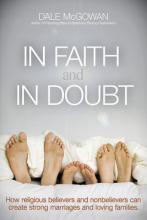
If interfaith marriages are supposedly doomed, Dale McGowan’s should have been toe-tagged from the start.
He’s a committed atheist; his wife comes from a line of Southern Baptist preachers. Yet 23 years and three kids later, they are still happily married.
“The key is to talk about your values,” McGowan said from his home in Atlanta. “A lot of time we mix up the words ‘values’ and ‘beliefs.’ Beliefs are what you think is true about the universe. Is there a God? Where do we go when we die? But values are what you believe are important and good. When you get couples talking about values they find out they share a tremendous amount, even if they don’t share beliefs.”
That’s what McGowan and his wife, Becca, did. While she believed in one God, she did not believe salvation could be had only through belief in Jesus. And he agreed that he could go to church with her — and did, for many years, with their children.

Dear Church,
I received some distressing news today. Oh, I know you thought you’d kept it secret, but I answered the phone when the doctor’s office called to change your chemo appointment.
Chemo? Seriously? What, you thought I wouldn’t find out eventually? I know I seem preoccupied sometimes, but I’m not an idiot. I can see the signs.
I knew something was up when I saw you shrinking, little by little over time. Maybe other people couldn’t tell, but I suspected something bad was going on. You can paste on a smile, and listen to your happy music, and buy new stuff. But anyone who really knows you, realizes your body has been slowly betraying you.
Dying happens. I get that. What really makes me mad, though, is that you didn’t trust me enough to tell me. Maybe you didn’t know for awhile. I guess that’s possible. But the doctor had to have told you, right? I mean, at some point you decided to do something about it — if only to keep it a secret. And if you didn’t know, then you’re not who I thought you were.


I finished my first Boston Marathon in 2002, running with two parishioners to raise funds for our church. The experience was exhilarating, and I’ve run the course six times since, relishing each year the cascade of powerful moments. Speaking as a preacher, the marathon was the sermonic gift that kept giving: the challenge of Heartbreak Hill, the boost even we slow runners get from cheering multitudes, the necessity of water and salty snacks. And Hebrews 12 gives us our text: “Let us run with perseverance the race that is set before us …”
With last year’s Boston Marathon, however, everything changed. Our church did have a runner in the race — he crossed the finish line six minutes before the first bomb exploded — but any interest in locating metaphorical gems was overshadowed by the real-time incursion of evil. Some parishioners knew victims, others were near the scene, and everybody joined in the immediate grieving of our city.
When we learned later that the perpetrators were Muslim, we felt another round of anguish, fearing that the incident could trigger a wave of religious prejudice and bigotry.
My first marathon ever — 2003 in New York City — did not go according to plan. On the positive side, I would never have guessed that P. Diddy would be running the same marathon and at the same pace for much of it, providing an entertaining entourage to distract me from my exhaustion. On the negative side, my name, which I had taped to my tank top so the crowds could give me much-needed encouragement, quickly peeled off, and I was anonymous in the crowd. My plan had been to run that last mile to the mantra “you can do anything” or “you are power,” but instead, my legs barely moving and my husband and close friend no longer by my side, I chanted dejectedly to myself: “Never again, never again.”
I didn’t know what misery associated with a marathon really was, though, until I heard about the Boston Marathon bombings, which took place one year ago today. On this day, two young brothers set off two bombs at the end of the Boston Marathon. As we waited to understand the damage, I remember thinking about the juxtaposition of the runners’ feelings of accomplishment setting in just as shrapnel began to fly. Then I received the painful — even if relieving — news that my first cousin had been right at the finish line with her husband and baby (born a year ago exactly on that marathon Monday) and had escaped the violence only because the baby needed her nap. We eventually learned that three people were dead, hundreds were injured, and the two suspected perpetrators were associated with radical Islam. I felt disgust and horror.
Moments such as this challenge each of us to live up to the “better angels of our nature,” as President Abraham Lincoln put it. As has been borne out by various terrorist attacks around the globe, terrorism breeds fear — its intended consequence. Too often this fear becomes fear of a religious group. We, as Jews, know intimately the perils of a society surrendering to this type of fear.

As an interfaith advocate, I find total inspiration in Dr. Martin Luther King’s multi-layered approach to peace and justice:
“Make a career of humanity. Commit yourself to the noble struggle for equal rights. You will make a greater person of yourself, a greater nation of your country, and a finer world to live in.”
The reason that I do interfaith, and the reason I signed the pledge to be Better Together, is because I believe that religion can be used as a tool for good in all three layers that King is referencing: in our world, in our country, and in ourselves.
CAN YOU GO to school to become an interfaith leader? An increasing number of faculty, staff, and students on campuses believe the answer is “yes.”
Interfaith leadership courses are starting to crop up at colleges across the country. At New York University and Nazareth College, you can even get a minor in the area. The organization I lead, Interfaith Youth Core, recently organized a conference for university faculty interested in this area. We expected 30 people to show up, and got nearly 120. This all suggests that this may be a field whose time has come.
Academically speaking, “interfaith leadership” is part of the larger field of “interfaith studies.” Just as you might study education at a university to become a teacher, in the future you will be able to take coursework in interfaith studies in preparation for a career in interfaith leadership.
Interfaith studies looks at the myriad ways that people who orient around religion differently interact with one another and considers the implications of that interaction for everything from personal lives to global politics. It’s a field that asks questions such as: In what religious groups is the intermarriage rate growing fastest, and what are the distinctive dynamics of such relationships? What types of political arrangements seem to foster positive interaction between faith communities, and what types are associated with interreligious tension? How effective are current religious education programs in forming young people in faith traditions?
Spirit Connections
Some Western and global South churches have established “sister church” relationships as a more mutual alternative to the old mission field approach. Drawing on fieldwork and interviews, Janel Kragt Bakker studies the give and take of this model in Sister Churches: American Congregations and Their Partners Abroad. Oxford
Border Clashes
The documentary The State of Arizona captures multiple perspectives on undocumented immigration in the aftermath of Arizona’s controversial Senate Bill 1070, dubbed the “show me your papers” law. Directed by Catherine Tambini and Carlos Sandoval, it will premiere on PBS’s Independent Lens series on January 14 (check local listings). communitycinema.org

At an interfaith summer camp in northern New Jersey, two dozen children explored a swamp to learn how creatures depend on safe water.
In Southern California, a Unitarian Universalist congregation installed a dry well so water from its church rooftops drains into underground pipes to replenish the water table.
In Vermont, members of a Lutheran church removed cars and appliances that had been dumped in a nearby stream and restored its banks with local willows and oaks.
Across the country, water has become more than a ritual element used in Christian baptismal rites or in Jewish and Muslim cleansing ceremonies. It has become a focus for worshippers seeking to go beyond water’s ritual symbolism and think more deeply about their relationship to this life-giving resource.
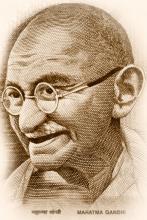
MARTIN LUTHER KING JR. once said that the greatest Christian of the 20th century was not a member of the church. He was referring to Mohandas Gandhi. A remarkable number of King’s fundamental beliefs—the use of active nonviolence as a tool of social reform, the commitment to loving one’s enemies—can be traced back to the influence of Gandhi, which means that one of the defining figures of 20th century American Christianity was profoundly shaped by the example of an Indian Hindu. As King said in 1958 of the civil rights movement, “Christ furnished the spirit and motivation while Gandhi furnished the method.”
But what of Gandhi’s influences? How did a skinny, middle-class, mid-caste Indian, so scared of public speaking as a student that a classmate had to read his speeches aloud for him, come to lead one of the great liberation struggles of the past century? A new book by Arvind Sharma, professor of comparative religions at McGill University, makes the case that the source of Gandhi’s strength was his spirituality. And while the heart of Gandhi’s faith was Hindu, as King’s was Baptist, the influences were remarkably diverse.
Pointing out that most of the biographies of Gandhi really tell the story of Mohandas Karamchand (the name he was given by his family), not Mahatma (a title that means “great soul” and is given to saints in India), Sharma’s book Gandhi: A Spiritual Biography sets out to give an account of the Mahatma. Sharma quotes Gandhi directly on the importance of highlighting the dimension of spirituality in any attempt to understand him: “What I want to achieve—what I have been striving and pining to achieve these 30 years—is self-realization, to see God face to face, to attain moksha [the Hindu term for liberation]. I live and move and have my being in pursuit of this goal.”
Three years ago, a nobody from nowhere got famous for doing something unpleasant.
The self-ordained pastor of an unknown Florida church threatened to burn a Quran. And then he did it. And then others with their own intentions picked up the story and used it to inflame Muslims in several nations.
The result: At least 50 people were killed, including seven United Nations employees.
Now that nobody is back, threatening to burn 3,000 Qurans on Wednesday as a “memorial” to the victims of the 9/11 attacks.
You may have noticed I’ve not named the man. That’s not an accident. Publicity is what he wants and I had decided that my small protest against him would be to not contribute to it. While I defend his legal right to do this, nobody needs to add to his spotlight.
And then I heard about a planned counterdemonstration by a Muslim interfaith activist, Mike Ghouse, who’s been plugging away at his cause for years. This year he’s bringing his 10th annual “Unity Day USA” to the same Florida town where the pastor has threatened to burn the Qurans.

Upon my recent return from the Middle East (with The Global Immersion Project), I was struck more than ever before at our Western infatuation around military aggression, violence, and division. Not only are these the primary narratives we are fed through our major media outlets, they are the narratives we subconsciously embrace through the latest bestseller, box office hit, or video game. Violence, death, and division have become normative. We are becoming numb to the very things that we – as ambassadors of hope and reconciliation – are to turn from as Resurrection People. It is as though there is a stranglehold on our on our ability to see and participate in the stories of healing and new life.
As surprising as this may be, embedded in the midst of these conflicts are endless stories of hope that never make the latest headline or sound bite. And in the times I've followed Jesus INTO these places of conflict, I continue to encounter stories of peace and hope that embody the Gospel message, stories by real people, happening right now, in places usually known only for conflict, violence, and death.
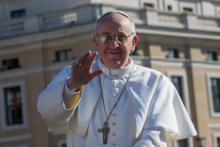
In message published on Friday, Pope Francis took the rare step of personally expressing his “esteem and friendship” to the world’s Muslims as they prepare to celebrate the end of the Ramadan fast.
While it is a long-established Vatican practice to send messages to the world’s religious leaders on their major holy days, those greetings are usually signed by the Vatican’s department for interfaith dialogue.
In his message, Francis explains that in the first year of his papacy he wanted to personally greet Muslims, “especially those who are religious leaders.”
Francis’ predecessor, Pope Benedict XVI, had fraught relations with Muslims. In a 2006 speech he quoted a Byzantine emperor who said Muhammad had only brought “evil and inhuman” things to the world, sparking a worldwide crisis in Christian-Muslim relations.
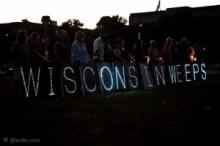
One year after a gunman opened fire in a Sikh temple in Oak Creek, Wis., killing six worshippers, Sikhs say they are hopeful about the future and even more determined to be better understood.
“The legacy of Oak Creek is not one of bloodshed,” said Valarie Kaur, founding director of the interfaith group Groundswell, a project of Auburn Seminary in N.Y.
“[It’s of] how a community rose to bring people together to heal and to organize for lasting social change,” she told the PBS television program “Religion & Ethics NewsWeekly.”

"And God spoke all of these words…You shall not give false witness against your neighbor." Exodus 20:1, 16
Several months back I overheard a conversation in an office waiting room. A young, 20-something guy entered the waiting room with his board shorts on and his windblown hair haphazardly tucked beneath his backwards baseball cap as though he’d just come in from surfing – not uncommon in the beach community of Jacksonville, Fla. He strolled confidently to the receptionist and asked her a question about the availability of a person he wanted to see, made an appointment, and it seemed his business was done and he’d be on his way. Instead he asked the receptionist where she was from, if she liked her job, and then talked about the weather. He then began to tell her about a Bible study he was leading and a little about his faith journey – for the longest time he felt lost, was starting to get in trouble, then he found Jesus, was born again, and began to set his life straight.
After sharing his testimony he asked the receptionist, “What religion are you?"

Last night, my wife Janny and I had the honor of sharing a table with a gathering of local Muslims for an Iftar meal. It is currently Ramadan, which means the Muslim community around the globe fasts everyday day from sunrise to sunset. No food. No water. No tobacco. No sex. Each night they have a celebration feast to break their daily fast called the Iftar meal. It is sacred, joyous, and a time to sit with those they love to worship the One they love, Allah (which is simply the Arabic translation of God).
It was into that sacred gathering that they expanded the table and pulled up a seat for us and a few other Christian and political leaders throughout San Diego. Their hope was simply to create space in their daily practice for their neighbors to experience life with them. They were both acknowledging city leaders who have been proactive in creating an environment of dignity and mutual relationship, and creating a space for new/renewed understanding of one another. Acknowledging our core faith differences, they made clear that it should in no way detract from our ability to share a common vision for the good of our city. We are neighbors who live, work, and play on the same streets with a common desire to see deep, charitable relationships, sustainable economy, and mutual understanding and a celebration of diversity.
As I often say, as followers of Jesus, we have no choice but to move toward relationships with those who are marginalized, dehumanized, and in need of love. We don’t compromise our faith by hanging out with people we may or may not agree with. No, in fact, we reflect the very best of our faith.

During a layover in the Phoenix airport on Friday, I caught the tail end of President Barack Obama’s remarks about the Trayvon Martin case. Struck by Obama’s words, I said to no one in particular, “It’s about time he said something about this.” The man next to me looked in my direction as I walked to get a snack, and I considered for a second going back and asking his impression of the president’s remarks. I kept walking toward the green licorice, but fate had other plans.
Who ended up being in seat 18B next to me? Yep. We smiled as we made eye contact, a mutual recognition that we had an overdue conversation coming and the time to have it.
For a living, I teach and facilitate dialogue. I train others how to — and why to — have challenging conversations that transform relationships and design community change. I have facilitated more than 10,000 hours of dialogue in the past 15 years.
I was feeling confident and curious. We got right into it.
“Well, looks like we are supposed to talk about it,” I said as he laughed. “What did you think of the president’s remarks?”
“I think I thought differently than you did,” John said