LGBTQ
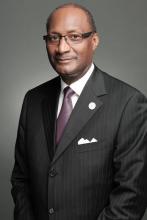
Since the Supreme Court ruled that same-sex marriage is constitutional, the Rev. Jerry Young has been in a quandary.
As the president of the National Baptist Convention, USA, a predominantly black denomination, he is grappling with a new reality: how to respond to the specter of discrimination against gays. While he doesn’t support gay marriage, the refusal of some religious bakers and florists to provide services to gays prompts memories of racially segregated hotels and restaurants.
“On the one hand, you have to be sensitive to the fact that you do not want people to be victims of discrimination — that’s just an absolute fact — you just do not want that to happen,” said Young, who grew up in Mississippi in the civil rights era and is developing a position paper to guide NBCUSA congregations on these issues.
“And on the other hand, there is this tension between what, as Christians, we believe God has called us to do, and what it appears to be, in some sense, what the culture seems to be doing.”

A few weeks ago, the single person’s lament was eloquently stated in The New York Times opinion pages, with a piece called "The Supreme Court’s Lonely Hearts’ Club" by Michael Cobb. Cobb articulated some of the pause that many of us singles have felt as the conversation has gone on about marriage, in particular how Justice Kennedy captured the spirit of the age by extolling the matrimony as the highest institution in the land.
I don’t disagree about the importance of marriage, but I have a lot of concern about how it has been talked about and in many ways idolized in this country. Much of the church has led the way on this idolatry — on the policy end, claiming the need to defend marriage; on the spiritual side, treating marriage as a pseudo-salvation, as though being married means that in some way you’ve "arrived" spiritually.
A few weeks ago, the single person’s lament was eloquently stated in The New York Times opinion pages, with a piece called "The Supreme Court’s Lonely Hearts’ Club" by Michael Cobb. Cobb articulated some of the pause that many of us singles have felt as the conversation has gone on about marriage, in particular how Justice Kennedy captured the spirit of the age by extolling the matrimony as the highest institution in the land.
I don’t disagree about the importance of marriage, but I have a lot of concern about how it has been talked about and in many ways idolized in this country. Much of the church has led the way on this idolatry — on the policy end, claiming the need to defend marriage; on the spiritual side, treating marriage as a pseudo-salvation, as though being married means that in some way you’ve "arrived" spiritually.
A few weeks ago, the single person’s lament was eloquently stated in The New York Times opinion pages, with a piece called "The Supreme Court’s Lonely Hearts’ Club" by Michael Cobb. Cobb articulated some of the pause that many of us singles have felt as the conversation has gone on about marriage, in particular how Justice Kennedy captured the spirit of the age by extolling the matrimony as the highest institution in the land.
I don’t disagree about the importance of marriage, but I have a lot of concern about how it has been talked about and in many ways idolized in this country. Much of the church has led the way on this idolatry — on the policy end, claiming the need to defend marriage; on the spiritual side, treating marriage as a pseudo-salvation, as though being married means that in some way you’ve "arrived" spiritually.

I have to force myself to go to church.
Saturday mornings, when Seventh-day Adventists like me observe Sabbath, I lie in bed extra-long. Sometimes, I roll over and shut my eyes. Other times, I have to physically force myself to get up and prepare, both mentally and physically, to go.
It didn’t use to be this way. I remember waking up extra early as a preteen when I was excited to go to church. More than likely, I would be singing at both services, either in a choir or in special music. I would stay long hours after the service for evening vespers.
That all changed when I came out as bisexual. I no longer felt welcome at worship.
The year is 2005. We are sitting down to dinner with our friend, Michael, in his apartment. Michael is gay and he’s wrestling with what that means. He is also searching for a church and he is drawn to oursbecause his theology and his understanding of God appear to align well with it. At some point in the meal he stops the conversation and asks bluntly,
"Do you think I would be welcome at your church? Is there is a place for someone like me?"
Jason and I exchange a look and the table falls silent. Finally I look up at Michael and say quietly,
“No. No, I don’t think there is. I’m so sorry.”
Fast forward several years. We’re in a new city and a new church. Jason gets an email from someone interested in checking out said church the following Sunday. She explains that she is gay and believes God made her that way. She’s not interested in debating the point. She’s just interested in finding a church. She thinks ours might be a good fit and asks the exact same question that Michael asked:
"Do you think I would be welcome at your church? Is there is a place for someone like me?"
Jason agonized over that email for days and it pained him immensely to write her back and say no. No, I don’t think there is. I’m so sorry.

“I believe Jesus would. I don’t have any verse in scripture. … I believe Jesus would approve gay marriage, but that’s just my own personal belief. I think Jesus would encourage any love affair if it was honest and sincere and was not damaging to anyone else, and I don’t see that gay marriage damages anyone else…” —Jimmy Carter, from his interview with Huffington Post Live
I grew up in Texas as a churchgoing Baptist. I memorized Bible verses as part of my “sword drills,” went to church camp, took part in the clown ministry and even helped in the nursery.
Then I was kicked out at age seventeen for asking too many questions. My youth minister actually threw a Bible at my head and, in a less than nuanced way, invited me to move on, lest I contaminate the minds and hearts of my friends with my doubt.
Some of my questions had to do with their biblical interpretation, which was literal — and their assertion that the texts we were memorizing were the perfect, infallible Word of God, straight from the mind of the Divine to the paper on which it was written.
I had questions.

Despite threats from some conservative Christian dissenters, civil disobedience may turn out to be an irrelevant response to gay marriage.
To understand why, we have to think seriously about what civil disobedience really is.
Here’s a good definition: If a government mandates what religious people believe God forbids, or forbids what religious people believe God mandates, civil disobedience may be required.
In the first case civil disobedience involves the refusal to do what government commands, and in the second case it involves the continued practice of an act that government has banned.
Could this apply to the new legalization of gay marriage nationwide?
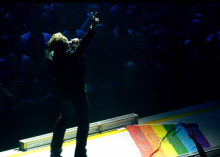
On Sunday, June 28, the day of gay pride parades in Chicago and around the world, millions celebrated the recent United States’ Supreme Court decision that effectively legalized gay marriage at the national level. But David Wichman took his personal Pride rally to the General Admission (GA) line at the United Center.
With his hand-decorated rainbow flag in tow, he wanted to get a place close to the stage. His flag simply said: “IN THE NAME OF LOVE – THANK YOU!” Wichman wanted Bono and the band to know their work as allies had not gone unnoticed.
Dozens of fans bring their banners and signs to the GA floor on each night of the tour — but not every fan has their banner or sign lifted high by the lead singer onstage. As Bono had done in Arizona in May after the news of Ireland’s successful marriage referendum, he turned this spirited Sunday night show into a celebration of marriage (his wife Ali was in attendance), and a joyful tribute to the civil rights advocates who worked to make marriage equality a reality for the whole United States.

In the wake of the landmark Supreme Court decision legalizing gay marriage, a favorite talking point among social conservatives was that even if they lost a battle, they could still win the war: The ruling in Obergefell v. Hodges was akin to the 1973 Roe v. Wade verdict legalizing abortion, they argued , and opponents would continue to fight, and steadily work their way back to victory .
There are several obstacles to that scenario, however. Here are some of them.
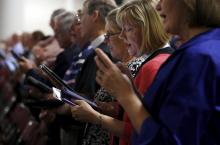
By an overwhelming majority in both of its legislative houses, the Episcopal Church made history July 1 by making marriage for same-sex couples available throughout the church.
The actions on marriage equality came after decades of progress toward fully including LGBT Episcopalians in the work and witness of the church.

When I think about that trip to Charleston with its confederate flag, slave auction block, statues to slave holders, and museums honoring the daughters of the confederacy, it makes it a whole lot harder to fully believe in the hashtag #lovewins. And when I see the subtle and not-so-subtle ways that racism has infused a largely white-led movement for LGBTQ justice — an infusion I have been complicit in even as I have attempted to critique it — my conscience convicts me. I know that in this one moment, love has won a precious victory that allows me the privilege to be healthy, loved, and fully seen. I also know that at this moment systemic racism has murdered nine beautiful people and brutalized countless others. It is a moment in time that asks us to both celebrate and mourn, and more than anything else reminds us of the work yet to be done.

“The court now holds that same-sex couples may exercise the fundamental right to marry. No longer may this liberty be denied to them.”
With these words, Justice Anthony Kennedy supported the decision of the Supreme Court to legalize same-sex marriage in the United States. Gay and lesbian couples across the country are celebrating this long-awaited decision. Those who are Christians are not only thanking the court but also thanking God. But we know that other Christians are not giving thanks — some are angry, others are confused and uncertain. Can a faithful Christian support the court’s decision? What can we say in response to questions voiced by some Christians?
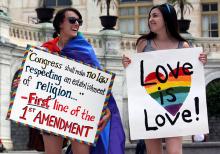
I would like to believe that Charlotte and Trudy are in the world to come, applauding and dancing.

The Supreme Court ruling June 26 to legalize gay marriage rested in pragmatic legal reasoning, the same approach in the June 25 ruling on the Affordable Care Act — the decision that saved Obamacare from a “death spiral.”
Justice Anthony Kennedy, author of the majority opinion in the 5-4 decision, described equal protection under the law as an inevitable step in the evolution of changing understandings of marriage across the centuries and essential for the safety and dignity of thousands of gay and lesbian couples and their children.
The Supreme Court ruling June 26 to legalize gay marriage rested in pragmatic legal reasoning, the same approach in the June 25 ruling on the Affordable Care Act — the decision that saved Obamacare from a “ death spiral.”
Justice Anthony Kennedy, author of the majority opinion in the 5-4 decision, described equal protection under the law as an inevitable step in the evolution of changing understandings of marriage across the centuries and essential for the safety and dignity of thousands of gay and lesbian couples and their children.

In the days before the Supreme Court made it possible for gay couples to marry everywhere in the U.S., we asked two couples of faith — one Jewish who live in a state that forbids gay marriage, and one Christian and opposed to gay marriage — what the decision would mean to them.
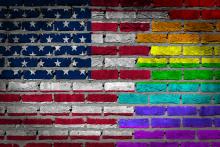
The Constitution was born within a worldview hospitable to transformation and open to corrections of injustices in letter and spirit. Examples abound: women’s right to vote, interracial marriage, the right to open legislative deliberations with prayer, and the right to education without segregation.
The Constitution has never claimed to be, in itself, the last word. Rather, it has claimed to be the first.
While I will not propose that every decision the Supreme Court has made has been for the betterment of all people, today’s ruling on same-sex marriage is an example of a nation reforming itself for the better.
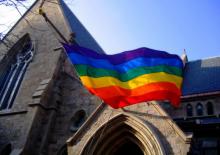
Following the Supreme Court’s ruling today that “same-sex couples may exercise the fundamental right to marry in all States,” many wondered how Christian leaders in the U.S. would react.
But despite lingering stereotypes, many religious folk in the U.S. are now supportive of same-sex marriage. In fact, a recent survey found that “among religiously affiliated Americans, supporters today actually outnumber opponents.”
Below, read some of the responses from Christian leaders — including evangelicals, Catholics, and Protestants — who have expressed their joy and support for today’s Supreme Court ruling, as well as the work left to be done towards full LGBTQ inclusion in our nation and churches.
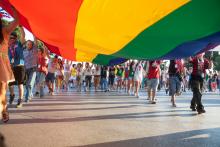
The debate is over.
In a landmark decision, the Supreme Court decided this morning that marriage was a fundamental right for all couples regardless of gender. All Americans who wish to can now marry the same-sex partner they love. Every state law that bans such marriages is now dead. And it is over. It is finished. This debate, at long last, is done.
This is a good day to be present. I want to document this day into my memory, so I might tell my children about it later. Although at 25 I can’t possibly understand all this decision entails, there may be a day down the road when I stand tuxedoed and teary-eyed and holding the hands of another, and I want this memory to color that moment. I want to feel the gift of it.
But this day also brings up a lot of complicated feelings for me, too. I am, after all, a follower of Jesus, and many in this family of Christians are not celebrating with me. They are unsure of what to say, uncertain of what the future holds.

Gay couples have a legal right to marry, SCOTUS ruled today.
“The court now holds that same-sex couples may exercise the fundamental right to marry. No longer may this liberty be denied to them,” wrote Justice Anthony Kennedy, the Washington Post reports.
The 5-4 ruling comes as a legal confirmation of the rapidly changing tide of public sentiment towards legalizing same-sex marriage, which was legal in only four states until the last five years, but saw 33 more states rule in favor since 2010.

This is awkward.
In a June 5 Facebook post, Franklin Graham suggested that it’s time to “fight the tide of moral decay that is being crammed down our throats by big business, the media, and the gay & lesbian community. ...This is one way we as Christians can speak out — we have the power of choice. ...Let’s just stop doing business with those who promote sin and stand against Almighty God’s laws and His standards," Franklin wrote on Facebook.
But Franklin’s popular autobiography, Rebel With a Cause, was published by Thomas Nelson, a Christian publishing company. Thomas Nelson’s publicity is handled by a company called Rogers & Cowan. One of the largest public relations firms in the world, Rogers & Cowan also is the publicist for ...
... Caitlyn Jenner.
Whoops.

This extravagant love poured out on my behalf felt like an offer of grace from God, a reminder that though the man I had dated couldn’t love me as I should be loved, God would make up for the rest. It was a convicting moment — I have often viewed this type of love and friendship as a consolation prize for not having a significant other. What a small way to live and love when you only expect love from spouse and children and see the love of friends and family as lesser. How could such a small group of people really show all the wonder and magnitude of God’s unfailing love toward us?