
Tim Brinkhof is a U.S.-based Dutch journalist who writes about religion, politics, and history.
Posts By This Author
A New Dante Movie Gets Lost In Hell
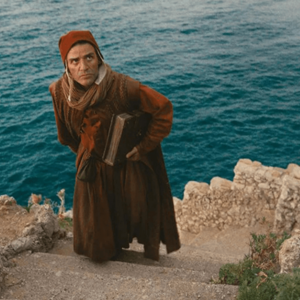
In the Hand of Dante is all over the place. The narrative advertised by its title, of medieval Italian poet Dante Alighieri’s struggle to write his epic poem, The Divine Comedy, competes for screen time with a neo-noir story in which a fictional version of Nick Tosches, the late author of the book on which this film is based, is recruited by a crime boss to authenticate the poem’s long-lost original manuscript.
Oscar Isaac plays both Dante and Tosches. Gerard Butler stars as an unpredictable, “I woke up and chose violence” hitman who accompanies Tosches to Italy, as well as Pope Boniface VIII, who exiles Dante from his native Florence. (The two belonged to opposing factions vying for control of the great Italian city-state, with Dante supporting civic independence from the Vatican.)
‘The Boys’ Is Over. Its Questions for Trump’s Evangelicals Remain
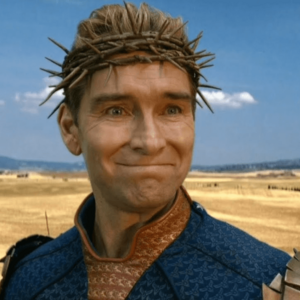
Amazon Prime’s The Boys wrapped up its fifth and final season last week, and its overarching theme was: faith. After becoming the de facto CEO of Vought and president of the United States, antagonist Homelander—a narcissistic Superman foil, wrapped in the American flag and played to perfection by Antony Starr—still isn’t satisfied.
Craving what he’s craved since lab birth—unconditional love and devotion with no expectation of anything in return—he declares himself a god and uses Vought’s media machinery to convince the American public of his divinity. Guided by visions of his former boss, Madelyn Stillwell—a Mary-esque mother-figure who, before he murdered her in Season One, used to breastfeed him—he ultimately decides to kill (“cleanse”) anyone who doesn’t “in their heart of hearts” believe in his divinity.
Werner Herzog and What Makes a Life Worth Filming
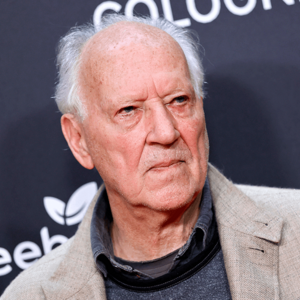
“Romantic” may not be the first word that comes to mind when talking about Werner Herzog—known for such charming expressions as “I believe the common denominator of the universe is not harmony but chaos, hostility, and murder”—yet it is, perhaps, one of the most appropriate.
The German filmmaker can be considered a romantic in both the contemporary-everyday and historical-philosophical sense. Like the poets and painters who emerged from the Sturm und Drang movement of the mid-18th century such as Johann Wolfgang von Goethe, Friedrich Schiller, and Henry Fuseli, he gravitates toward the fantastical, transcendent, and sublime. His films, documentaries, and books frequently center on characters who attempt to do the impossible for the sake of its impossibility, and in doing so, posit that existence is, at its core, the stuff of feeling rather than thought. After all, reason alone can’t explain why someone would hoist a steamship over a mountain, live among grizzly bears, or—as in his latest documentary, Ghost Elephants—chase a potentially nonexistent herd of proboscideans across the Angolan highlands.
How Fascism Became a Religion
Want to understand today’s political landscape? Study Mussolini’s story first.
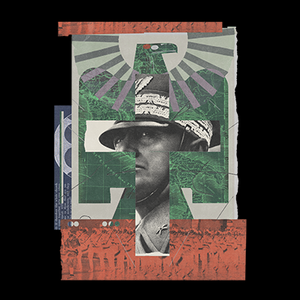
DURING ONE MEMORABLE scene in Mussolini: Son of the Century, a critically acclaimed series about the rise of Benito Mussolini currently streaming on MUBI and Apple TV, the fascist leader finds his wife, Rachele, in a church, praying for the recovery of their sick child. An avowed, outspoken atheist, Mussolini tells her to direct her pleas to the doctors treating him instead. When ignored, he looks up at the ceiling and asks God to prove God’s existence by smiting him—a request which, to Mussolini’s self-satisfaction, goes similarly unanswered. Outside, the couple is greeted by a crowd shouting “Duce,” or leader. Bathing in the public’s adoration, Mussolini spreads his arms, his pose mirroring the cross atop the church behind him.
Mussolini’s desire to rival and replace Christianity is not a fabrication or exaggeration on the part of the TV series, directed by filmmaker Joe Wright and based on a well-researched historical novel of a similar name by Italian author Antonio Scurati. Fascist leaders frequently compared their movement to the Catholic Church, describing themselves as prophets and saints while referring to their followers as believers and worshippers. In a way, the party apparatus didn’t just look or sound like religion; it was a religion, custom-made for an age when Christianity was rapidly giving way to atheism.
Although Mussolini’s 20-year reign came to a brutal end during World War II, when he and his mistress were executed in front of a similarly jubilant crowd, his legacy has survived. To this day, this early fascism serves as a blueprint for conservative and neo-fascist movements across the world, from the United States to Italy itself. Looking at what happened when Mussolini rose to power more than a century ago will help us understand what’s happening today.
Is ‘Warfare’ an Anti-War Movie?

'Warfare' / A24
Even if you haven’t seen Warfare, you might have come across news headlines calling it “the most realistic war film ever made.” This isn’t a cheap marketing ploy. The film, the latest from Ex Machina, Annihilation, and Civil War director Alex Garland, does indeed have a strong claim to that title. Garland’s first foray into cinematic nonfiction, Warfare is based on the memories of Navy SEAL soldiers who were ambushed by al-Qaida in the aftermath of the Battle of Ramadi in 2006.
Can Movies Function as a Mode of Religious Instruction?
We promise, we’re not talking about ‘The Passion of the Christ.’
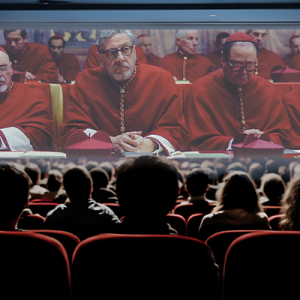
From Conclave / igoriss / iStock / Focus Features
SINCE ITS PREMIERE in late 2023, Wim Wenders’ Perfect Days — a quiet, contemplative film about a janitor who cleans Tokyo’s public toilets — has been showered with accolades, including a Cannes Film Festival Palm d’Or nomination, an Oscar nomination for Best International Feature, two Japan Academy Film awards for Best Director (Wenders) and Actor (Kōji Yakusho), and even an Ecumenical Jury Prize, an independent award created by international Christian media organizations SIGNIS and Interfilm.
All these honors more or less speak for themselves, except — perhaps — the last one. Perfect Days is, after all, neither a Christian film nor an explicitly religious one. Except for the occasional reference to concepts related to Buddhism, such as meditation, karma, and nirvana, the only time protagonist Hirayama seems to make contact with some sort of higher power is when he listens to Nina Simone’s “Feeling Good” on his way to work each morning.
Fortunately for Wenders, Ecumenical Juries — which attend film festivals across the world — don’t limit themselves to the likes of Jesus Christ Superstar or The Passion of the Christ. At least, not anymore. “Initially, the focus was on films reflecting the Christian worldview,” says S. Brent Plate, a professor of religious studies at Hamilton College in New York, longtime Ecumenical Jury member, and author of Religion and Film: Cinema and the Re-creation of the World. “Over time, we shifted toward a broader interpretation of that focus, looking for films that, even if they don’t directly address religion, promote humanistic, progressive values.”
As a result of this shift, the Ecumenical Jury’s mission has come to raise worthwhile questions for film aficionados and religious scholars alike: Can movies function as a mode of religious instruction, bringing us closer to the divine the way a sermon might? Can they teach us how to be better people, inspiring us to lead more fulfilling lives by untangling the mysteries of the human condition? And, most important perhaps, can they nourish our spirit, impart morality, and help us overcome moments of personal crises in an age where the historical provider of such services in the West — the church — is losing its longstanding influence?
Christianity and Capitalism Keep Killing Robert Pattinson in ‘Mickey 17’
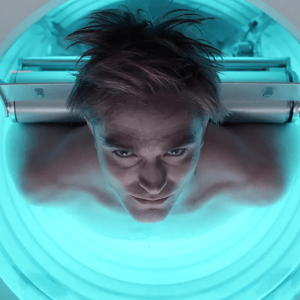
'Mickey 17' / Warner Bros.
Similar to Parasite, Mickey 17 is ultimately about the ethics of revolutionary struggle. The film considers how Christian morality — especially as understood by thinkers like Friedrich Nietzsche, Michel Foucault, or Karl Marx, the latter of whom famously referred to religion as the “opiate” of the masses — prevents the downtrodden from standing up for their rights. Here, Pattinson’s Mickey is a clear stand-in for Christ and the model Christian. Resurrected ad infinitum, he humbly accepts the pain, suffering, and dehumanization inflicted on him by his apathetic, at times downright demonic coworkers as punishment for his perceived sins.
Divorcing Russian Orthodoxy From the Kremlin’s Agenda
Theologian Katya Tolstaya on making sense of evil, including Putin’s ongoing war against Ukraine.

Illustration by Nico Ortega
IN JULY 2014, the Russian state-owned television network Channel One aired a news story that sickened many Russians.
Speaking from a refugee camp near Rostov, a woman named Galina Pyshnyak claimed to have seen Ukrainian soldiers in the contested Donbas region torture a child while his mother watched. Pyshnyak said, “They took a 3-year-old child, a small boy in panties, in a T-shirt, and nailed him as Jesus to an advertisement board.”
The story, which independent journalists were unable to verify, was quickly called out by international watchdogs as Russian propaganda: a way for the Kremlin to rally support for its occupation of Crimea and — in time — plant the seeds for its 2022 invasion of Ukraine as a whole. The “crucified boy” story served as a call to arms, as cases were reported of Russians who volunteered to fight against those Ukrainians who crucify little children. Subsequent investigations showed that a version of the story had first appeared on the Facebook page of Alexander Dugin, one of the most successful propagandists of the Russkiy Mir (“Russian World”) ideology. Channel One retracted the story in December 2014.
To Netherlands-based theologian Katya Tolstaya, however, the explicit Christian imagery of Pyshnyak’s “eyewitness” account and the visceral responses it elicited throughout Russia represented something else: In Putin’s world, religion and politics were becoming narrowly intertwined.
Over the years, experts have produced various explanations for Russia’s return to totalitarianism and who should be held responsible. Some argue the development stems from the ambition and personality of Russian President Vladimir Putin himself, while others point the finger at a broader Russian culture. Assorted studies focus on the political or the historic, the economic or the religious roots of totalitarianism. Tolstaya, for her part, sees religion as both a problem and a solution. Divorcing Russian Orthodoxy from the Kremlin’s imperialist agenda, she argues, can help Russians come to terms with a dark past that they have yet to process.