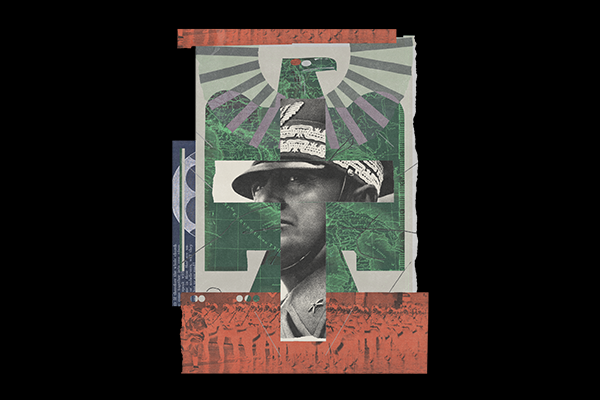
DURING ONE MEMORABLE scene in Mussolini: Son of the Century, a critically acclaimed series about the rise of Benito Mussolini currently streaming on MUBI and Apple TV, the fascist leader finds his wife, Rachele, in a church, praying for the recovery of their sick child. An avowed, outspoken atheist, Mussolini tells her to direct her pleas to the doctors treating him instead. When ignored, he looks up at the ceiling and asks God to prove God’s existence by smiting him—a request which, to Mussolini’s self-satisfaction, goes similarly unanswered. Outside, the couple is greeted by a crowd shouting “Duce,” or leader. Bathing in the public’s adoration, Mussolini spreads his arms, his pose mirroring the cross atop the church behind him.
Mussolini’s desire to rival and replace Christianity is not a fabrication or exaggeration on the part of the TV series, directed by filmmaker Joe Wright and based on a well-researched historical novel of a similar name by Italian author Antonio Scurati. Fascist leaders frequently compared their movement to the Catholic Church, describing themselves as prophets and saints while referring to their followers as believers and worshippers. In a way, the party apparatus didn’t just look or sound like religion; it was a religion, custom-made for an age when Christianity was rapidly giving way to atheism.
Although Mussolini’s 20-year reign came to a brutal end during World War II, when he and his mistress were executed in front of a similarly jubilant crowd, his legacy has survived. To this day, this early fascism serves as a blueprint for conservative and neo-fascist movements across the world, from the United States to Italy itself. Looking at what happened when Mussolini rose to power more than a century ago will help us understand what’s happening today.
Read the Full Article