Faith

We have listened to many of the modern-day prophets of our times. They have pointed the way toward justice and restoration. We have prayed together and moved our bodies together and exercised the discipline of silence together in order to get a glimpse at God’s kind of justice. In more ways than one, we have had a mountaintop experience, but most of us don’t live on mountaintops. We live back down in the valleys, in cities and town, in the commotion of life and work and love.
And so, it is necessary that we take time while on the mountaintop to reflect on all that God has given us in this special place. To imagine the implications of these truths, these questions, these stories on how we will live our lives.

Colorado Springs really must have angered God.
I’m not sure what the city's residents have done, but He has to have a reason for burning up homes and possessions. One thing we know: God sends messages through natural disasters to certain groups who defy him and peddle evil. How else could we explain what’s happening?
Mark 4 tells us that Jesus controls the wind. And it is the wind, in large part, that has caused the fire to spread. Perhaps we should heed the warning of Jesus in Luke 13 and repent or else face the reality of perishing like them.
Is it possible that groups such as Compassion International and Bibles for the World have secretly condoned certain sins that will, in the end, keep people out of the kingdom of God? What message is God sending to groups like HCJB Global and Biblica?
This fire seems to be warning to them, and everyone to repent. They need to step up and reaffirm the Evangelical tradition. They must turn back from distorting whatever it is they have distorted about God’s character.
Does this sound ridiculous?

On Thursday, the Supreme Court ruled that the federal government does hold the constitutional power to mandate that most American's purchase health insurance or pay a penalty. This power is maintained in Congress’s ability to levy taxes.
The justices also ruled that the federal government does hold the constitutional power to expand Medicaid, making more people eligible to receive the benefit, but, like the original Medicaid law of 1965, states can opt out of the expansion if they so choose.
What does this mean? And what does this mean for Jesus followers?

Where there is no vision, the people perish. ~ Proverbs 29:18
Thursday’s Supreme Court ruling on the constitutionality of the Affordable Care Act was remarkable in a number of ways. The vast majority of articles, blogs, and analyses focus on the political ramifications of the decision.
Is this a win for the Obama administration or fuel for the Romney campaign? Pundits have looked at nearly every political angle, from the upcoming presidential election to its effects on local politics.
While I appreciate the political analysis and the importance of political processes to the wellbeing of the United States, I believe that a majority of coverage has missed one of the most remarkable points of the ACA: It changes the vision of our national community.
I have been thinking about the church of my youth. I have been remembering, if you will, as a guy who has read too much Updike (I'll never forgive him for the Rabbit books) might remember his youth.
There is a melding of nostalgia for what was as well as what might have been. It's a mess, to be honest, a kind of lie that draws me in no matter how often I tell myself it is a lie. Sometimes these lies of memory are the heart's truth.

Today, as President Obama followed the monumental decision of the Supreme Court to uphold the Affordable Care Act, his wife, Michelle Obama addresses an assembly of 30,000 leaders and laity at the African Methodist Episcopal Church Conference in Nashville, Tennessee. We're still waiting for the video to come, but meanwhile, browse through the transcript of her speech on faith, families, and what's next.

A few weeks ago I (an ordained minster who has gone to church my whole life) walked away from church — for three months. It is what I've decided to do with my sabbatical. You can read about my initial thoughts on my blog or on The Huffington Post. As the journey unfolds, I will be blogging about it in this series entitled, “Church No More.” I hope you will not only follow along, but add your voice to the reflection by commenting or joining the discussion on my FB page.
It might be that the thing which concerned me the most about leaving the church was losing my spiritual community. It's not that I thought the spiritual-but-not-religious folk were helplessly lonely people wandering around seeking a spiritual community. Not at all. I just assumed that it might be immensely difficult to find and plug into a community like that in the course of three months. I also couldn't help but think it would be just a bit — well, fake to seek out a community for the sake of observing them and then leaving a few months latter. Not just fake but somewhat mean spirited and completely missing the point of community.
Here's the thing, I am a minister. I understand myself to be a person who ministers by following the lead and teachings of Jesus. (I also happen to follow the teachings of many other spiritual and/or thought leaders from Buddha to Neil deGrasse Tyson, but that's for another post some other time). Because of that, the idea of life without a spiritual community gives me the heebie-jeebies. (I apologize for using such a technical term, but a duck is a duck is a duck).
The better way says, if we follow God’s religious values we can use global technology, green economy, and targeted economic and infrastructure investment, total access to education, and creative job creation strategies to address the ugly realities of poverty. If we follow the enduring ethic of love we can beat our swords of racism into the plows that will till the new soil of brotherhood and sisterhood
If we see the poor as our neighbors, if we remember we are our brother’s keeper, then we shall put the poor, rather than the wealthy, at the center of our agenda.
If we hold on to God’s values, the sick shall have good health care. The environment shall be protected. The injustices of our judicial systems shall be made just. We shall respect the dignity of all people. We can love all people. We can see all people as God’s creations.
We can use our resources to develop our minds and economy, rather than build bombs, missiles, and weapons of human destruction.
Do we want to keep pressing toward God’s vision? Values are once again the question of our times.
Do we want a just, wholesome society, or do we want to go backwards? This is the question before us. And I believe that at this festival there is still somebody who wants what God wants. Somebody who understands there are some things with God that never change
There are still some prophetic people that have not bowed, who as a matter of faith know that Love is better than hate. Hope is better than despair. Community is better than division.
Peace is better than war. Good of the whole is better than whims of a few. God wants everybody — red, yellow, black, brown and white taken care of. God wants true community, more togetherness … not more separateness. God wants justice, always has, always will.
Because with God some things never change.
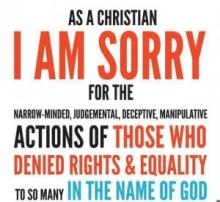
Two weeks after we arrived in Portland, Amy (my wife and new senior pastor at First Christian Church in downtown Portland) decided she needed to do something meaningful to express her voice as a person of faith in the community. There already were the folks handing out tracts down on the campus of Portland State University, which is definitely not us. There were plenty of community leaders to meet, hands to shake and even media outlets to connect with so we’d have a better handle on key circles of influence.
But none of what was really what we had in mind.
The annual Pride fest was taking place that weekend along the banks of the Willamette River, and we knew we should probably go. Folks in our new congregation are in various stages in their journey of discerning where they are with regard to sexual orientation, but overall, it’s an incredibly open and loving place for all people. There are gay singles and couples who attend regularly, and who participate in leadership and other ministries like everyone else. But the fact of the matter is that most people outside the walls of the church don’t know that. And honestly, how will they ever know if we’re not willing to tell them?
Better yet, why not show them?

I know I’m cynical, but I didn’t know how dead I got inside.
It was easy to give up on the world. There are way better people than I failing to pull us out of our quagmire.
It was pretty easy to give up on the church too. Pick your disappointment....
So, like I said, I knew I was cynical, but I didn’t know I was about to die from my cynicism. Then I went to the Wild Goose Festival. I wasn’t healed there. Just the opposite. I was playfully wooed to mourn the passing of my younger self.

“The spirit that enables one person to overleap the boundary of the body in knowledge and love and to incorporate the other in the self is matched by the same spirit in the other.”
~ Luke Timothy Johnson, Living Jesus: Learning the Heart of the Gospel
“He said to her, ‘Daughter, your faith has made you well; go in peace, and be healed of your disease.’”
~ Mark 5:34
After several days of renewed public debate about health care, we hear this weekend the familiar healing stories from Mark chapter 5. By Sunday we will know the U.S. Supreme Court’s decision regarding challenges to the Affordable Care Act. So politically charged is this discussion, so designed is it to distort, divide, undermine, and confuse, it’s easy to forget that the issue, at its core, is a simple one: how ought a humane society tend to its suffering ones and aim for the well-being of all?
We will also hear this passage on a day when many will be anticipating the Fourth of July, and perhaps expecting their Sunday worship to kickstart the holiday’s celebration. In hearing the text from Mark, such worshipers might well wonder: What does Jesus’ encounters with a desperate, suffering woman and a young girl believed to be dead have to do with America’s love of freedom and fireworks?
Billy Sunday was the most famous evangelist in America during the first two decades of the 20th century. Without the aid of loudspeakers, TV or radio, Sunday preached to over 100 million people the classic evangelical gospel that remains familiar to many people today. Repent and believe in Jesus, who died on the cross for your sins, and be saved from eternal damnation. The simplicity of Sunday’s message prompted millions of early 20th century Americans to examine the state of their souls and consider their eternal fates. Yet when it came to conscientious objectors during World War I, Sunday spared no mercy:
The man who breaks all the rules but at last dies fighting in the trenches is better than you God-forsaken mutts who won’t enlist.
Throughout our nation’s history, it’s been an axiom that Presidents lead us into wars, while Christians provide the flags and the crosses. Barring a few notable exceptions — Anabaptists, Quakers, and early Pentecostals — evangelical fervor has often promoted an uncritical nationalism that baptizes American military adventures with religious legitimacy. It’s no coincidence that the setting of Mark Twain’s famous War Prayer —in which Twain delivers a devastating critique of the use of religion to justify imperialism — is a Protestant Christian church. Given the historical record, it may seem the deck is stacked against American evangelicals organizing into a comprehensive peace movement — yet that’s exactly what’s happening.

SHAKORI HILLS, N.C. — On a swelteringly hot solstice weekend in the southeast, a couple thousand folks gathered in the woods of North Carolina to get their collective goose cooked. An early summer camp like no other, this second annual festival invokes a Celtic image of the Holy Spirit and sparks unlikely convergences inside the great emergence of the contemporary Christian counterculture.
The Goose blends the best of an intellectually engaged faith conference and social justice activist base camp with the sonic frivolity of a modern rock festival and stirs all concepts and collapses all constructs in a steamy potluck stew of primal camp meeting and postmodern tent revival. Without a doubt, the blossoming and beckoning of the Wild Goose movement in North America heralds a bright radical future for today’s Jesus followers bringing the kingdom come.
Wild Goose Festival: Sunday Call to Worship from cathleen falsani on Vimeo.

The second Wild Goose Festival has just ended. I left a piece of my heart in the hills of North Carolina. Ahead is the third WG fest at the end of August in Portland OR. And then there will be next year and the next... The White House sent the Rev. Derrick Harkins (faith outreach director for the Democratic National Committee) to observe and talk with some of us this year. So I guess WG got noticed.
Last year's WG was the first and there were about 1,300 of us there. This year we were closing in on 2000-plus. And now WG is West Coast bound too. The names of the speakers Jim Wallis and all the rest (I spoke 3 times) added up to a "draw" along with the big name musical performers. But the heart of the festival wasn't in the events but in the conversations.
For me the highlight of the festival was the fact that there was no wall of separation between us speakers and performers and everyone there. I spent 4 days talking with lots of people from all over America and other places too, about ideas but also about very personal subjects. I met Ramona who was the cook at the Indian food stand and found she is ill and has no health insurance and I was able to connect her with a friend who knew a friend at the WG fest locally to help her get the full checkup she needs. I could do that because the festival was full of the sort of people who help, love and care so for once there was someone to call.
And I watched the sneak preview of the movie Hellbound that will be released this fall. It happens that I'm one of the people interviewed in the movie but that's not why I say it is one of the best films I've ever seen. We watched it at 11 PM and talked until 2 AM. People were just stunned.
I spoke with Chris Yaw recently, host of an online program called ChurchNext. On it, he has dialogues with a number of church leaders about the current state of organized religion, the changing face of Christianity and what our churches may do to remain (or become) relevant, vital ministries in the world.
Here’s a video of our chat. You can also download the whole episode from his website, or catch it as an audio-only MP3.
Tuesday was a big day.
Nearly 150 evangelical leaders signed onto an “Evangelical Statement of Immigration Reform.” Signers came from across the spectrum of evangelicalism including leading Hispanic evangelical organizations, to pastors such as Max Lucado, Bill Hybels, Joel Hunter, and Jim Daly, president of Focus on the Family.
No, that isn’t a typo. Sojourners stood side by side with Focus on the Family to draw attention to the plight of millions who have been caught up in our broken immigration system. It was exciting to see such unity across the traditional political spectrum that rarely happens in Washington.
Make no mistake, there are still big gaps in theology and politics among those in this group. But Tuesday wasn’t about politics. Rather we focused on the things we agreed were fundamental moral issues and biblical imperatives. This coming together to help fix a broken immigration system on behalf of those who most suffer from it is just what politics needs and could begin to affect other issues, too.
Instead of ideology, we came together because of morality and common sense. And that’s what leaders are supposed to do.

I struggle to know how much is enough. I hear about Joseph Kony and the many children he’s exploited as child soldiers. I get angry, discouraged. I write about it, talk to friends about it.
And then my life keeps moving and I don’t think about it again for days or weeks.
Trayvon Martin, an unarmed teenager, is gunned down on the street. The nation is divided, both outraged about the killing and fearful of the threat to gun rights and laws of self-defense.
And then we talk about something else.
Today’s issues include the nuns going head-to-head with the Vatican, as well as stories about still more preachers being busted for spousal abuse, or expelled from their jobs because of their sexual orientation.
Tomorrow it will be something else.

I'm rewriting the old African-American spiritual “Down By the Riverside.”
(Don't worry. It's OK . I'm a minister).
My new version goes something like this:
Gonna lay down my robe and stole
Down by the Riverside
Down by the Riverside
Down by the Riverside
Gonna lay down my robe and stole
Down by the Riverside
Ain't goin' to church no more.
Yep! That's it. This minister is walking away from church — well, at least for the next three months.

Author Anne Lamott, one of our favorite Jesus-loving subversives, recently delivered the undergraduate and interdisciplinary studies commencement address at the University of California at Berkeley.
Lamott's funny, irreverent, and yes, profound, words of wisdom for the Berkeley graduates included the following, about what she thinks the "truth of their spiritual identity" might be:
Actually, I don’t have a clue.
I do know you are not what you look like, or how much you weigh, or how you did in school, and whether you get to start a job next Monday or not. Spirit isn’t what you do, it’s … well, again, I don’t actually know. They probably taught this junior year at Goucher. But I know that you feel it best when you’re not doing much — when you’re in nature, when you’ve very quiet, or, paradoxically, listening to music....

The votes are counted, the concession speeches made, the victory parties had. Wisconsin, a word that has become as synonymous with divisive politics as it is for cheese and beer, is done with the recalls.
In the end, some change was made. Between the first round of recalls and yesterday’s election, the senate has shifted from Republican to Democratic control. And yet, not much has changed. We still have a union-busting governor and a climate change doubter as lieutenant governor.
The calls, from politicians and citizens, have been pretty consistent. It is time to move forward. It is time to put aside our divisions and find a way to govern together. It is time of our state to heal.
Whatevs.
See, I’m not all that interested in moving forward – not because I like the fighting or because I think it is healthy to be so divided that the mere mention of politics in casual conversation makes blood pressures boil.