Faith
 It started with a few pieces of construction paper.
If you’ve been following my blog at all over the past few months, you know that Amy and I recently moved our family from Southern Colorado, where we planted a church eight years ago, to Portland, Oregon. Though we’re still doing ministry, it’s a completely different kind of work. Now we’re at a 133-year-old church in the heart of the city. The facility is incredible and the history of the church spans generations. But with that comes a good deal more administrative work than either of us is used to.
We found a preschool for Zoe right away. In fact, the first day she told us that we needed to leave and let her do her school thing. She’s the kind of kid who blooms wherever she’s planted. Mattias, our eight-year-old son, is a little more complicated. Aside from him having Asperger’s, the schools here don’t get out for a couple of weeks yet. This means not only that he has no other kids his age to play with, but also that the typical summer activities we could enroll him in don’t start until mid-June. The result: he gets to spend some pretty long days with us at the church.
Most times, he makes the best of it. He’s figured out how to navigate the labyrinthine halls by scooter, and he has plowed through more cartoons on the iPad than is healthy, I’m sure. But we have to work and we have no other options for him. So far, we’ve all managed.
But yesterday afternoon, he’d had enough. He looked up from his chair on the other side of Amy’s desk with tears filling his eyes. “Mom,” he said quietly, “I’m so bored.” There are plenty of adjectives that describe Mattias, but quiet isn’t one of them. So you know when his voice reduces to a whisper, he is really being sincere.
Amy came down and stuck her head around the corner into my office. “We’re going across the street to throw paper airplanes in the park, she said. “want to come?”
Image by Feng Yu/Shutterstock.

NASHVILLE, Tenn. --- Andrew Hamblin's Facebook page is filled with snippets of his life.
Making a late-night run to Taco Bell. Watching SpongeBob on the couch with his kids. Handling rattlesnakes in church.
Hamblin, 21, pastor of Tabernacle Church of God in LaFollette, Tenn., is part of a new generation of serpent-handling Christians who are revitalizing a century-old faith tradition in Tennessee.
While older serpent handlers were wary of outsiders, these younger believers welcome visitors and use Facebook to promote their often misunderstood — and illegal — version of Christianity. They want to show the beauty and power of their extreme form of spirituality. And they hope eventually to reverse a state ban on handling snakes in church.
Sweet 16 and never been theologically on point.
Got some good ones this week. Enjoy.

Writing for The Washington Post, Lisa Miller says yes:
"Technology can greatly enhance religious practice. Groups that restrict and fear it participate in their own demise....If religious groups don’t embrace and encourage the practice of faith online, the faithful might go shopping instead."
Read more here

A recent piece on the Huffington Post's Religion page described the death of Pastor Mark Wolford, a Christian minister known for handling venomous snakes during his worship services to demonstrate the power of his faith. The stunt went south, however, after he was bitten on the thigh during worship and died at a hospital not long after.
The practice, though rare, is employed in a handful of Christian congregations in response to a literal interpretation of verses 17 and 18 in the 16th chapter of Mark:
And these signs will follow those who believe. In My name they will cast out demons; they will speak with new tongues; they will take up serpents; and if they drink anything deadly, it will by no means hurt them; they will lay their hands on the sick, and they will recover.
There are several dangers this story raises, not the least of which, of course, is death by venomous snake bite. Such communities require public displays of faith that are meant to test the resolve of the faithful. And such practices are not restricted to backwoods protestant churches; some Catholics (and others) are enamored with the phenomenon on stigmata, where people exhibit physical signs of crucifixion, such as wounds on their hands or feet.
There’s the more obvious danger of putting someone in harm’s way by expecting them to perform a dangerous act to prove their faith. But there’s also the undercurrent of religious one-upsmanship, wherein folks are forever striving to be more daring, graphic or otherwise attention-grabbing. In addition to the potential physical danger, there’s the risk of pressing people to be deceptive in their faith practices, simply to enjoy the validation or admiration they seek, and which is held in such high esteem in these particular circles.
WITHOUT SOME advance warning, you might not know that Jeff Sharlet is a man of God. That’s not an insult or backward compliment so much as it is fact. Though perhaps best known for his acclaimed nonfiction expose The Family: The Secret Fundamentalism at the Heart of American Power, Sharlet doesn’t beat readers over the head with the proverbial Bible he carries in his knapsack. If you don’t know what clues to look for—tales of Germans born again in Oklahoma, descriptions of hipster trucker caps emblazoned with flashy youth crusade logos—you might miss some of his most powerful nods to spiritual and religious influence in his travels. You might mistake the nondenominational journalist for just another fantastically gifted storyteller, a shrewd correspondent reporting back from remote spiritual enclaves, rather than a disciple of God seeking to understand those with whom he shares some belief.
Sweet Heaven When I Die begins by tracing Sharlet’s youthful days visiting a girlfriend’s Colorado ranch and his grandmother’s Knoxville home. His keen sense of personal history first grounds his essays in what is clearly important in his own life: the closeness of loved ones, the nearness of God. But he quickly moves beyond situating himself in his writing and instead steps back to peer like a prophet into the lives of others—philosopher and educator Cornel West or Yiddish novelist Chava Rosenfarb.
Sharlet also nimbly passes through the outer realms of faith and lack thereof. In one of the book’s most poignant vignettes, he retraces the short life of Brad Will, once called one of the country’s “leading anarchists.” (The oxymoronic label suitably amused Will.) Will’s activism began in a same-sex marriage standoff with Promise Keepers in Boulder, Colorado, and then carried him north to Quebec City and south to his 2006 death in Oaxaca de Juarez. Throughout his fiery life, he kept in close contact with his straight-laced Republican family; attending his mother’s 60th birthday party celebration was a chief concern when he was detained for a week following the 1999 WTO protests in Seattle.

Ah, the life of the church. So many arguments, so little time.
The list of subjects about which the saints disagree is seemingly endless, encompassing both the profound and the woefully mundane.
The ordination of women. The proper role of religion in politics. Climate change. Homosexuality and same-sex unions. Pre-, Post-, or A-millennialism. Biblical translation. Gender pronouns for God. How best to aid the poorest of the poor. How best to support the sanctity of marriage. Hell. Heaven. Baptism. Which brand of fair-trade coffee to serve in the fellowship hall. The use of “trespass/es” or “debts/debtors” in reciting the Lord’s Prayer. Whether to use wafers, pita, home-baked organic wheat, gluten-free or bagels at the communion table. What color to paint the narthex.
It should come as no surprise to most Christians that the world outside the church looking in sees it rife with conflict, bickering, arguments and castigation — of the “unbeliever” and fellow believers alike.
Frankly, it also should come as no surprise to the rest of the world that the church — by virtue of being a community of humans — naturally would have such disagreements and discord.
A dear friend recently reminded me of David Ford’s gem of a book, The Shape of Living: Spiritual Directions for Everyday Life. On the back cover, Nicholas Wolterstorff describes it beautifully: “[This book's] spirituality is profound and reflective, yet always concrete, and never dishonest or evasive; it uses not only Scripture but literature with creative facility. Simple, yet rich. A jewel of the spiritual life in its everyday manifestations. I want to savor it with repeated readings.”
Ford traces the “multiple overwhelmings” in our lives — the forces that shake us and shape us, those with the power to wound or crush and those that are life-giving and transformative. At stake in reckoning with such tumult is the whole of our lives and our living. “How,” he asks, ”in the midst of all our overwhelmings, are our lives shaped?”
Atheists and others who don’t adhere to a religion often say they can be good without God. Now, three new studies appear to back them up.
Researchers at the University of California, Berkeley conducted three experiments that show less religious people perform acts of generosity more from feelings of compassion than do more religious people. The findings were published in the current issue of the online journal Social Psychological and Personality Science.
Their results challenge traditional thinking about what drives religious people to perform acts of kindness for others.
“The main take-away from the research is that there may be very different reasons why more and less religious people behave generously, when they do,” said Robb Willer, an assistant professor of sociology at Berkeley and a co-author of the studies.

As I've read and listened to Christian reaction in the wake of Obama's interview stating his personal opinion on same-sex marriage, I've been discouraged with the nature and tenor of the conversation itself. Specifically, I'm troubled by the way many Christians choose to take definitive and certain stances about complex issues, and the rhetoric they use to state and defend these positions, rhetoric that tends to divide rather than unite and close discussion rather than open it.
I'm interested in exploring what it is about the Christian religion, and perhaps more specifically, evangelicalism that results in such an approach.
I fully understand the attractions of certainty. From my study of C. S. Lewis I know that his popularity among evangelical Christians in the 1940s and 1950s was largely due to his style of certitude. Lewis was writing in a time where scientific discoveries and religious liberalism were challenging the assertions of orthodox Christianity. In a period of doubt and questioning, Lewis seemed to have a way of cutting through complex arguments and reaching a simple solution that was convincing to his readers.
Being vulnerable isn’t easy. I think it would be easier to stand outside naked for a moment of mocking than to unveil the inner-self to others for a lifetime of judgment. However, I recently heard theTED Talk below by Brene Brown on her years of study on the subject of vulnerability.
What she discovered moved me to the core.
Brene states that in order for us to connect we have to allow ourselves to be SEEN. This is scary for the shy and the outspoken because we all think the same thing — “Is there something about me that if people knew they would withdraw?”.
Every soul cries: “Am I worthy of connection?” We then allow the mass public to tell us the answer to that. Please note: that unstable analysis can never end well no matter how popular one may seem. This leads us to live in shame of who we are in which Brown describes shame as “the fear of connection.”
I believe I can state truthfully that we live in a world of people full of shame. We’re scared to death of each other!

I am a bubbly extrovert who struggles with an enormous amount of anxiety when meeting new people.
Sounds like an oxymoron doesn’t it?
This weekend, I ventured down to Chicago to meet a group of women I’ve been in relationship with via Internet for more than a year. Let’s just break that down for a minute:
- a group of women
- a group of women I’m meeting for the first time… alone
- a group of women who have a preconceived notion of who I am based on good pictures and thought-out witty comments I post online.

Choose carefully those with whom you surround yourself. Pay attention to that which you pursue with all your heart, all your soul and all your might -- and to what compromises you are willing to make in that pursuit. Make those compromises judiciously and with reflection, because when they all add up, you may realize that you’ve become someone you don’t recognize.
Who you will become is determined in large part not by what you acquire, but by what you give -- and how you give of yourself.

Nearly a quarter of a century after DNA testing was used to prove that a defendant had been falsely convicted of a crime, the American public has become familiar with the phenomenon and how the script plays out in our courtrooms.
The exonerated defendant stands before a judge and is informed that the conviction is vacated and the charges are dismissed. And then the former inmate —more than 100 have come from Death Row — is joined by family members and lawyers in a celebration on the courthouse steps.
Yes, it is a joyous occasion to step from behind prison bars after years — as many as 30 years in one case —of being locked up for a crime that was not committed.
But, as a report issued Monday by the National Registry of Exonerations makes clear, behind every one of these jubilant moments are tragedies, some of them of enormous proportion.
The report documents nearly 900 individual cases of exoneration. Combined, these (mostly) men and women served more than 10,000 years in prison for crimes they did not commit. In fact, in more than 100 cases, there was no crime at all — accidents were mischaracterized as murders and crimes were just concocted based on a web of lies and falsehoods.

I feel very honored to be invited by this class to give this commencement address, and I asked about the make-up of your class. Most of you, I am told, are going right into the church, or are already there— to ordained ministry and other missions of the church.
So I want to speak directly to you about the vocation of the church in the world. Let me start with a baseball story. I have been a little league baseball coach for both my sons' teams over many years. And I’ve learned that baseball teaches us “lessons of life.”
Just a few weeks ago, our 9-year-old's team was down 5-0, and we had already lost our opening couple of games. It didn’t look good. But all of a sudden, our bats and our team came alive; and all the practice and preparation we had done suddenly showed itself. Best of all, our rally started in the bottom half of the order with our weakest hitters. Two kids got on with walks and our least experienced player went up to the plate. With international parents, Stefan had never played baseball before and you can tell he doesn’t have a clue. But somehow he hit the ball; it went into the outfield. Our first two runs scored and he ended up on second base. Being from a British Commonwealth culture, he began to walk over to the short stop and second baseman and shake their hands! “Stefan,” I shouted, “You have to stay on the base!” “Oh,” he said, “I’ve never been here before.”

Typcially, cults don’t garner media attention unless they do something really big, like when Heaven’s Gate rose to the public eye in 1997 after 39 members committed mass suicide. And while cults may welcome newcomers openly or warily, it seems they prefer to remain elusive and secretive.
In the feature-length drama Sound of My Voice, Peter Aitken, a 20-something school teacher, is angry at the cultish fanaticism that led to his mother’s death (per her cult’s teaching, she refused to take medicine when she was gravely ill) and turns a cynical eye toward belief patterns he believes distort reality.
Shaped by an experience that left him void of parental companionship, he searches for meaning alone, not knowing what to believe.

I hear people “brag” on a fairly regular basis about how little sleep they get, how many hours on end they work or how poorly they eat because of the demands of their schedules. Sorry, but this is not something to be proud of; it’s a sickness.
It’s no wonder, then, that on the rare occasion we actually slow down long enough to pray, worship, reflect or simply be in the moment, we have no idea how to do it. I watch people in church, and it’s clear from the body language that we don’t know how to slow down. I had a friend back in Texas who was so bad about overworking himself that he’d get sick every single time he took a vacation.
Some might argue this is a case for not taking time off in the first place, but that’s ignorant. Just because we can hold off the effects of frantic, disembodied living by pushing harder doesn’t mean we ever outrun the consequences.
Taken further, I think that such living is un-Biblical.
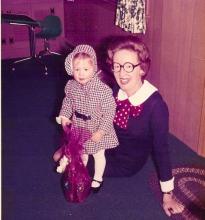
“My mother... she is beautiful, softened at the edges and tempered with a spine of steel. I want to grow old and be like her.” ~ Jodi Picoult
When asked to describe my mother, Helen, my usual answer is: Queen Esther in espadrilles and a matching purse.
Esther comes to mind when I think of Mom because she was fiercely loyal, smart, determined, brave and deeply faithful. The sartorial descriptors capture my mother’s somewhat less spiritual side – always put together with a classic sense of style (although these days she leans more toward head-to-toe matching ensembles from Chicos and alligator flats, now that her penchant for wearing pointy-toed heels in the ‘60s and ‘70s have caught up with her poor feet.)
Mom has impeccable style and staggering grace, particularly in the midst of trials and tribulations. She is flinty (think Katharine Hepburn) and has an abiding, deep-in-her-DNA faith [think St. Therese of Liseux.]
Helen is a force with which to be reckoned and woe to you who would make the mistake of messing with anyone she loves.

Amy is incredibly intuitive, and she enjoys a faith that I find sort of mysterious. This extends beyond God to faith in other people too: another quality I tend to lack. When I met her, she was already serving in ministry, while I hadn’t darkened the door of a church in a decade. I got in trouble in church in the first place for doubting and questioning, which seemed to rub up against the more intuitive faith of those in my church at the time.
The message I got was that critical thought and faith simply didn’t mix. But in the more “progressive” mainline churches, I found a space in which such challenging questions were welcome. Small wonder, I guess, that some folks view such denominations and churches as fomenting atheism beneath the cloak of Christianity.
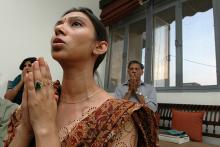
LOS ANGELES -- Even though she met her husband through an arranged marriage, Pooja Sindhwani considers herself a modern woman. She worked in interior design in her native India for four years, and she and her husband spent a year getting to know each other before their wedding. When she followed her husband to Houston, she wasn't worried about adjusting to life in the United States.
"You feel you're going to a country that offers opportunities," Sindhwani said, "you expect that things will work out."
Except when they don't.
Unable to land a job in Houston, Sindhwani slipped into depression. Like thousands of Indian women, she was issued an H-4 "dependent spouse" visa that did not allow her to work.
Sindhwani's husband was a highly skilled foreign worker, sponsored by a U.S. company on an H-1B visa. The Indian women who marry highly skilled workers also tend to be well-educated professionals. Many think it will be easy to transfer from a dependent spouse visa to a work visa.
The constant rejections from companies that couldn't sponsor her work visa took a toll on Sindhwani.