Faith

Growing up, I didn’t think my mother liked me; I know she loved me, but she didn’t know how to handle me. Mom was quiet and melancholy; I was brash and angry. Melancholy and anger were the mechanisms we each used to cope with the family’s dysfunction. But we had little in common. Well, except for the dysfunction.
But I did know my mother loved me. She said she worried about me, she wanted me to be happy; she wanted me to know Jesus. And she prayed for me every day. Every morning as I got ready for school, I passed the den and caught a glimpse of her reading her Bible and praying.
Maybe she wasn’t close to me, but I saw with whom she was close: God. Over time I saw what that friendship did to her. It made her good and kind, even in the face of disappointment and sorrow.
As an adult I tried to get closer to Mom by sharing the things that mattered to me. The first attempt didn’t go so well. I gave her a copy of my MFA thesis screenplay, which was a dark comedy about a dysfunctional family. She never read it.
it.
“I just don’t get it,” she flustered. I think she didn’t understand screenplay formatting.
Editor's Note: Yesterday, President Obama announced his personal support for same-sex marriage. Within the Christian community and the nation at large, there are a diversity of opinions regarding human sexuality. While often a divisive issue, Sojourners has released the following statement encouraging respect for equal rights, religious liberty, and civil discourse.
"Sojourners supports equal protection under the law and full legal rights for all people regardless of sexual orientation. We affirm the right of faith communities, congregations, and religious organizations to define marriage in accordance with their own traditions and interpretation of Scripture....
 TRANSCRIPT OF PRESIDENT OBAMA'S INTERVIEW WITH ABC NEWS ON SAME-SEX MARRIAGE, MOTHER'S DAY, ET AL
ROBIN ROBERTS: Mr. President. Thank you for this opportunity to talk to you about-- various issues. And it's been quite a week and it's only Wednesday. (LAUGH)
PRESIDENT OBAMA: That's typical of my week.
ROBIN ROBERTS: I'm sure it is. One of the hot button issues because of things that have been said by members of your administration, same-sex marriage. In fact, your press secretary yesterday said he would leave it to you to discuss your personal views on that. So Mr. President, are you still opposed to same-sex marriage?
PRESIDENT OBAMA: Well — you know, I have to tell you, as I've said, I've — I've been going through an evolution on this issue. I've always been adamant that — gay and lesbian-- Americans should be treated fairly and equally. And that's why in addition to everything we've done in this administration, rolling back Don't Ask, Don't Tell — so that — you know, outstanding Americans can serve our country. Whether it's no longer defending the Defense Against Marriage Act, which — tried to federalize — what is historically been state law.
I've stood on the side of broader equality for — the L.G.B.T. community. And I had hesitated on gay marriage — in part, because I thought civil unions would be sufficient. That that was something that would give people hospital visitation rights and — other — elements that we take for granted. And — I was sensitive to the fact that — for a lot of people, you know, the — the word marriage was something that evokes very powerful traditions, religious beliefs, and so f-orth.
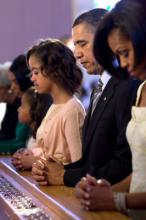
After nearly four years in the Oval Office, President Obama is incorrectly thought to be Muslim by one in six American voters, and only one quarter of voters can correctly identify him as a Protestant, according to a new poll.
Voters do better identifying Mitt Romney’s Mormon faith, according to a poll released Thursday (May 10) by the Public Religion Research Institute in partnership with Religion News Service. A slim majority of voters -- 51 percent -- knows the presumed Republican presidential nominee is Mormon.
“Wow. He said it 100 times that he’s not a Muslim,” said Zainab Al-Suwaij, executive director of the American Islamic Congress, expressing surprise over the persistent number of American voters (16 percent) who make the mistake.
Is there something insidious behind the belief, a concerted attack to link the president with a religion that's considered alien -- or worse -- by some Americans?
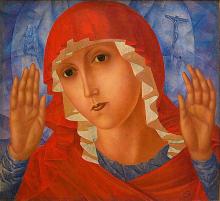
A few years ago, I guest-lectured in a Women’s Studies class at Bethel University. My topic was How Motherhood Shapes a Woman’s Soul, but I ended up talking more about how motherhood sort of mirrors God, how being a mom (or hearing from moms) helps us understand God, his relentless love, his willingness to forgive and his patience with the whiney little complainers that we are.
Frankly, I was amazed at how engaged the women (and man) in the class were. I’m used to talking about issues maternal, but usually it’s to moms. Not to 21-year-old college seniors. But either these students were actually interested or exceptionally polite. I prefer to assume the former. After my lecture, we even had a lively round of Q&A. They asked lots of great questions, but two have really stayed with me.
The first that stuck was: “Why would anyone want to have kids?”
And the other was: “Why haven’t we ever heard this before? Why is it that I’ve gone to church my whole life and never once heard that moms might have special insight into God that should be shared?”
The first question made me laugh (and made me realize perhaps I ought to be guest-lecturing in abstinence classes!). The second question made me want to cry.
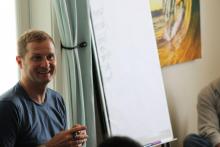
“Oh, a dolphin.”
The speaker, dressed in khaki jeans, a blue t-shirt and flip-flops, interrupts his train of thought about spiral dynamics and the church when some movement in the ocean a few hundred yards away on the other side of the beach house’s open briefly catches his attention.
The audience of 50 — mostly 30- and 40-something-year-old pastors, the vast majority of them men, but with at least a few young clergywomen too (a refreshing change from most evangelical gatherings of this kind) — laughs heartily and more than a few attendees crane their necks to try to catch a glimpse of a dorsal fin in the distance.
The sounds of the Pacific crashing on the shore mix with a reggae tune playing on the outdoor stereo of the bar next door as the speaker, a 41-year-old former pastor and bestselling author, resumes his riff on categories of consciousness and the spiritual practice of meeting people exactly where they are.
Rob Bell isn’t in Kansas … I mean Michigan … any more.

I wrote a story a while back about a family in our church back in Pueblo whose baby was due just after we left town. Early in the pregnancy, doctors diagnosed little Avery with HLHS, Hypoplastic Left Heart Syndrome. There was a good chance he’d need surgery in utero or immediately after being born, and there was a formidable chance that he wouldn’t survive the procedure. There was also, of course, a higher than normal risk to Lyndsay, the mother, too.
It was hopeful watching the church family rally around the Vigils, praying for them, bringing them meals, visiting and doing what they could to offer support in what I’m sure felt like a time of emotional free-fall. It was also weird to know that, when Avery actually came, we wouldn’t be there.
Avery's first day as an oxygen-breathing member of the human race.
That day was today.

Mother’s Day and today is a celebration of the role of my maternal life, a role that has proved to be more satisfying and blessed, which is closer to my heart, than writing or art or friendship or even marriage. The work and longing of a life-time, almost, has been invested in my children — the beings who had their start like seeds in my own body, who have bloomed and flourished, who overcame barriers and difficulties caused by my own parental inexperience or ignorance, who grew as I grew, who now have lives of significance, who are learning along with their own offspring, much as I did but in a far more swiftly changing world.
So there were pleasurable moments as I heard from all five individually. And flowers — yellow daisies and Queen Anne’s lace from Robin, my eldest. (It’s a favorite flower for us both. She and I remember back to her wedding to Mark, on an island in an Illinois forest preserve, when her wedding bouquet was made of those white lacy flowerets, exploding like fireworks.) I hope to use those delicate flowers as objects to write about when I talk about poetry at an elementary school next week.

I take an online quiz that promises to tell me what kind of mom I am.
What’s it going to be? Sporty Mom? Church Volunteer Mom? TV-Free Mom? Old Mom? Even though I eschew labels, I still wonder what the quiz will tell me about what kind of mom I “really” am.
I answer the questions quickly and, after my score is tabulated, I learn that my “Mommy Style” is . . . drum roll, please . . . Earthy Mom! Yay! I think I was tagged as “earthy” because I admitted that my family is serious about recycling, that I chose the sling as the best way to carry an infant, and because I preferred “I Got You, Babe” to Madonna’s “Vogue” or Chaka Khan’s “I’m Every Woman” as my “Mom Theme Song.” (Just FYI—The Beatles’ “With a Little Help from My Friends” wasn’t an option.)
I got zero percent as my Sporty Mom score. My Fashionista Mom score was dismally low. I got a fairly good score for Classic Mom, but far fewer points than I’d expect for Multitasking Mom. (That last score offended me a bit. I grant you that I’m not a fashionista or really very sporty. But a multitasker? I failed on that? Have you seen me at dinnertime? I’m like one of those people who can spin plates. Homework! Phone calls! Permission slips! Butternut squash and coconut milk soup! Neighbor kids ringing the doorbell to sell popcorn and Girl Scout cookies! I can manage it all—and all at once!)
Oh well. I’ll take the Earthy Mom moniker. After all, I’ve been called all sorts of things as a mom.

It turns out that packing all the belongings you need for at least three months into the back of a Prius is a challenge. Of course, being a guy it’s the kind of challenge that makes life worth living. Anyone who has ever been a Tetris junkie can appreciate the exhilaration of fitting forty-seven differently shaped items into a space made for about half the volume. Yes, I had to jump up and down on the back hatch, and several keepsakes are undoubtedly smashed beyond recognition. But by God, I got it all in there.
While I was basking in the glory of being a master packer, my family was busy feeling. Amy kept up her “four cries an hour” regimen, while three-year-old Zoe melted down whenever she realized this toy or that piece of furniture was not going with us after all. It’s a strange feeling, leaving most of our valuables behind, but for me, it’s kind of liberating. I love the idea of grabbing what I can carry and heading west until I reach the edge of the earth.
Apparently my family doesn’t share the same romantic bug. They like stability.
“This is the longest I’ve ever lived anywhere,” said Amy, wiping tears aside. “This is home.”
“Yeah, but we’re taking home with us,” I said, trying in vain to employ the typically male strategy of emotional deflection.
“Taking it where?”
“Good question.”
DC-based pastor and former Sojourners staff member, Rev. Aaron Graham unpacks what it means to have faith and serve in government for The Washington Post:
It breaks my heart today to see how often politics shapes our faith, rather than faith shaping our politics. Over the years the church in America has become so biblically illiterate that we are often being more influenced by cultural and political trends than we are by the Word of God.
Read his full article here

Politics is a true American idol, and the 2012 presidential election will be a dramatic demonstration of that reality.
Simply put, we create an idol when we ascribe attributes or place hope in persons or things that should belong only to God. People of faith may be tempted to worship at the altar of politics, but make no mistake: The kingdom of God and the kingdoms of politics are never one and the same.
Our worship of God rightly should shape our engagement with politics, but when politics shapes our religion it distorts our service (and worship) of the One True God.

Today, Sojourners' Communications Director Tim King talks with CNN's Lisa Desjardins about politicians and God-talk in this 2012 presidential election season.
From CNN.com:
Is Washington a holy city? It might seem that way, with all the talk about religion and morality in the 2012 election.
But all that God talk may be rubbing voters the wrong way.
"It's getting ugly out there," said Tim King, an evangelical Christian who works for the progressive religious group Sojourners. "There are a lot of Christians who are using their faith as a political weapon, which it's never meant to be."
Listen to Tim's comments on CNN Radio inside the blog.
To believe is easy. You can fill stadiums with people wanting to believe, either to solidify what they already think or to grasp hold of something because they feel cast adrift and lost at sea.
To doubt, to interrogate your fear, to really question what you believe, that’s difficult. It’s difficult because we want to protect ourselves from doubt and unknowing. Indeed when we encounter somebody who is different from us, our first experience is often to see them as monstrous, as having beliefs and practices which are alien and stranger and historical and contingent. When we encounter them we either want to consume them, make them part of our social body, or we want to vomit them and get rid of them. Or perhaps we want to have some sort of interfaith dialogue where we can talk about where we agree.
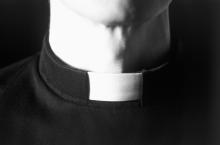
The Clergy Project is an online support network for pastors who have lost their faith and found atheism.
The goal of the project is not to pull pastors from the pulpit, but to provide those who have already lost their faith with a safe place to anonymously discuss what comes next. The hope is they will eventually feel strong enough to put their families, friends and careers on the line and announce their atheism.
“When you leave the ministry, you can lose all of that, “ said Dan Barker, a former minister, co-president of the Freedom From Religion Foundation and a founder of The Clergy Project. “You have to ask yourself, ‘Who am I now?’ . . . . The Clergy Project is a place where their self-respect is restored.”
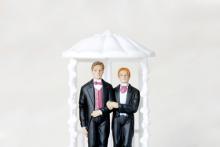
Opposition to gay marriage is significantly lower in 2012 compared to the previous two presidential campaigns, a survey by the Pew Research Center for the People & the Press shows.
For the first time, the level of strong support for gay marriage is equal to the level of strong opposition, researchers report. In the April 4-15 survey, 22 percent of Americans say they strongly favor permitting legal marriage for gays and lesbians; an identical percentage said they strongly oppose it.
In 2008, strong opposition was twice as high as support -- 30 percent vs. 14 percent.
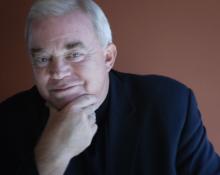
I returned to Sojourners this week, after a three-month sabbatical. The time away was a deeply needed one, and did my soul good. It did my body good too, and I feel better than I have in years — much lighter and healthier than before.
Sunrise walks on the beach, yoga and prayer to the morning light, and then running along the waves put many things in perspective. Wonderful time with Joy and my boys — Luke and Jack — made me remember how blessed I am.
A main purpose of the sabbatical was to write a new book and, gratefully, I am now on the last chapter. It’s about “why Jesus came,” and the writing made me feel closer to him. Re-reading C.S. Lewis' Narnia chronicles, while on retreat at a monastery overlooking the Pacific Ocean at the beginning of my time away, set the tone for the sabbatical.
My favorite chapter in the new book is called “Aslan, Narnia, and the Living Teacher Who Walks Among Us.”
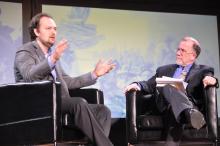
Just a few years ago, Ross Douthat earned the distinction of becoming the youngest regular columnist the New York Times has ever employed. He also has the unique position of being a conservative Christian in the belly of what some Christians might consider the proverbial “beast.”
So, how's that going for him?
“It’s been wonderful,” he told Michael Cromartie, Vice President at the Ethics and Public Policy Center, during an onstage interview at the Q Conference in Washington, D.C. Tuesday evening.
The conversation focused on the themes of Douthat’s new book, Bad Religion: How We Became a Nation of Heretics.
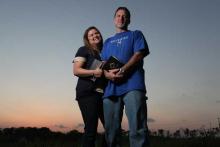
Bruce Bolin celebrated Easter Sunday this weekend among Southern Baptists, just as he did when he prayed at a tiny Kentucky church where his family filled half the pews.
After decades away from faith, "I slowly began to see what I was missing was the relationship with God that I could find in my church," said Boling, 45, who has settled in with a little Baptist congregation in Hendersonville, Tenn.
Lydia Scrafano's heart again thrilled to hear Catholic hymns sounding on a great pipe organ, just as she did as a child in Detroit.
"I missed it all. I missed taking Communion with a priest. I missed the stained glass. I missed the Virgin Mary," says Scrafano, 55, who has reconnected with her faith through a Catholic church in Williamsburg, Va.
Like many Christians and Jews, Boling and Scrafano drifted — or marched — away from the religion of their childhood. Then, unlike most, they came back.

Poetry is language made material.
It presents us with objects and the world, yes, that is part of its materiality, but it also – and perhaps fundamentally – makes our very language into a thing, rather than simply a medium. Like remembering that you exist in time, and becoming aware of your temporality, poetry takes what we are always immersed in and says, Remember; become aware.
Thus it is like all art a meditative practice. You must slow down, quiet yourself, and actively receive – a strange gesture, perhaps paradoxical, but one that is, if nothing else, prayer. And so for Holy Week, I want to present four (mostly) contemporary poems that can direct meditation without limiting it, that can engage prayer in our physical existence and the existence of the Resurrection as event, that can slow one down, that can build sensual memory of the acts we do and life we live in constant remembrance of it, of Him.