Faith

This is not another book that simply critiques religion. In Religion For Atheists: A Non-believer's Guide to the Uses of Religion, Alain de Botton, a noted author on a wide range of themes – from architecture to the works of Proust – examines those engaging and helpful aspects of religion (particularly focusing on Christianity, Judaism and Buddhism) that might, as he puts it, “fruitfully be applied to the problems of secular society.”
Anyone who might be offended by a work that from the outset (indeed on its very first page) asserts that “of course no religions are true in any God-given sense”, is encouraged to steer clear of this book by the author himself.
It is a book that seems to swing between revulsion of religion and the “religious colonization” that atheists are charged to reverse and a recognition that all is not well in the secular world, and that these ills may be somewhat righted by looking toward religion – let me clarify – toward those aspects of religious traditions that de Botton believes are relevant to the world today: community, kindness, education and art, for example.
The very first subject to be tackled is that of community – something that Sojourners knows a little something about (check out Nicole Higgins’ recent review of Wanderlust for some insights) – and what strikes me as interesting is that de Botton’s hypothesis on the loss of community mirrors a phrase often spoken by Sojourners CEO Jim Wallis:
Did we lose our sense of community when we began to privatize our faith?
Forty-five years ago today, the Rev. Dr. Martin Luther King delivered his now-famous speech at Riverside Church in New York City, declaring his opposition to the war in Vietnam. One year later -- 44 years ago today -- he was murdered by an assassin.
It is fitting that these anniversaries occur this year during the week we commemorate the death and celebrate the resurrection of Jesus.
Dr. King’s Riverside speech is frequently quoted, with his scathing political indictment of the war and the systems of exploitation and oppression that led to it. But how often do we remember that he began that speech by noting that while the Nobel Peace Prize was “a commission to work harder than I had ever worked before,” it was not the most important thing. He continued by saying that:
This is a calling that takes me beyond national allegiances, but even if it were not present I would yet have to live with the meaning of my commitment to the ministry of Jesus Christ. To me the relationship of this ministry to the making of peace is so obvious that I sometimes marvel at those who ask me why I'm speaking against the war. Could it be that they do not know that the good news was meant for all … Have they forgotten that my ministry is in obedience to the One who loved his enemies so fully that he died for them?
Dr. King was able to be the leader he was, take the risks he did, and ultimately make the final sacrifice, because he knew who called him and who he followed. He knew that the sacrificial death and resurrection of Jesus was a living presence in his life and gave him the hope to follow.
For him, as well as us, believing in Jesus means being a follower and a disciple in bringing the kingdom he lived and taught. By raising Jesus, by vindicating his life and death, God vindicated his message – the kingdom he proclaimed has come and will come. And because God raised Jesus from death, his living presence continues among us and we are empowered to follow him and to live the kingdom. The resurrection is the event on which our faith and hope depends.
That faith sustained Dr. King, and it can sustain us.

I know that the sun will rise tomorrow.
With all of the scientific facts and astronomical data we are blessed with today, I can expect to wake up tomorrow and see rays of light shining through my window.
There is also no debating time. Our clocks, both digital and internal, continue to tick onward no matter the circumstances. These are inexorable certainties in life. However, these proven facts of our existence are limited. They are not the whole story.
There are things in life we neither can physically see nor explain, and yet we choose to believe anyway.
When our little siblings place their fallen teeth underneath their pillows, hoping to see a winged fairy deliver gifts in return, they are relying entirely on an unproven belief. When students choose universities to attend, they do not know what the outcomes of their decisions will be, nor can they predetermine their futures after school. But they continue to grow and experiment with life anyway.
Even the wisest of theologians and clergy have very few answers to the questions pertaining to God’s existence that enter our minds on a daily basis. All of these situations represent something many of us hold onto so dearly: Faith.

While I believe in the principle of church-state separation, there are times when it is taken too far. Today’s example is a food pantry in Seymour, IN.

I’ve written a couple of pieces recently that have gotten a lot of attention about why younger people tend to walk away from church.
If you haven’t seen them yet, here are the links:
Seven Reasons Why Young Adults Quit Church
Four More (BIG) Reasons Why Young Adults Quit Church
Some readers suggested I might also post a piece about why young adults come back to church. Though I can’t say for sure why ALL young adults in church do so, I can share a few reasons why I, as a young adult, returned to church after an absence of ten years.
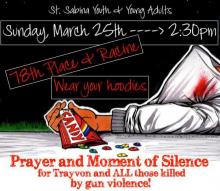
Christians and other people of good faith nationwide stood in solidarity with Trayvon Martin this weekend by wearing hooded sweartshirts — aka "hoodies"— to church.
Monday marks the one-month anniversary of Trayvon's slaying in Sanford, Florida at the hands of neighborhood "watchman" Gregory Zimmerman, who shot and killed the 17-year-old African-American boy in “self defense” for “looking suspicious” while dressed in a hooded sweatshirt.
Trayvon was unarmed, carrying only a package of Skittles, an iced tea and his cell phone.
Last week, people across the nation began wearing hoodies to work, school, and community marches in response to Trayvon's slaying and the injustice of the kind of racial profiling that it would appear directly led to it. On Sunday, many churches took that vision a step further as pastors and congregants donned hoodies and wore them to church for what some congregations called "Hoodie Sunday."

Galatians 3:22: Is it the faith of Jesus or faith in Jesus that’s the key?
Amy Reeder Worley: It is both the faith of and in Jesus that lead to salvation, which is another word for “liberation.”...
Pablo A. Jiménez: I have always preferred to speak about the faith of Jesus than about faith in Christ. Most people find this shocking and many have tried to correct my theological statements. However, I persist in speaking about the faith of Jesus....
Christian Piatt: I would tend to say it depends on whom you ask, but based on my personal experience, maybe it has more to do with when you ask someone such a question about their understanding of Jesus....

Remember Rep. Paul Ryan’s 2011 budget, The Path to Prosperity? Well, it’s baaa-aaack — and this time the path is smoother and wider and offers a quicker trip to judgment.
Christianity and most of the world’s faith traditions explicitly demand protection for the poor and the preservation of the lives and dignity of all. Well, the Chair of the House Budget Committee, Ryan, high-tails it down his Path, budget rolled in-hand, in the exact opposite direction from those moral commitments.
Bob Greenstein, president of the Center on Budget and Policy Priorities (CBPP), concluded that the Ryan budget “is Robin Hood in reverse — on steroids. It would likely produce the largest redistribution of income from the bottom to the top in modern U.S. history and likely increase poverty and inequality more than any other budget in recent times (and possibly in the nation's history)."
Any responsible budget plan requires a balanced approach that would both increase revenue and reduce spending. This proposal would cut taxes, merely hope for revenue, increase military spending, and slash most everything else that isn’t protected by large corporate interests.

 Editor's Note: Earlier this week, our intrepid blogger/reporter/resident-God-Nerd Christian Piatt sat down with the makers of the highly-anticipated film Blue Like Jazz — Donald Miller, director Steve Taylor and Marshall Allman, the actor who portrays protagonist "Don" in the screen adaptation of Miller's best-selling memoir — to talk about faith, film and ... fate.
Blue Like Jazz premiered at the SXSW Festival in Texas earlier this month and opens nationwide April 13. Piatt caught up with the filmmakers in a Colorado Springs theater where they were hosting a sneak-peek screening and persuaded the gents to unpack the story of the-little-film-that-could and the Spirit that buoyed them along the way.
The wide-ranging interview covers everything from John Coltrane's "A Love Supreme" and what Miller calls "dangerous theological ideas" to the astounding grace of God and peanut butter cups. Fascinating and funny, the conversation with the hearts and minds behind Blue Like Jazz is a humdinger.
Watch the interview in its entirety and read Piatt's reflections on the film and his conversation with its makers inside the blog ...

Fifteen-hundred years ago, a Dublin-based shepherd made his mark on history by turning the Chicago River green, staggering inebriated through the city, and inventing the "Kiss Me I’m Irish" hat. Along the way, he wrote Bushmills whiskey drinking songs about the pain of being alive, mixed a cocktail whose name evokes an act of terror, and dyed his hair red.
He magically expelled snakes from the island of his birth, wrote a lyrical memoir of his terrible childhood, won the Rose of Tralee beauty contest, mixed lager and Guinness together (presumably out of an excess of self-loathing and bad taste), had a great oul’ Famine, stared meaningfully across the Atlantic, and dreamed of America.
But he still hasn’t found what he’s looking for.
It’s St Patrick’s Day weekend, and despite the fact that millions of people will celebrate something like this vision of what it means to be Irish, pretty much none of the above is true.

Howling wind whipped my long, unruly hair in penitent lashes across my face as I stood in the rain, staring at the churning sea at the northernmost point of Ireland. This place, Malin Head in County Donegal, for some mysterious or mystical reason — perhaps because it is such a broody, dramatic place, or maybe it’s got something to do with ancestry, or both — is the spot I love most in the world.
It is a wild land, the kind of place where myths are born, where giants and saints might come bounding over the next hillock followed by a troupe of little people or a herd of magical sheep.
Whatever the reason, I feel at home here and have returned time and again over the last 15 years, drawn to stand on its rocky cliffs like water to the shore.
We’ve been hearing a lot in the news media lately about women’s bodies. Just when we thought the messy fight over contraception was over, Democrats and Republicans are butting heads again over renewal of the 1994 Violence Against Women Act, a once widely supported bill that is now being met with opposition from Republicans due to new provisions that “would allow more battered illegal immigrants to claim temporary visas, and would include same-sex couples in programs for domestic violence,” according to the New York Times.
If you were walking down the street and a stranger approached you and punched you in the face what would you want to do in that moment? Sure, this is an odd hypothetical situation, but really, answer the question.
Few would say, “I would want to give that person a hug.” Depending on the size of the attacker most would either fight back or run away. But let’s suppose you fought back, and even vanquished your assailant, pummeling him repeatedly for his dastardly deeds. What then?
Would he, through being beaten, come to understand his wrong in hitting you? No, he might start plotting his revenge, or his friends would think about getting you back for what you did. If they did, then you would have friends that would want to get them back. So it goes with the endless spiral of violence.
We have been fooled into believing that violence is a respectable solution for problems in our world. What we fail to see is the many problems that violence brings with it, beginning with more violence. Violence also brings hurt, fear, anger, a desire for revenge, death and enmity.

As a progressive Christian in my mid-20s, it'd be safe to bet I might be a fan of Donald Miller. And I am. Miller's Blue Like Jazz and Searching For God Knows What are among the books that have significantly affected my faith journey.
And, like many others in my demographic, I met the news of an adaptation of Blue Like Jazz with both hope and apprehension. Like Miller himself, “at first, I didn’t understand how it could be a movie. I couldn’t see it on a screen.”
My own anxieties about a big-screen adaptation fell into two categories. First Jazz is, for all intents and purposes, a memoir. And memoirs — or the biopics they often become onscreen — are, in my opinion, rarely great films. They are usually little more than a path to the Oscars for actors who are pining after an ego-boost (but I guess that’s another story).
What saves Blue Like Jazz, thankfully, is that it is a memoir with a difference. It isn’t a rose-tinted, romanticized account of some historical or celebrated figure. It is the memoir of someone who is very much like me — just a little bit funnier. That’s where the appeal comes from and I'd expect that's what will make Blue Like Jazz (the film) a success both here and abroad.
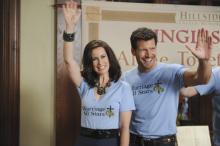
Over the weekend, Newt Gingrich decided to wade into a minor cultural skirmish by claiming that the new ABC dramedy GCB is an attack on faith fueled by anti-Christian bias.
As Gingrich is, from my perspective at least, prone to flights of intellectual fancy, I was at first prone to roll my eyes and ignore his latest sojourn into the ridiculous. But upon further reflection, I thought it merited a response because his notion that a satire could be the latest cannon fodder in the alleged war on religion (which usually means “war on Christianity” to those who invoke it) speaks to a larger cultural conundrum: Christians and our sense of humor (or, rather, the lack thereof.)

From time to time I revisit the question: Why are young adults walking away from religion?
Although the answer(s) vary from person to person, there are some general trends that I think apply in most cases. (In the list below, when I refer to “we,” “I” or “me,” I’m referring to younger adults in general, and not necessarily myself.)

Last week, I spent a couple of days listening to Eugene Peterson share stories and precious wisdom from his 80 years on this little blue planet.
It was a blessing of unparalleled riches to sit at Peterson’s feet (literally — I was in the front row and he was on a stage that put me at eye level with his black tassel loafers) and learn.
For the uninitiated, Peterson is a retired Presbyterian pastor and prolific author perhaps best known for The Message, his para-translation of the Bible and titles such as Practice Resurrection and A Long Obedience in the Same Direction.
A native of Western Montana, Peterson and his wife of more than 50 years, Jan, returned to Big Sky Country several years ago to the home his father built on the shores of Flathead Lake when Eugene was a child.
Undoubtedly, it will take me many months — or years — to digest all that Peterson shared with a smallish group of youngish Christian leaders at the Q Practices gathering in New York City. But I can say what struck me most indelibly is how at ease — content, yes, but more than that — Peterson is in his own skin. Fully present. Mellow but absolutely alert, energized, fascinated by the world and the people around him.
Relaxed — that’s it.

Even a blind squirrel finds a nut once in a while. A million monkeys typing for a million years would eventually produce Shakespeare.
And once in a blue moon, Televangelist and 700 Club head Pat Robertson and I agree on something.
When asked about his position on the decriminalization of marijuana, Robertson said the following:
“I just think it’s shocking how many of these young people wind up in prison and they get turned into hardcore criminals because they had a possession of a very small amount of controlled substance. The whole thing is crazy.”
Umm, can I get an “Amen?”

There was a movement back in the 1960s that many of us only have read about, while others vividly remember. Philosophers and theologians explored what was labeled the “Death of God” movement. Interest in the subject has re-emerged particularly as of late because William Hamilton, one of the more prominent voices in the Death of God movement, diedlast week at age 87.
The movement inspired TIME Magazine’s now-famous cover (seen here) in 1966, raising the question in the public forum: Is God Dead? The cover has since been listed by the Los Angeles Times as one of the “Ten Covers that Shook the World.”
Hamilton’s faith was shaken during his teenage years when three of his friends were making a homemade pipe bomb. The project went wrong and detonated, killing two of the three boys.
The two killed were Christians. The lone survivor, an atheist.
Hamilton’s crisis of faith centered around a theological concept known as theodicy, which explores the question: why do bad things happen to good people? More specifically, why does misfortune seem to befall the faithful, while those lacking faith enjoy what seems to be a providential hall pass?

A headline from Reuters stopped me in my tracks earlier this week.
It read, ‘"Pray for us" say Syria rebels as army closes in’." I was struck by how moving I found this statement, this plea.
I do my best to remember places of conflict and strife in my prayers, but very rarely have I been petitioned to pray from a conflict situation by those in the middle of the conflict. It may be a strange reaction on my part to conflate a headline from a news report to be a direct request for my prayers, but that is how I responded when I read it.
“Pray for me” is not an abstract or passive statement. When we are asked to pray for someone, or a group of people, we are charged to bring their need or suffering to God.