Faith
 "The man who can articulate the movements of his inner life," the late Christian apologist and author Henri Nouwen said, "need no longer be a victim of himself, but is able slowly and consistently to remove the obstacles that prevent the spirit from entering."
Throughout the ages, how Christian believers have chosen to articulate their inner lives has had many manifestations in literature, music, architecture, and other artistic endeavors.
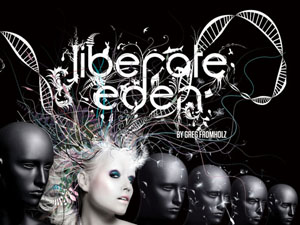
As a means of communicating and wrestling with his inner life -- his journey of faith -- Greg Fromholz, an American expatriate youth worker for the Church of Ireland in Dublin, wrote a book titled Liberate Eden, but traditional publishing houses found that his work was a bit too iconoclastic for their tastes.
"It is just too different to be Christian," one publisher pronounced.
Rose Berger from Sojourners magazine spoke to the hundreds of us gathered in Lafayette Park just before we processed to the fence surrounding the White House. She mentioned the irony of building a monument to Dr. Martin Luther King, Jr. by the powerful political forces who disregarded or dismissed his message during his lifetime -- we only honor him after he is safely dead. How ironic also that the dedication of the monument was postponed by the most recent example of significant climate change. Will evidence of climate change begin to also signal political change?
Rose called on us to take up the banner of the Living Spirit of Dr. King within ourselves and allow it to inspire us as we risked arrest by calling on President Obama to take a clear stand to help protect our environment and begin to make a U-turn from the climate change path we are traveling as a nation and culture. We are part of a two-week vigil and civil disobedience action calling the president to deny permission for building the proposed Keystone XL Pipeline from the environmentally devastating tar sands/oil shale development in Alberta, Canada to refineries in Texas.
 To the farmers who grow our food, the harvesters who pick it, the transporters who bring it to market, the grocers who present it, and the cooks who prepare it.
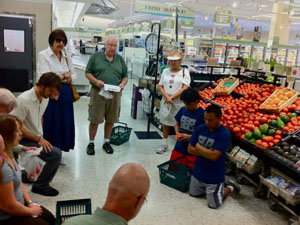
Here's the prayer we prayed at a nearby Publix grocery in the produce section on Friday:
A Prayer for Publix
Living God, you are the Creator of this beautiful and fertile world. You made sun, rain, soil, air, seed, and seasons. We praise you for the green of lettuce, the yellow of lemon, the orange of a tangerine, and especially for the bright red of a tomato. They are beautiful to our eyes, delicious to our taste buds, and nourishing to our bodies. We pray to the Lord, Lord, hear our prayer.
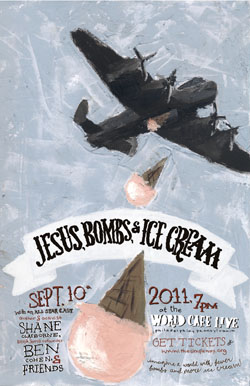 I was in Baghdad in March 2003, where I lived as a Christian and as a peacemaker during the "shock-and-awe" bombing. I spent time with families, volunteered in hospitals, and learned to sing "Amazing Grace"
Rev. Steve Stone was just trying to be a good neighbor.
Two years ago, the pastor of Heartsong Church in Cordova, Tennessee, on the outskirts of Memphis, learned that a local mosque had bought property right across the street from the church. So he decided some Southern hospitality was in order.
A few days later, a sign appeared in front of the church. "Heartsong Church welcomes Memphis Islamic Center to the neighborhood," it read.
That small act of kindness was the start of an unlikely friendship between the two congregations, one that made headlines around the world. Members of the mosque and church have shared meals together, worked at a homeless shelter, and become friends over the past two years. When Stone learned that his Muslim friends needed a place to pray for Ramadan because their building wasn't ready, he opened up the doors of the church and let them hold Ramadan prayers there.
So let me suggest that this Labor Day, the church cannot afford to perpetuate the labor movement as an unexamined challenge in our society. Debates about the role of unions are everywhere, and demand thoughtful theological discussion, consideration, and action.
This Labor Day weekend, we are challenging every congregation and faith community in Ohio and around the nation to devote a portion of your worship service to exploring a biblically informed perspective on labor. This could include part of a homily, a testimony, a time of prayer for labor members in your parish, church, or faith community, or hosting a special conversation or panel on issues of faith and labor.
The first few nights weren't so bad. It was on the fourth night, the night it rained, that it got to me. I had just spent the past week sleeping on the sidewalk in front of the Illinois state Capitol building in Springfield. Throughout the week, young people of faith, college students, as well as homeless and formerly homeless youth traveled from Chicago to Springfield. Some slept on the sidewalks at night, and others came solely to lobby their legislators. We were all there for the same reason -- because each year nearly 25,000 youth experience homelessness in the state of Illinois. Not only were there not the resources to help these youth, but most legislators and most of the general public didn't even realize the problem existed.
In the past few weeks, I've written about a lot of full-page ads. This full-page ad is different. Too often, homeless youth have been invisible. The Ali Forney Center, a service provider for LGBT homeless youth, has a full-page ad in this month's issue of Sojourners magazine. GLAAD, the Gay and Lesbian Association Against Defamation, connected the Ali Forney Center to Sojourners, as a part of an advertising campaign the Ali Forney Center is running. The ad highlights that up to 40 percent of homeless youth identify as lesbian, gay, bisexual, or transgender. I have talked with many teens who became homeless because they were kicked out of their homes or ran away from abuse by their parents because of their sexual identity. After their homes became dangerous, they went to the streets, where many were attacked and some were trafficked or forced into prostitution.
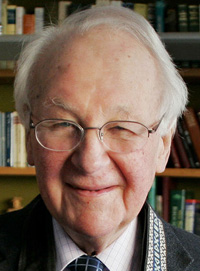 [Editors' note: Rev. John Stott, one of the world's most influential evangelical figures over the past half-century, died this Wednesday at age 90. Rev. Stott served as a contributing editor for Sojourners magazine, when we were known as The Post American, and wrote this article for the November/December, 1973 issue of the magazine. We will always remember Rev. Stott for his profound contributions to our community and the Church.]
It seems to be a characteristic of the Anglo-Saxon mind to enjoy inhabiting the "polar regions" of truth. If we could straddle both poles simultaneously, we would exhibit a healthy balance. Instead, we tend to "polarize". We push some of our brothers to one pole, while keeping the other as our own preserve.
What I am thinking of now is not so much questions of theology as questions of temperament, and in particular the tension between the "conservative" and the "radical."
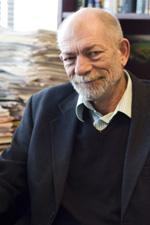 My office has two overflowing bookshelves, with more books stacked on top and on the windowsill. But above my desk within easy reach is a small shelf. On it I keep those books I most regularly use in thinking and writing. Here are the top 10.
1. The Bible: What can I say about the foundational source of God's guidance in everything? I read or refer to it nearly every day. It was given to us "for teaching, for reproof, for correction, and for training in righteousness" (2 Timothy 3:16).
2. The Book of Common Prayer: I am not Anglican/Episcopalian, but there is something in the formal prayers of the traditional liturgy that resonate with my soul. On those days I really don't feel like praying or can't find the words, it's comforting to have a place to turn for inspiration.
Today is another intense day of politics at the White House. The debt default deadline is fast approaching. The stakes for the nation are high as politicians can't agree on how to resolve the ideological impasse on how to reduce the deficit before the nation defaults on its financial obligations.
Yesterday, before Congressional leaders were due at the White House for critical negotiations, I, along with 11 other national faith leaders, met with President Obama and senior White House staff for 40 minutes. We were representing the Circle of Protection, which formed in a commitment to defend the poor in the budget debates. Sitting in the Roosevelt Room of the White House, we opened in prayer, grasping hands across the table, and read scripture together. We reminded ourselves that people of faith must evaluate big decisions on issues like a budget by how they impact the most vulnerable.
After having spoken at the Greenbelt Festival in England a number of times now, we at the Center for Action and Contemplation always hoped and planned that we create a similar festival for spirituality and the arts in the United States. We had nothing comparable, and it was a niche waiting and needing to be filled. Therefore, we were honored to be a part of the first Wild Goose Festival in North Carolina last June, and hope that we can convene a truly ecumenical, radical, and socially engaged crowd of people living at the intersection of justice, spirituality, and creativity -- and those who want to be!

- How do you like your chocolate chip cookies? (Personally, I prefer thick, chewy, and not too sweet.)
- Are you a stay-at-home dad?
- Learn more about new media and faith.
- Religious groups are part of the suit against Alabama immigration law (hat tip: CCIR).
- The changing face of AIDS.

The way you think and feel about the world is shaped by what you see when you get out of bed in the morning. I remember hearing this from civil rights activists. It simply means that perspective is hugely determined by place, context, and vantage point. This is profoundly true for me and most of the people I've ever met. You see the world from the place you live.
Part of the problem in the current budget impasse in Washington, D.C. is the perspectives of the politicians in the debate. Every morning they see and hear each other; the gladiator ring of national politics; the Washington media; their donors; their ideological base; and their latest poll ratings.

You don't need a ton of proof to know that more and more churches are struggling to survive. It seems churches that are in this predicament have one of two options: revive or die. There are a lot of books, seminars, and workshops given on how to go about reviving a church. However, there is not one cookie cutter, full-proof, and effective strategy in reviving a church. Having said that, it doesn't mean that it is impossible. There are many examples of struggling churches that have successfully revived the congregation, increased the health of the church, and expanded their ministry.
At the Wild Goose Festival in North Carolina last weekend, I was able to speak with Anna Clark, author of Green, American Style, president and founder of EarthPeople, a green consulting firm, and a contributor to Taking Flight: Reclaiming the Female Half of God's Image Through Advocacy and Renewal. Anna has a heart for equipping churches to make small and big changes for the sake of creation care and stewardship of the earth's resources. How can Christians do this, you ask? Read our conversation to find out.